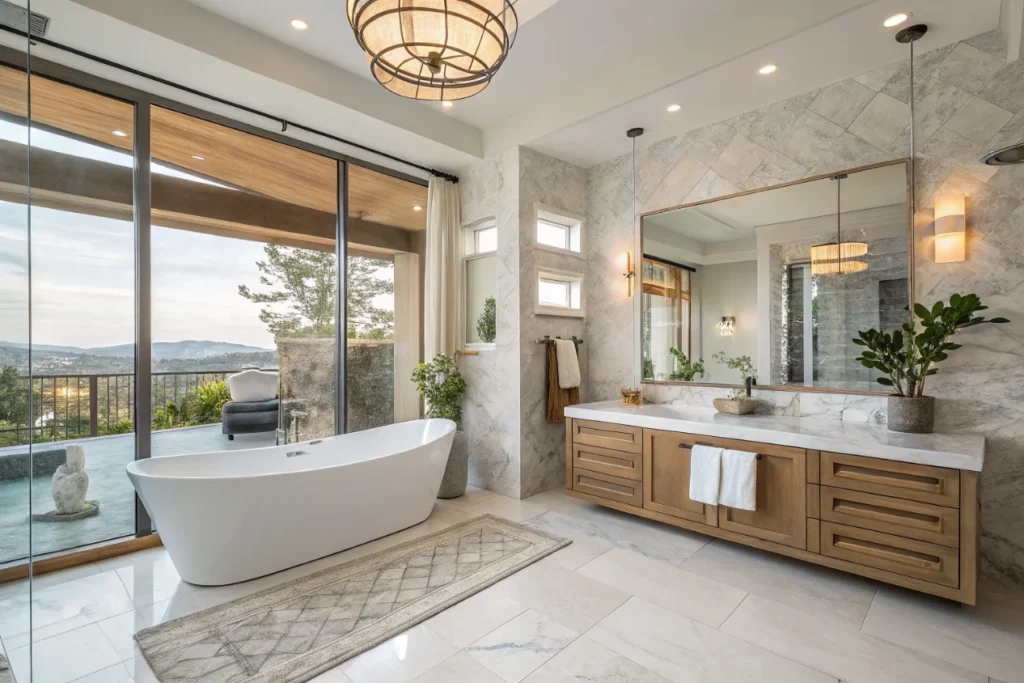
A thoughtfully executed washroom design can completely transform the way you experience your home — the bathroom is one of the few rooms where you spend time completely alone, and elevating its design turns a purely functional space into a genuine daily retreat.
From minimalist spa-inspired layouts and dramatic dark tile schemes to bright Scandinavian designs and warm material-led renovations, the range of beautiful washroom design possibilities has never been more exciting — or more accessible regardless of room size and budget.
Whether you are planning a full renovation or refreshing what you already have, these washroom design ideas cover the most impactful visual and functional approaches for every style, space, and price point — helping you build a bathroom you genuinely love spending time in.
List of 15 Best Washroom Design Ideas
1 Spa-Inspired Minimalist Washroom Design
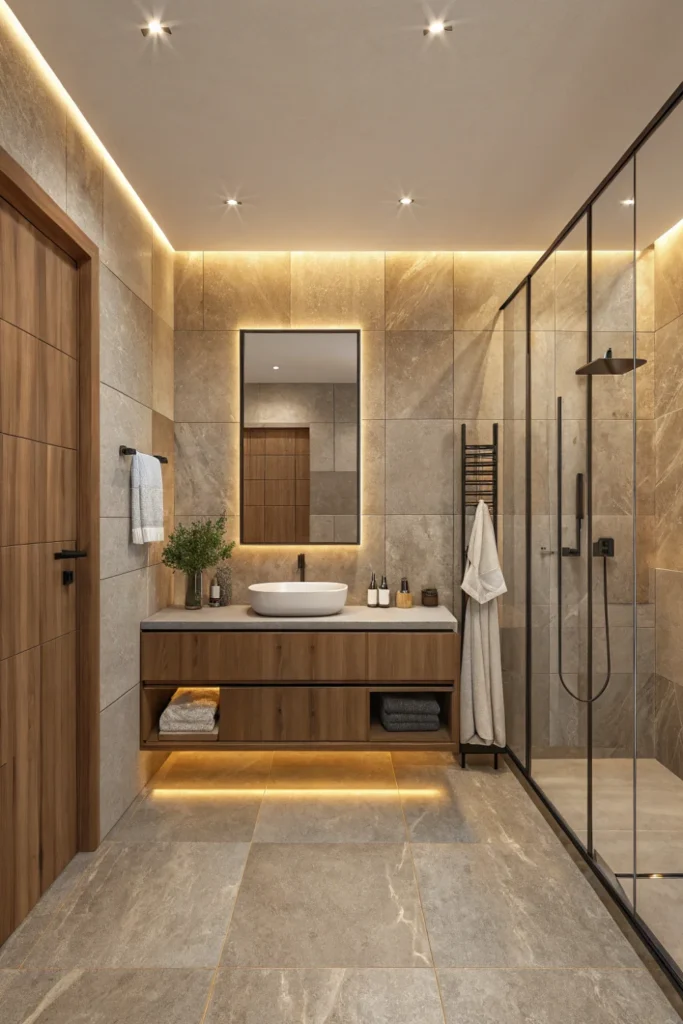
A spa-inspired minimalist washroom design strips the room back to its essentials — a clean-lined vanity, a frameless glass shower, large-format neutral tiles, and a carefully edited selection of quality accessories — creating a space defined by calm, uncluttered luxury that rewards restraint rather than abundance.
The visual language of this washroom design approach is borrowed directly from high-end hotel bathrooms: seamless surfaces, concealed storage, warm neutral materials, and an almost complete absence of visual noise. Every item in the room must earn its presence.
Warm stone, matte ceramic, and natural timber are the material trinity of spa minimalism — each contributes organic warmth that prevents the restrained palette from feeling clinical, making the room genuinely inviting rather than simply ordered.
Install a heated towel rail as an integrated architectural element rather than a surface-mounted afterthought — a recessed or wall-flush heated rail contributes to the spa washroom design aesthetic while eliminating the visual intrusion of a projecting freestanding unit.
2 Dark and Dramatic Washroom Design with Moody Tiles
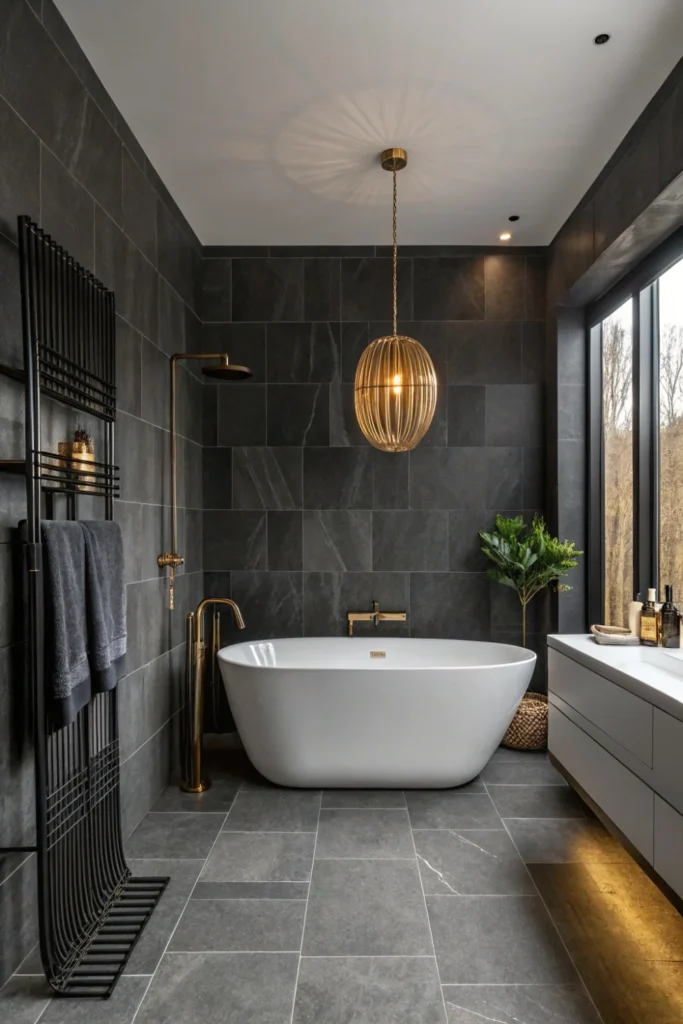
A dark washroom design — deep charcoal, slate, midnight green, or inky navy tiles from floor to ceiling — creates one of the most atmospheric and photographically striking bathroom aesthetics available, transforming what is typically a bright white utilitarian space into a moody, intimate retreat.
The counter-intuitive power of a dark washroom design is that it makes the room feel enclosed in a cosy rather than oppressive way — like a cave or a cocoon — particularly when warm lighting is used to create amber pools of light against the dark surfaces. Brass, copper, and gold hardware intensifies this richness dramatically.
Use large-format dark tiles rather than small mosaic or standard-sized tiles in a dark washroom design — large tiles have fewer grout lines, which means less visual interruption across the dark surface and a more seamless, enveloping effect that small tiles cannot achieve regardless of their colour.
3 Japandi Washroom Design — Japanese and Scandinavian Fusion
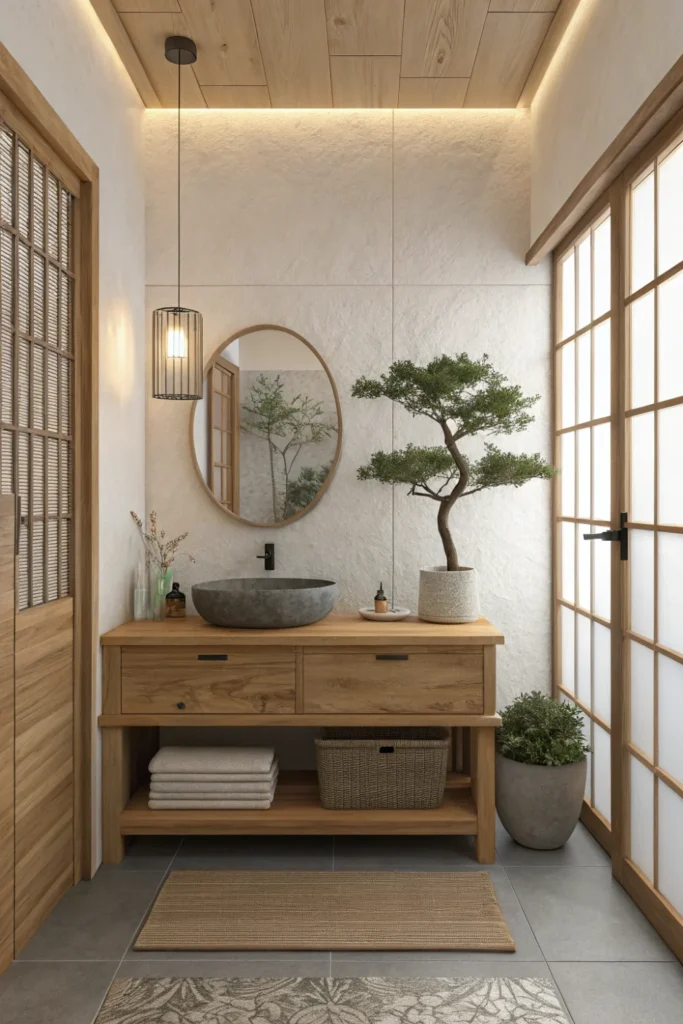
The Japandi washroom design style — a fusion of Japanese wabi-sabi and Scandinavian hygge sensibilities — creates bathrooms of extraordinary calm through the combination of warm natural wood, matte stone, clean geometry, and a deliberately limited palette of warm whites, warm greys, and natural timber tones.
In a Japandi washroom design, every material is chosen for its natural quality and honest character — an unpolished limestone wall, a teak bath mat, a hand-thrown ceramic basin, a bamboo shelf — creating a space that feels simultaneously simple and deeply considered.
Introduce a single live plant — a small bonsai, a trailing pothos, or a simple sprig of eucalyptus in a slim ceramic vase — as the only organic element in an otherwise spare Japandi washroom design. The contrast between the living plant and the still, ordered surfaces creates the essential wabi-sabi tension the aesthetic requires.
4 Freestanding Bath as the Washroom Design Centrepiece
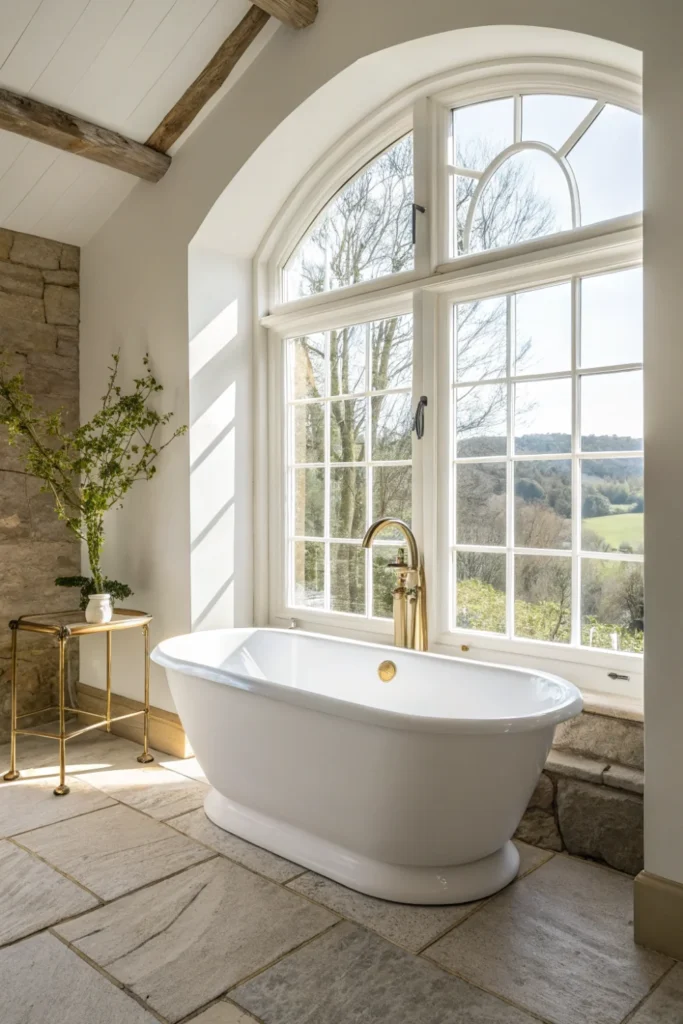
A freestanding bathtub positioned as the sculptural centrepiece of a washroom design is one of the most immediately impactful and status-communicating bathroom decisions available — it transforms the bathroom from a functional wet room into a room built around the ritual of bathing.
The form of the freestanding bath — whether a classic roll-top, a contemporary stone resin oval, a sleek rectangular slab, or a dramatically coloured contemporary shape — establishes the entire room’s design character. Every other washroom design decision should serve the bath rather than compete with it.
Position a freestanding bath so that at least one long side faces the room’s primary natural light source — bathing in natural light is one of the most simply luxurious experiences a washroom design can deliver, and the light on water and the bath surface creates a quality of atmosphere no artificial lighting can replicate.
5 Wet Room Washroom Design for Seamless Flow
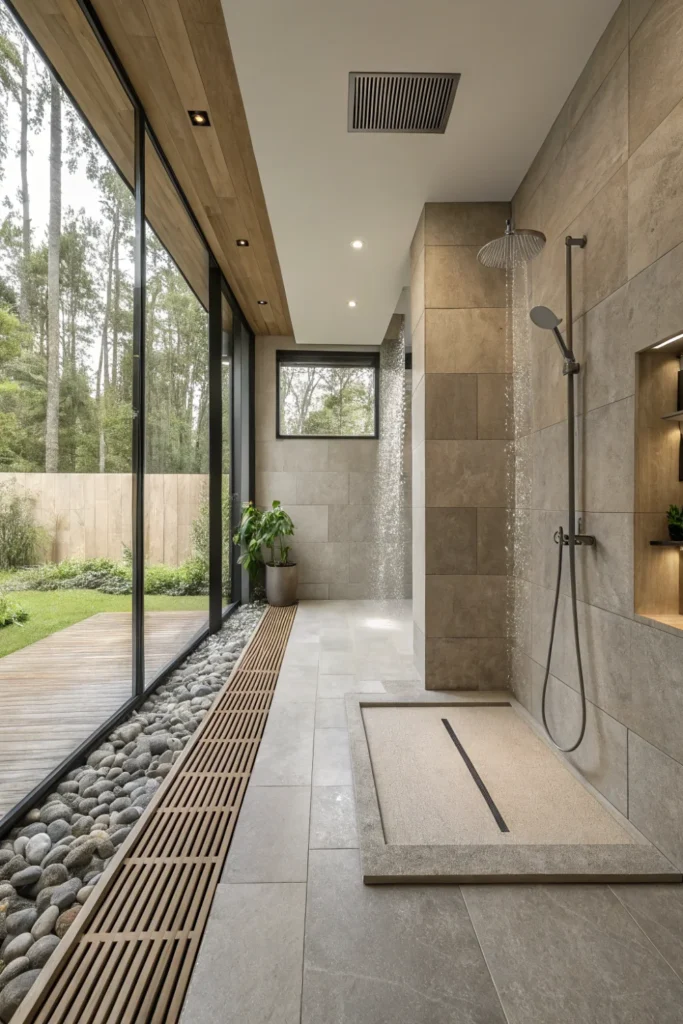
A wet room washroom design — where the entire bathroom floor is waterproofed and graded to a central or linear drain, eliminating the need for a shower tray or screen — creates one of the most spacious-feeling and architecturally sophisticated bathroom layouts available, making even a compact room feel significantly larger by removing the visual barriers of shower enclosures.
The continuous floor tile that runs under the shower area, around the bath, and to the vanity creates a seamless, expansive surface that is the defining quality of a well-executed wet room washroom design — the room reads as a single unified space rather than a collection of wet and dry zones divided by glass and trays.
Specify a linear drain running the full width of the shower wall rather than a central point drain in a wet room washroom design — a linear drain allows a continuous tile run with no slope interruption, which is both more aesthetically seamless and more practically effective for water management across the full shower area.
6 Statement Wall Tile as the Washroom Design Hero
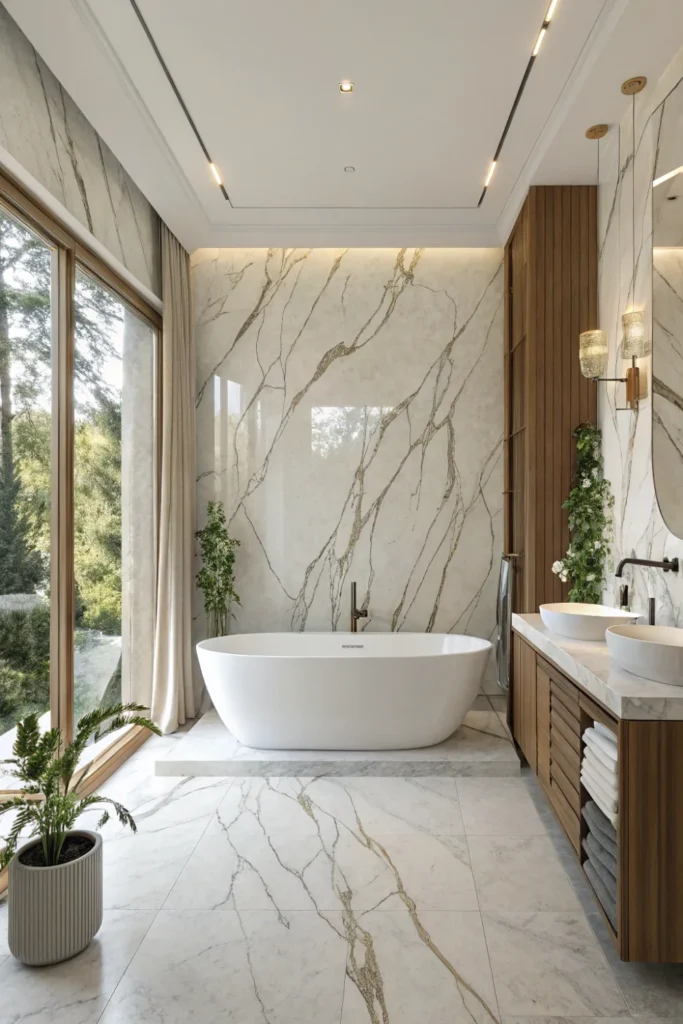
Choosing a genuinely beautiful, character-rich wall tile — handmade zellige in a jewel tone, a large-format bookmatched marble slab, an intricate Moroccan encaustic pattern, or a bold graphic porcelain print — and making it the unequivocal hero of the washroom design creates a room with a strong visual identity that requires very little additional decoration to feel complete.
The discipline of the hero tile approach is keeping everything else subordinate — simple fixtures, plain complementary floor tile, neutral accessories — so that the statement tile has the visual space it needs to be properly appreciated. A spectacular tile competing with equally spectacular hardware, lighting, and accessories is simply noise.
This is one of the most impactful and relatively accessible washroom design moves because a tile upgrade does not require structural change — it can be applied to an existing bathroom layout and transform the room’s entire character.
Use the statement tile on the largest single uninterrupted wall in the washroom — the shower back wall, the wall behind the bath, or the full wall behind the vanity — rather than distributing it across multiple smaller surfaces where its impact is diluted by interruptions.
7 Double Vanity Washroom Design for Master Bathrooms
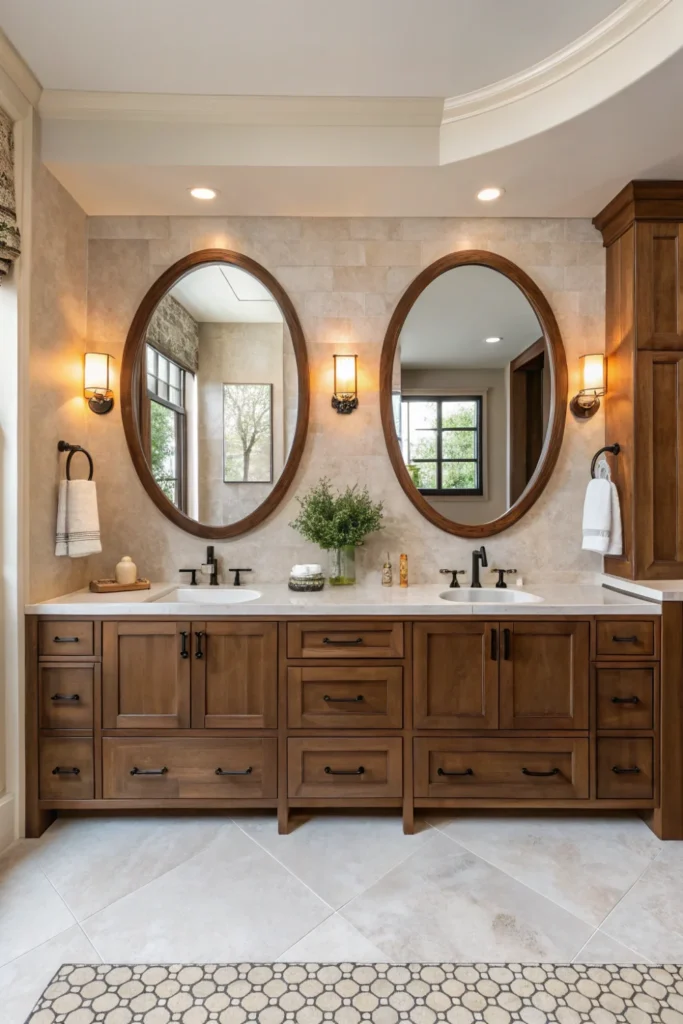
A double vanity washroom design — a wide vanity unit with two basins, two mirrors, and shared or individual storage — transforms a master bathroom into a genuinely functional shared space that feels hotel-suite in its symmetry, scale, and considered organisation.
The design opportunity of a double vanity goes beyond mere function — a wide counter run in quality stone, two statement mirrors with individual lighting, and cohesive hardware creates the most architecturally imposing wall in the bathroom, anchoring the washroom design with a horizontal composition of significant visual weight and elegance.
Install individual task lights for each side of a double vanity washroom design rather than a single light bar spanning the full width — each person gets properly directional illumination for grooming, and the symmetrical pair of lights framing each mirror creates a more visually balanced and architecturally considered composition than a single shared source.
8 Industrial Washroom Design with Exposed Elements
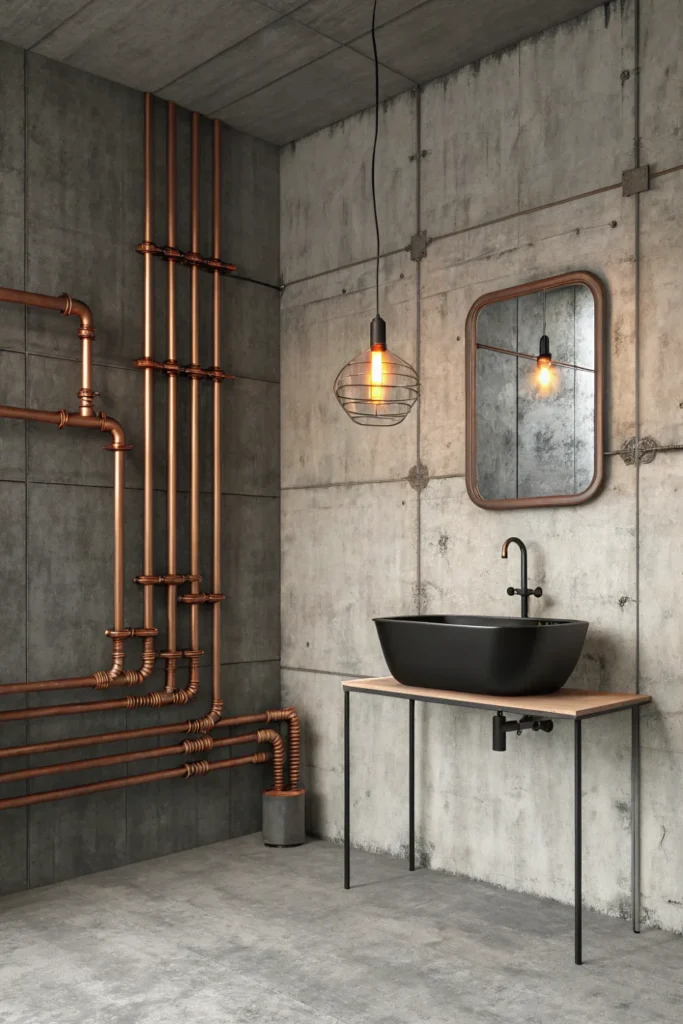
An industrial washroom design — exposed steel pipe work, concrete walls or floors, black metal fixtures, factory-style lighting, and raw material finishes — creates a bathroom with a distinctly urban, workshop-inspired character that is the polar opposite of the spa aesthetic and equally compelling in the right context.
The key to an industrial washroom design that feels intentional rather than unfinished is the precision of the detailing — exposed pipes that are neatly routed and properly bracketed, concrete that is smoothly finished and sealed, black metal that is consistent across all fixtures. Industrial does not mean rough; it means honest about material and structure.
Use warm Edison or tubular filament bulbs in an industrial washroom design rather than cool white LEDs — the warm amber light of vintage-style filament bulbs softens the hardness of concrete and metal and creates the intimate, workshop-at-dusk atmosphere that defines the best industrial bathroom interiors.
9 Terrazzo Washroom Design for Playful Sophistication
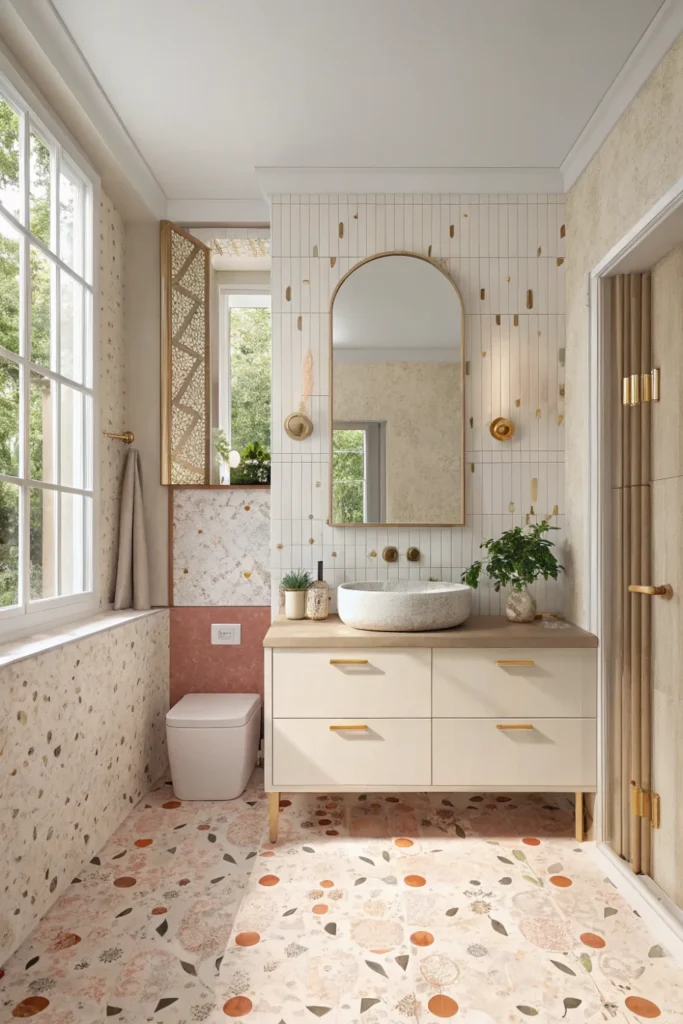
Terrazzo — the speckled aggregate material of marble, glass, and stone chips set in a cement or resin binder — has become one of the defining washroom design materials of contemporary interiors, bringing a quality of playful sophistication that is unlike any other surface available: simultaneously retro and completely current.
In a washroom design context, terrazzo works on floors, walls, shower surrounds, basin tops, and even as a cast basin itself. A continuous terrazzo surface — the same material on floor and walls — creates an immersive, enveloping effect that is the bathroom equivalent of a statement wallpaper room, with the added durability of a fully waterproof material.
Choose a terrazzo aggregate colour that includes at least one tone from your fixture finish — if your taps are brass, look for terrazzo with amber or gold chips; if your fixtures are chrome, look for silver or grey aggregate. This small chromatic link makes the washroom design feel cohesive rather than coincidental.
10 Biophilic Washroom Design with Plants and Natural Materials
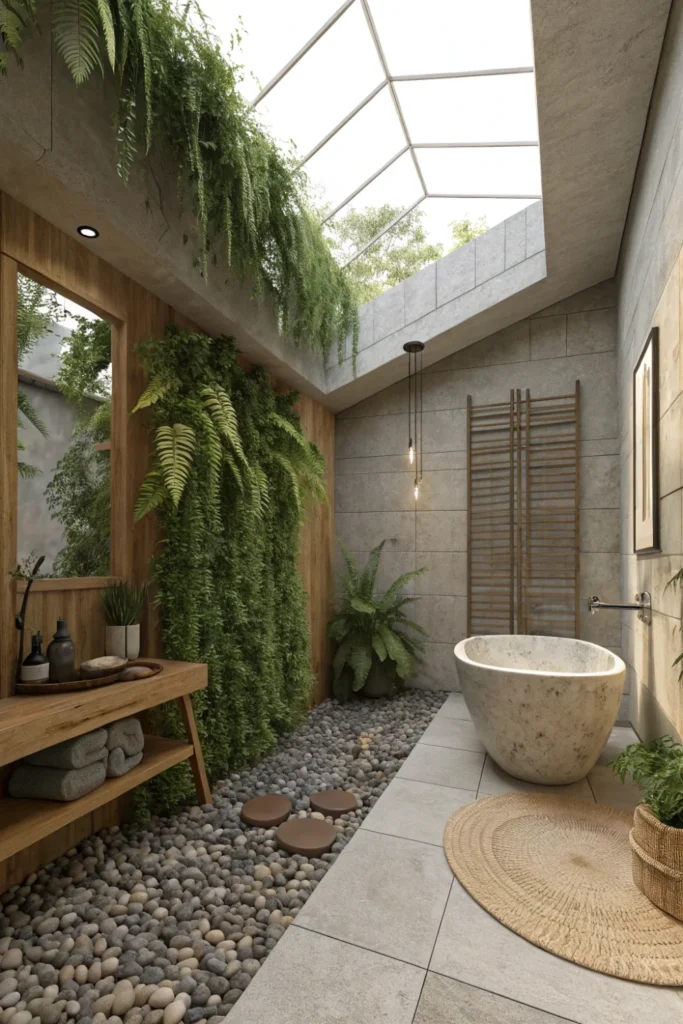
A biophilic washroom design — one that actively incorporates living plants, natural materials (unpolished stone, raw wood, bamboo), and natural light — creates a bathroom that feels connected to the living world rather than sealed within a waterproof box, producing a genuinely restorative environment that goes beyond surface aesthetics.
The key biophilic washroom design moves are: a skylight or enlarged window to maximise natural light and sky views, a planting scheme using humidity-loving species like ferns, orchids, and peace lilies, and material choices that remain visibly organic — rough-edged stone, grain-visible timber, hand-thrown ceramics rather than manufactured uniformity.
Install a skylight above the bath or shower if structurally feasible — natural overhead light is the single most transformative biophilic washroom design element, making plants thrive without supplemental lighting and creating a bathing experience of extraordinary quality that no side window can replicate.
11 Compact Powder Room Washroom Design with Maximum Impact
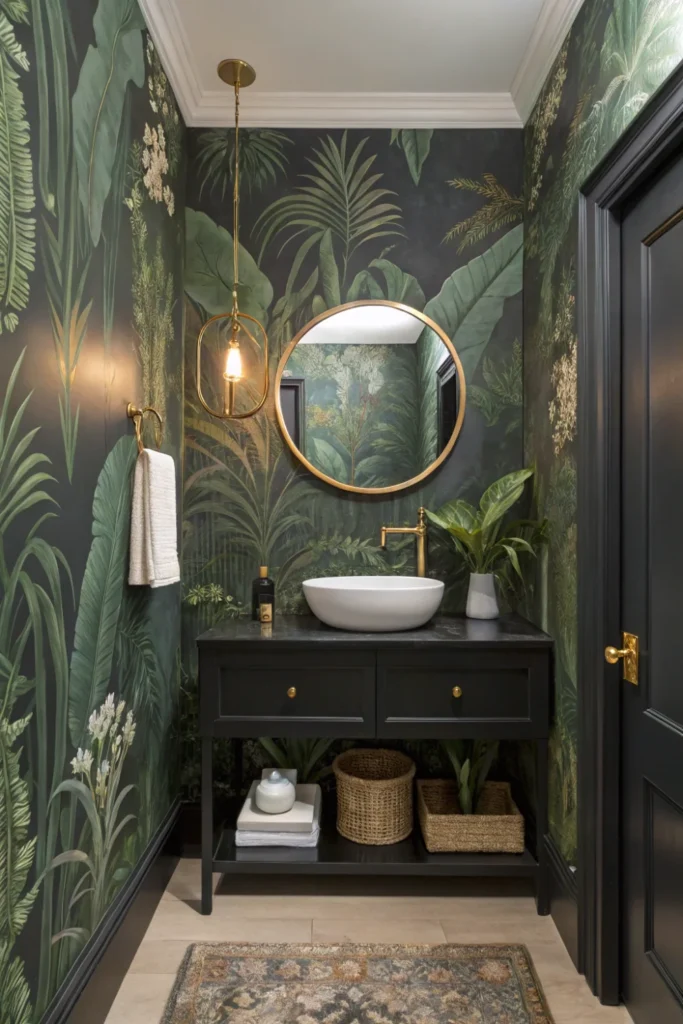
A small powder room or guest cloakroom is the washroom design opportunity most frequently underestimated — because the space is compact and used briefly by guests, it can absorb a level of decorative boldness and commitment that would overwhelm a larger bathroom, making it the ideal room for a dramatic wallpaper, an unusual basin, or a striking colour that the main bathroom could never carry.
The most memorable powder room washroom designs treat the small space as a jewel box — maximalist wallpaper on every wall, a sculptural vessel sink on a slim console, a single oversized round mirror, and a statement light fitting create an experience that is brief but genuinely unforgettable.
Install a wall-mounted basin with exposed decorative pipe work in a powder room washroom design — a small room benefits enormously from the open floor space a wall-mounted basin creates, and deliberately beautiful pipe work (in copper or brass) turns a plumbing necessity into a design feature.
12 Vintage and Antique-Inspired Washroom Design
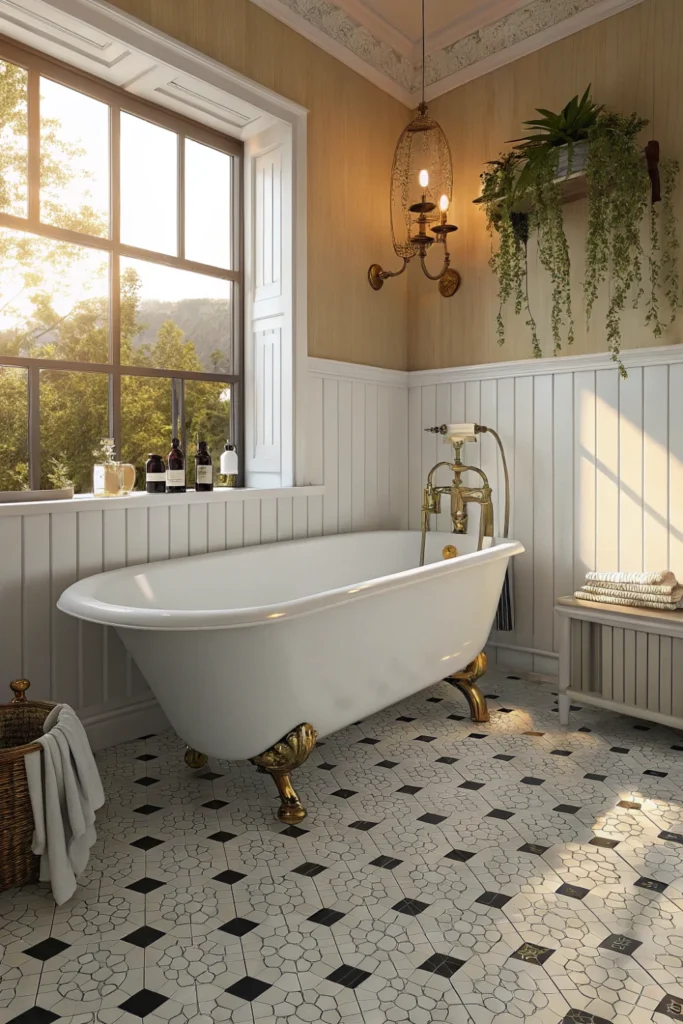
A vintage or antique-inspired washroom design — built around period fixtures, reclaimed materials, and deliberately aged finishes — creates a bathroom with irreplaceable character and warmth that new-build design cannot manufacture regardless of budget, because the authentic quality of age is genuinely unavailable from any showroom.
Period-appropriate fixtures — cross-handle taps in unlacquered brass, a clawfoot bath, a high-level cistern with a pull chain, a pedestal basin with ornamental legs — form the structural vocabulary of a vintage washroom design that new fixtures, however beautifully made, cannot fully replicate.
Mix one or two genuinely antique plumbing fixtures with new equivalents rather than attempting a fully antique bathroom — the contrast of a beautiful vintage roll-top bath with a new, unseen shower valve and modern plumbing behind the walls gives you the aesthetic without the maintenance complexity of fully antique plumbing infrastructure.
13 Colourful Maximalist Washroom Design
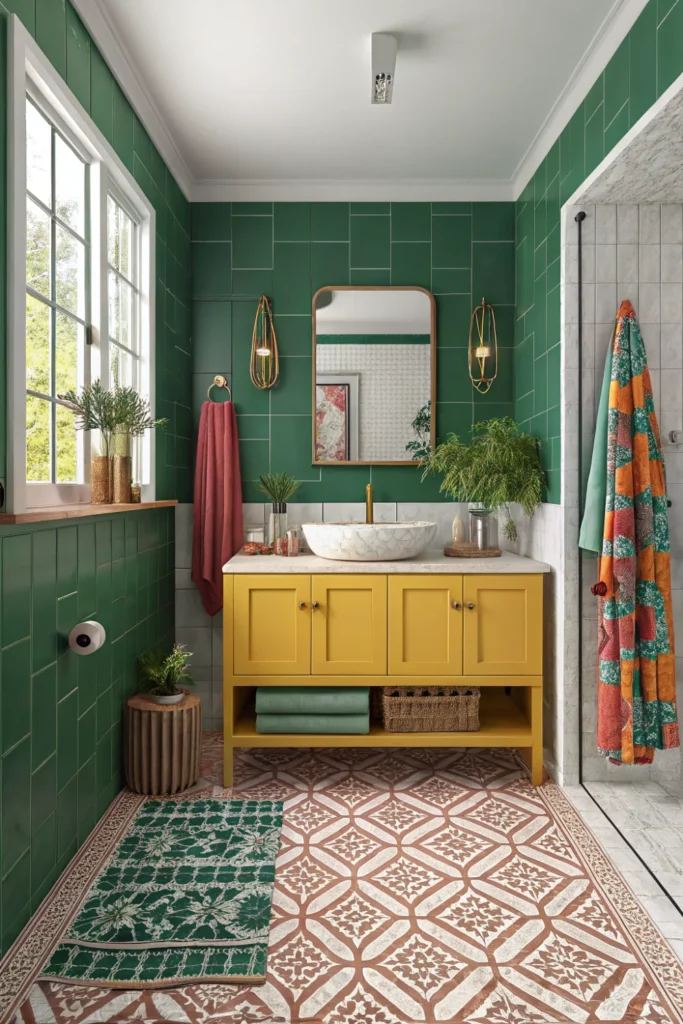
A bold maximalist washroom design — where colour, pattern, texture, and personality are embraced rather than edited — creates a bathroom that feels joyful, energising, and unapologetically individual in a world of identical spa-white bathrooms. The maximalist washroom is not about excess for its own sake; it is about confidence and commitment to a fully realised decorative vision.
The most successful maximalist washroom designs are built on a strong internal colour logic — a dominant colour that appears in the tile, echoed in the vanity, referenced in the accessories — rather than a random accumulation of patterns and colours that happens to be dense. Controlled maximalism reads as designed; random accumulation reads as cluttered.
In a maximalist washroom design, limit your pattern to two types maximum — one large-scale pattern and one complementary small-scale pattern in the same colour family. Three or more competing patterns create genuine visual noise that makes even a beautifully coloured room feel disorganised and uncomfortable.
14 Smart Storage Washroom Design for Clutter-Free Calm
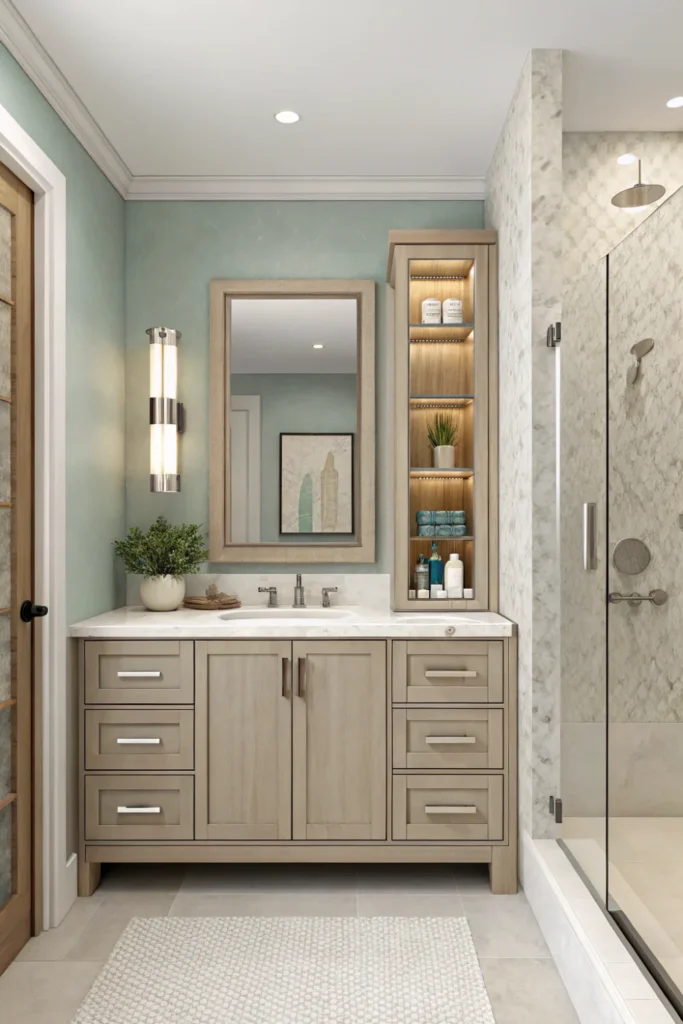
The most beautiful washroom design photographs in the world share one quality above all others: completely clear surfaces. Achieving this in a room that houses hundreds of daily-use products requires a storage-first washroom design approach where every item has a concealed, accessible home before the first tile is specified.
Recessed niches in shower walls, full-height mirrored medicine cabinets, under-vanity drawer systems with custom inserts, and built-in wall cupboards all contribute to a washroom design where function is entirely concealed, allowing the designed surfaces to remain permanently visible and uncluttered.
Build shower niches at two heights rather than one — a tall niche at standing height for shampoo and body wash bottles, and a lower niche at knee height for shaving products and foot care items. Two purpose-sized niches store more than one large niche and keep the shower wall looking more refined and considered.
15 Luxe Material Upgrade — Marble, Brass, and Linen
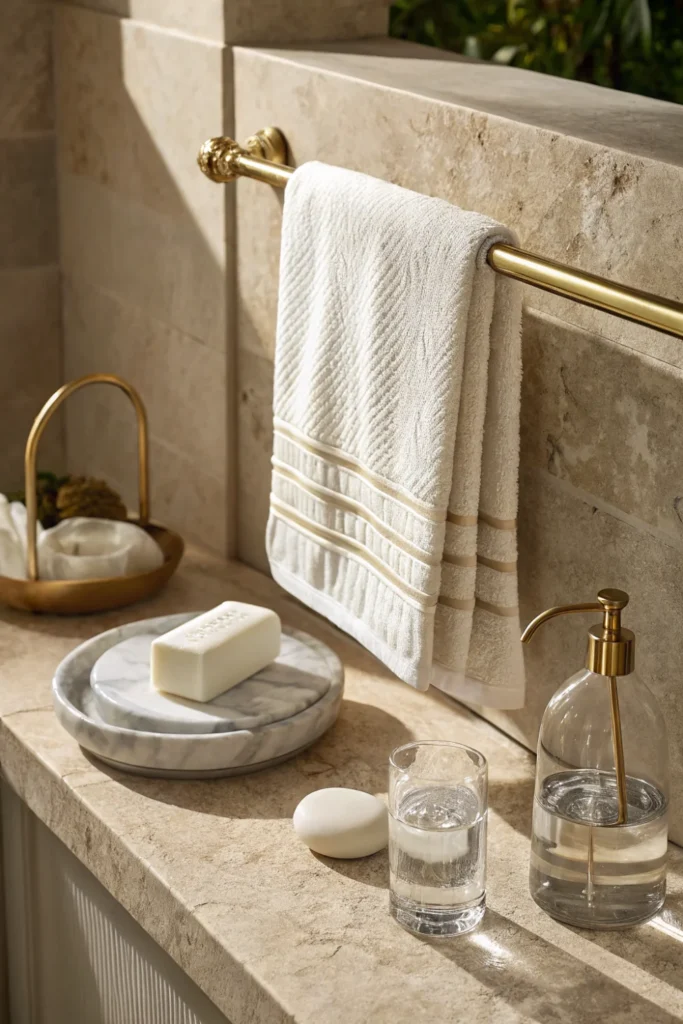
The simplest and most consistently effective washroom design upgrade is a deliberate material elevation — replacing standard ceramic with natural stone or high-quality porcelain, upgrading chrome fixtures to brushed brass or unlacquered nickel, switching synthetic towels for heavyweight Turkish linen, and replacing plastic accessories with ceramic, glass, or stone equivalents.
This material upgrade approach can be applied to an existing bathroom without structural change, progressively replacing lower-quality items with better versions over time. Each individual upgrade is modest in cost; collectively they transform the bathroom’s perceived quality from standard to genuinely luxurious.
The principle behind this washroom design strategy is that quality materials communicate their own value through touch and sight — the weight of a stone soap dish, the warmth of a brass tap, the drape of linen towels — in a way that shapes the experience of using the room as powerfully as any architectural feature.
Start the material upgrade process with towels and hardware — these two elements are touched every day, making their quality immediately and continuously felt, and they are the two upgrades most easily noticed by guests, delivering the highest social return of any washroom design material investment.
Why Washroom Design Ideas Are Worth the Investment
Investing in thoughtful washroom design delivers returns that significantly exceed cost — bathrooms consistently rank among the top three rooms that influence property valuations and buyer decisions, with a well-designed master bathroom regularly adding 5–10% to a home’s perceived value in competitive markets.
The daily quality-of-life return on good washroom design is equally compelling — the bathroom is the room where most people begin and end each day, and starting the morning in a beautifully designed space that feels calm, warm, and considered sets a genuinely different psychological tone from beginning the day in a functional but uninspiring room.
Quality materials chosen for a washroom design renovation also outlast cheaper alternatives by decades — natural stone, solid wood, quality ceramic, and brass fixtures all improve with age and use rather than degrading, making them more economical over a fifteen-to-twenty-year period than the cycle of replacing lower-quality materials every five years.
Things to Consider Before Choosing Washroom Design Ideas
Before committing to any washroom design direction, assess your room’s fixed constraints honestly — the position of the soil stack determines where the toilet can go, the location of the existing plumbing rough-in determines where the bath and shower can be positioned without prohibitive cost, and the window and door positions determine the viable wall surfaces for key design features. Working with these constraints rather than against them saves significantly on plumbing and structural costs.
Consider the long-term maintenance commitment of your chosen washroom design materials — natural stone requires periodic sealing, real wood in wet areas needs careful waterproofing and regular oiling, grout-heavy tile schemes accumulate mould faster than large-format or grout-minimal alternatives, and unlacquered brass develops a patina that some people love and others find difficult to maintain. Choose materials whose maintenance reality matches your actual cleaning and maintenance habits.
Always plan ventilation before finalising any washroom design — inadequate ventilation is the leading cause of mould, paint failure, and material deterioration in bathrooms regardless of the quality of the design and materials. A mechanical extractor fan properly sized for the room volume, ideally on a humidity-sensitive control, is the single most important non-decorative investment in any washroom design project.
Comparison Table of Washroom Design Ideas
| Washroom Design Style | Cost Range | Best Room Size | Maintenance Level | Key Feature | Longevity |
|---|---|---|---|---|---|
| Spa Minimalist | $5,000–$30,000 | Any | Low | Floating vanity, stone tile | 15–20+ years |
| Dark & Dramatic | $3,000–$20,000 | Any | Medium | Dark large-format tile | 10–15 years |
| Japandi | $4,000–$25,000 | Small–Medium | Medium | Timber vanity, matte stone | 15+ years |
| Freestanding Bath Centrepiece | $3,000–$20,000 | Medium–Large | Low–Medium | Sculptural bath | 20+ years |
| Wet Room | $6,000–$25,000 | Any | Low | Seamless floor drain | Permanent |
| Statement Wall Tile | $1,500–$12,000 | Any | Low–Medium | Hero tile wall | Permanent |
| Double Vanity | $3,000–$18,000 | Large | Low | Wide vanity run | 15+ years |
| Industrial | $3,000–$15,000 | Any | Medium | Concrete, black metal | 10–15 years |
| Terrazzo | $4,000–$18,000 | Any | Low (sealed) | Terrazzo surfaces | Permanent |
| Biophilic | $3,000–$20,000 | Any | High (plants) | Skylight, plants | Varies |
| Compact Powder Room | $800–$6,000 | Small | Low | Bold wallpaper, vessel sink | 10–15 years |
| Vintage / Antique | $2,000–$15,000 | Any | Medium–High | Period fixtures | Decades |
| Colourful Maximalist | $2,000–$12,000 | Any | Low–Medium | Bold tile and colour | 10–12 years |
| Smart Storage Design | $2,000–$14,000 | Any | Low | Recessed niches, flush cabinets | Permanent |
| Luxe Material Upgrade | $500–$8,000 | Any | Medium | Stone, brass, linen | 20+ years |
Frequently Asked Questions About Washroom Design Ideas
How do I choose the right washroom design style for my home?
The most reliable way to identify the right washroom design style is to look at the architectural character of your home as a whole — a Victorian terrace naturally suits a period-inspired or artisan tile washroom design; a contemporary new-build suits a minimalist or Japandi approach; a converted warehouse suits an industrial treatment. Working with the home’s existing character rather than against it almost always produces a more convincing and more lasting result.
Beyond architecture, consider how you use the bathroom — if you take long soaking baths regularly, a freestanding bath centrepiece design is the right investment; if you shower daily and rarely bathe, a wet room with an exceptional shower experience serves you better. The most beautiful washroom design is the one that is designed around how you actually live.
What is the most cost-effective washroom design upgrade?
Replacing existing chrome fixtures and hardware with a quality brass, brushed nickel, or matte black alternative is the most cost-effective single washroom design upgrade available — changing the tap, towel rail, toilet roll holder, and shower fitting to a cohesive finish in a quality material transforms the bathroom’s perceived quality dramatically without any structural change, tiling, or plumbing work.
The second most cost-effective upgrade is a complete declutter and accessory refresh — replacing mismatched soap dispensers, toothbrush holders, and bathroom accessories with a coordinated set in ceramic, glass, or stone; investing in heavyweight linen or Turkish cotton towels in a consistent colour; and clearing all non-essential items from every surface. The room’s quality is immediately and substantially elevated with no structural investment.
How do I make a small washroom design feel larger?
The five most impactful visual techniques for making a small washroom design feel larger are: using large-format tiles that run continuously from floor to wall without a contrasting border; installing a frameless glass shower screen rather than a framed one or a curtain; choosing a wall-hung toilet and floating vanity to expose maximum floor area; using a full-length mirror or a large mirror over the entire vanity wall; and keeping the colour palette to a single light tone across floor, walls, and ceiling.
A wet room washroom design is the most architecturally effective small-bathroom solution because the elimination of the shower tray, curtain, and enclosure removes the three visual elements that most strongly fragment a small bathroom into separate zones — without them, the room reads as a single unified space that is inherently larger than its actual dimensions suggest.
What hardware finish works best for most washroom design styles?
Brushed brass is the most versatile single hardware finish for washroom design — its warm yellow-gold tone works with both neutral and coloured tile palettes, complements both contemporary and traditional fixture forms, and develops a beautiful living patina over time that ages more gracefully than any lacquered or plated alternative. It is the finish that appears most consistently across the widest range of high-end washroom design photography for precisely these reasons.
Matte black is the strongest contemporary alternative — it provides a bold graphic contrast against light surfaces, suits industrial and maximalist washroom designs particularly well, and requires the least maintenance of any hardware finish because water spots and minor marks are essentially invisible against the dark matte surface. The choice between brass and matte black often comes down to whether the washroom design palette runs warm (brass) or cool (black).