
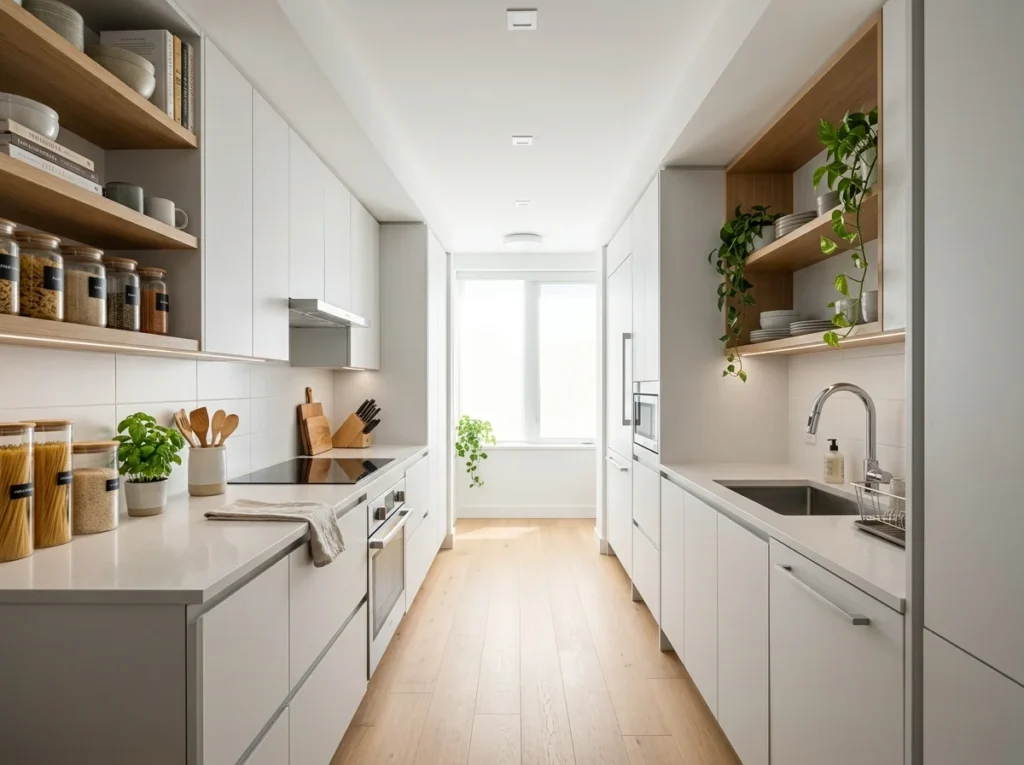
A well-designed galley kitchen is one of the most efficient and underrated layouts in residential design. Two parallel runs of cabinets and countertops create a cooking corridor that puts everything within arm’s reach — a format so effective that professional restaurant kitchens have used it for decades.
The challenge with a galley kitchen is not function — it is making the narrow, linear space feel open, beautiful, and genuinely enjoyable to cook in. With the right choices in color, lighting, storage, and layout, a galley kitchen can be transformed from a cramped corridor into a sleek, highly organized culinary space.
This guide covers the best galley kitchen ideas that kitchen designers and home cooks actually recommend — with practical tips, honest comparisons, and product picks to help you maximize every inch of your galley kitchen beautifully.
List of 10 Best Galley Kitchen Ideas
1. Light Color Cabinets to Open Up the Space
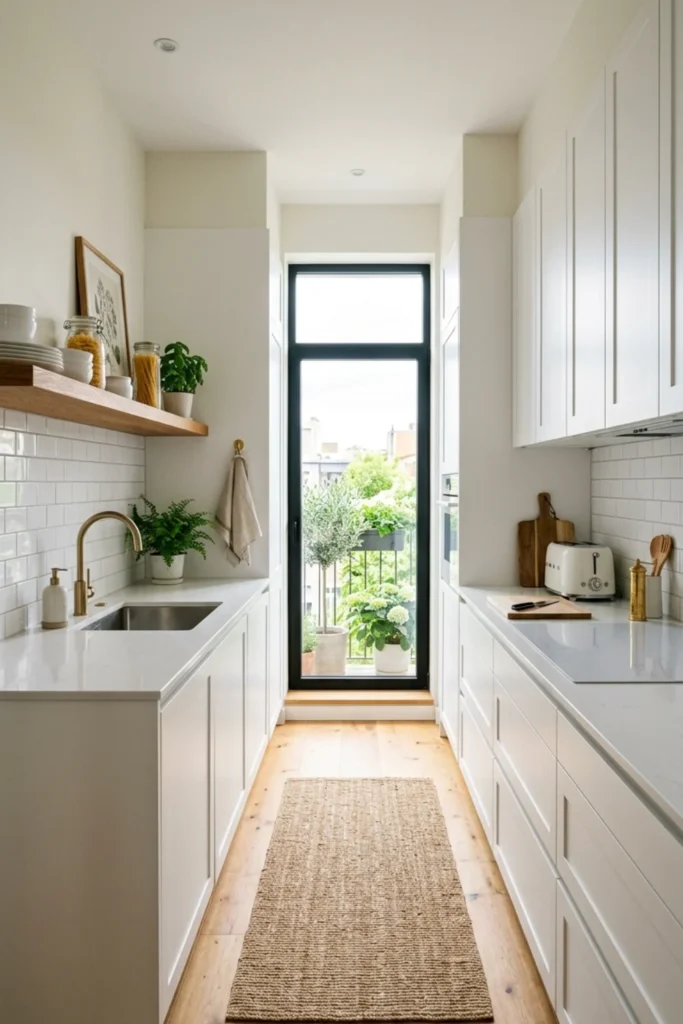
Light-colored cabinets — white, cream, soft gray, or pale sage — are the single most effective design choice for making a galley kitchen feel larger, brighter, and more open than its actual dimensions suggest.
Light cabinets reflect natural and artificial light back into the narrow corridor, reducing the tunnel-like effect that darker cabinetry amplifies. White Shaker-style cabinets are the most popular choice for galley kitchens because their clean lines and bright tone maximize the sense of space without sacrificing style.
Pair light cabinets with a light countertop in white quartz or pale stone to continue the reflective, airy palette across every horizontal surface — the more consistently light the surfaces, the more spacious and cohesive the galley kitchen feels from end to end.
Pro Tip: Choose handleless or J-pull light cabinets in a galley kitchen where possible — eliminating protruding handles removes physical obstacles in the narrow corridor and keeps the cabinet faces visually clean and uninterrupted, amplifying the spacious quality that light colors create.
2. Open One End for Better Flow
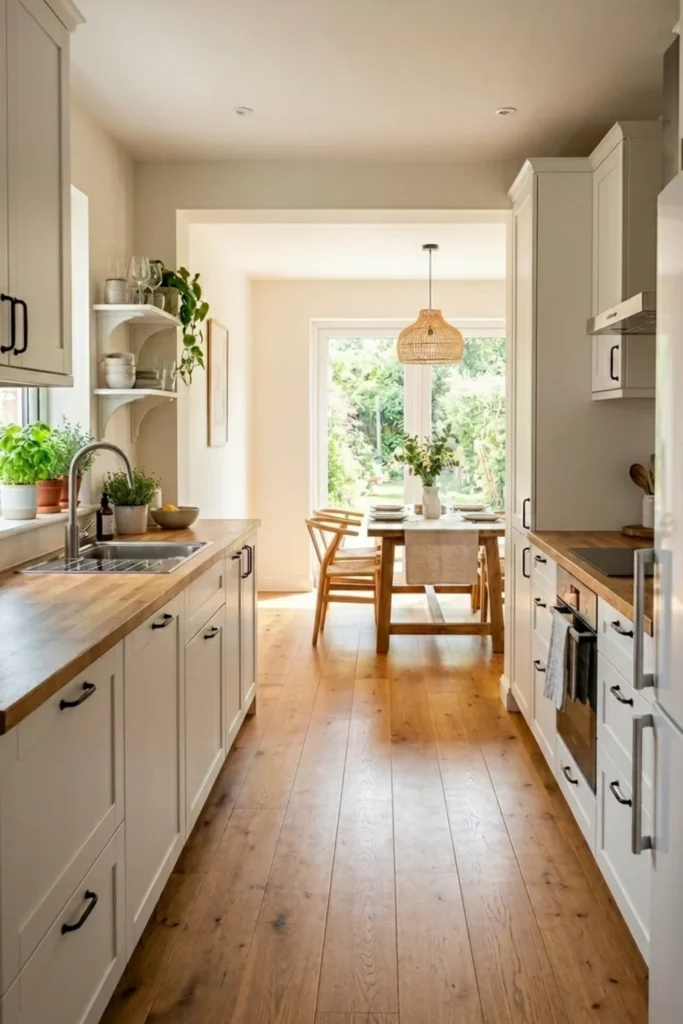
Opening one or both ends of a galley kitchen — by removing a wall, widening a doorway, or connecting the corridor to an adjacent dining or living space — is the single most transformative structural improvement for a closed galley kitchen layout.
An open-ended galley kitchen immediately resolves the two most common complaints about the format — the feeling of enclosure and the lack of social connection to the rest of the home. Removing an end wall connects the kitchen to a dining area and allows the cook to participate in conversation while preparing food.
Even a partial wall removal or a wide arched opening rather than a full structural change creates a significant improvement in perceived space and social connectivity, at a fraction of the cost and disruption of a full open-plan conversion.
Pro Tip: If a full wall removal is not feasible, replace a solid door at the galley kitchen end with a wide sliding barn door or pocket door — sliding doors eliminate the space consumed by a door swing in a narrow corridor and create a more open, connected relationship between the kitchen and the adjoining room.
3. Mirrored or Glossy Backsplash for Visual Depth
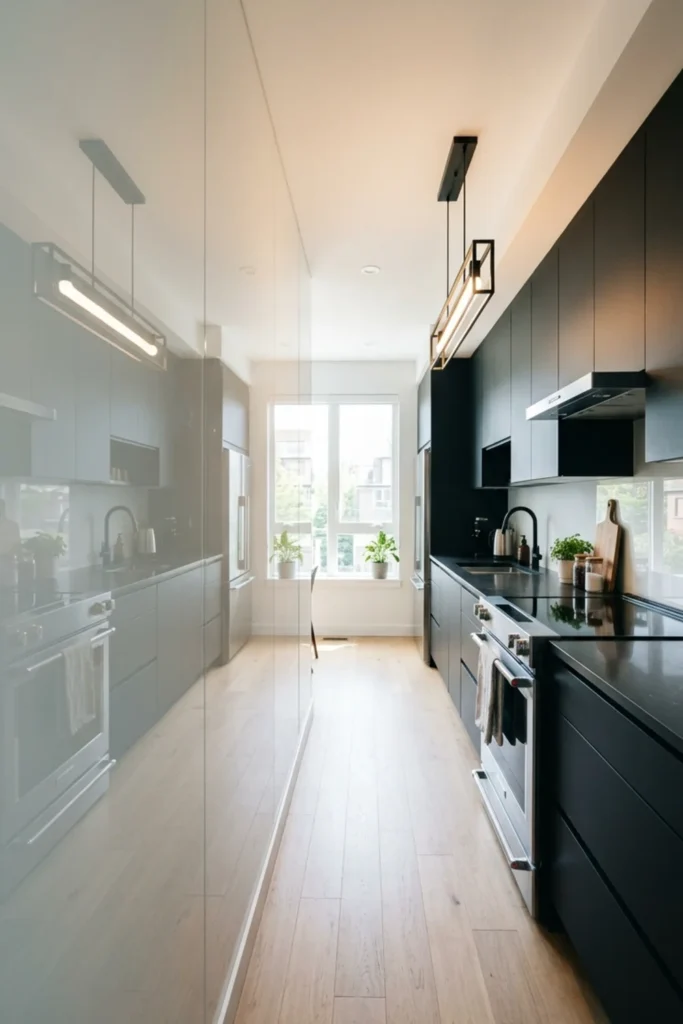
A mirrored or high-gloss backsplash is one of the most effective visual tricks in galley kitchen design — it reflects light and the opposite wall’s cabinetry back into the space, creating the illusion of doubled width that makes a narrow galley kitchen feel significantly more generous.
Mirrored glass tile, polished stainless steel panels, and high-gloss white or colored glass backsplash sheets all deliver this light-doubling effect while providing a durable, easy-to-clean surface that suits the high-splatter environment of a kitchen backsplash.
A full-height mirror panel running the entire length of one galley kitchen wall — from countertop to upper cabinet — creates the most dramatic visual expansion effect, reflecting the opposite cabinet run and effectively making the kitchen appear twice as wide as it actually is.
Pro Tip: Use mirrored or glossy backsplash panels behind the cooking area only rather than the full length of the galley kitchen if a full mirrored installation feels too intense — a partial reflective backsplash still creates significant visual depth while leaving the remaining backsplash as a grounding neutral surface.
4. Under-Cabinet LED Lighting
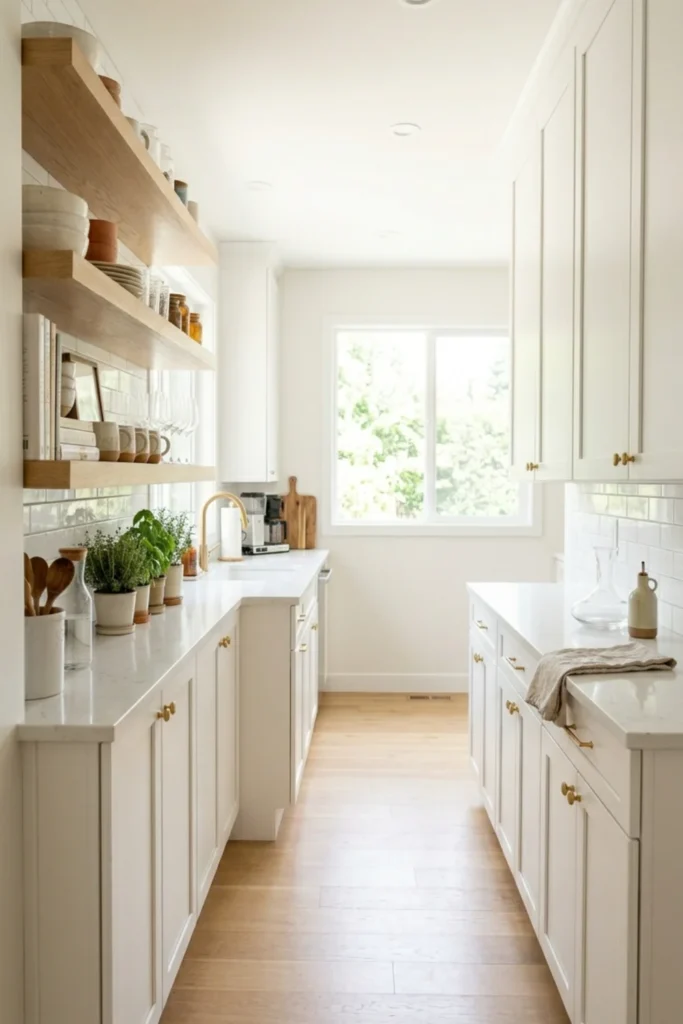
Under-cabinet LED lighting is one of the highest-impact and most practical galley kitchen upgrades available — it illuminates the countertop work surface directly, eliminates the shadows that overhead lighting casts in a narrow kitchen, and creates a warm, layered lighting atmosphere that transforms the galley kitchen’s evening character.
In a galley kitchen where overhead lighting positioned in the narrow corridor center is often too far from countertop work surfaces on either side, under-cabinet LEDs are not a luxury but a genuine functional necessity for safe and comfortable food preparation.
Choose warm white LED strips at 2700K to 3000K for under-cabinet installation in a galley kitchen — cool white strips create a harsh, clinical quality in the close working environment of a narrow kitchen, while warm white enhances the natural materials and finishes most kitchens feature.
Pro Tip: Install under-cabinet LED strips as far forward on the cabinet base as possible — positioning the strip toward the front edge of the cabinet rather than the back ensures the light falls on the full depth of the countertop work surface rather than being blocked by the cabinet frame.
5. Open Shelving on One Side
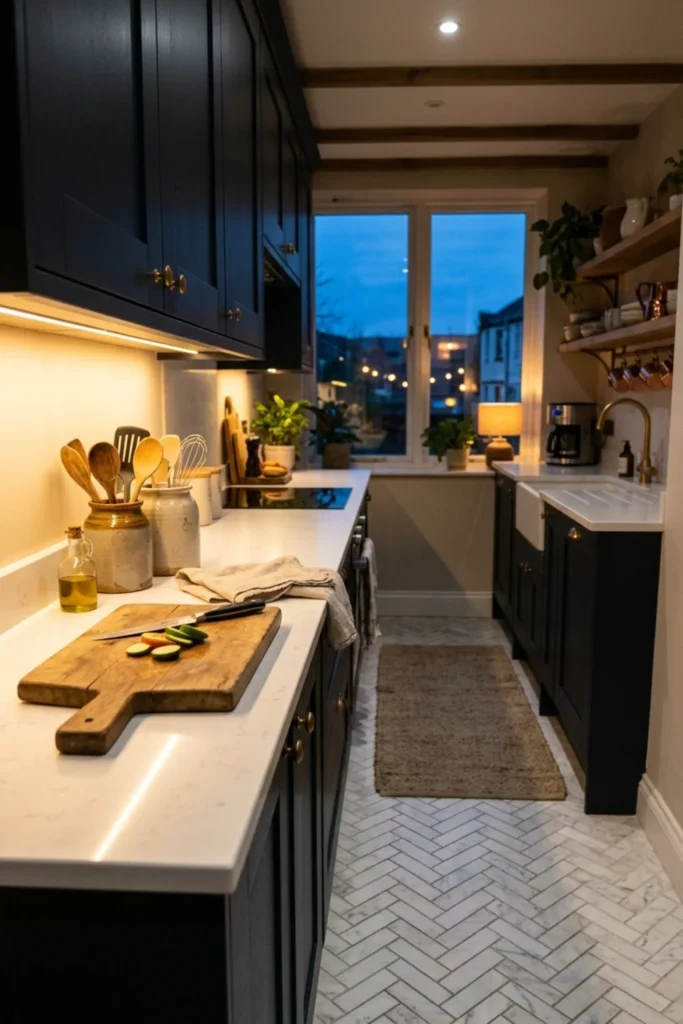
Replacing upper cabinets on one wall with open shelving is one of the most effective galley kitchen ideas for reducing the enclosed, oppressive quality that two full walls of ceiling-height cabinets create in a narrow corridor.
Open shelves visually recede into the wall rather than projecting forward as closed cabinet boxes do — the visual openness of shelving versus the visual bulk of upper cabinets makes a meaningful difference to the perceived width of a galley kitchen without reducing storage capacity significantly.
Style open galley kitchen shelves with a disciplined, organized mix of everyday ceramics, glassware, a few cookbooks, and one or two plants — the visible display adds personality and warmth to the galley kitchen while keeping the most-used items immediately accessible.
Pro Tip: Install open shelving on the darker or less naturally lit wall of a galley kitchen — the visual openness of shelving on the darker side prevents that wall from advancing visually and makes the galley kitchen feel more balanced and spacious than it would with closed cabinets on both sides.
6. Dark and Dramatic One-Wall Contrast
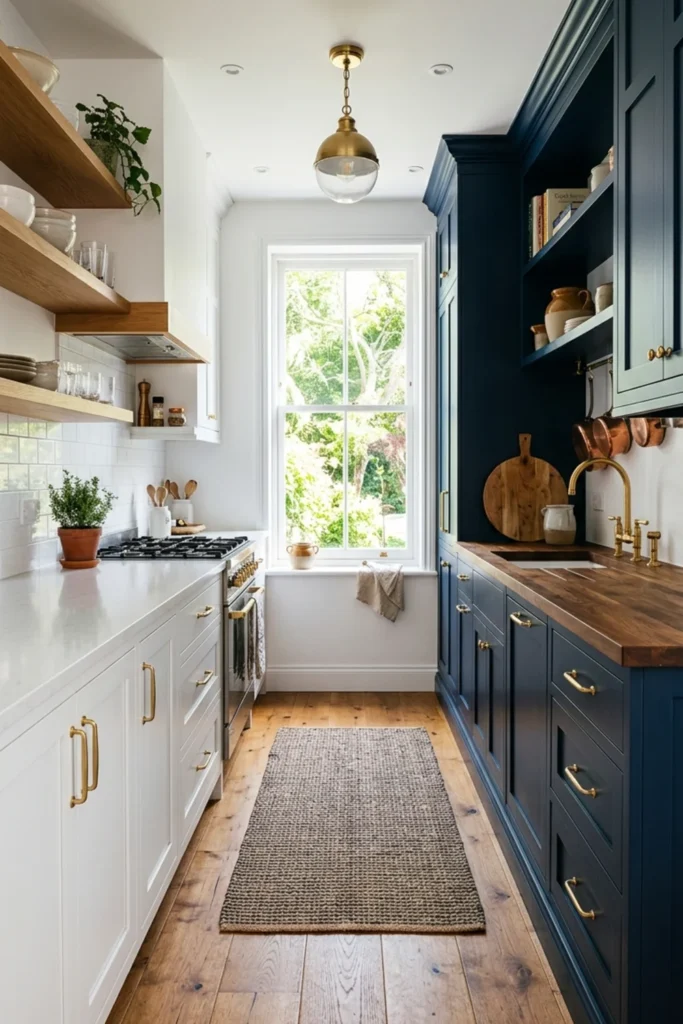
A one-wall contrast treatment — painting or finishing one run of galley kitchen cabinets in a deep, saturated color while keeping the opposite wall light — is one of the most design-forward and visually dynamic ideas for a galley kitchen that feels predictable or bland.
Navy, forest green, charcoal, deep terracotta, or matte black on one galley kitchen cabinet run creates a dramatic focal point that draws the eye down the length of the corridor and gives the space a sense of deliberate, confident design rather than cautious neutrality.
The light-and-dark contrast between the two parallel cabinet runs prevents the galley kitchen from feeling like a uniform tunnel — the visual differentiation between the walls creates the impression of greater width and makes the space feel more like a designed interior than a functional corridor.
Pro Tip: Apply the dark color to the cabinet run opposite the primary window or light source — this placement ensures that the darkest surface is the best-lit one, preventing it from absorbing too much light and making the galley kitchen feel dim or cave-like.
7. Statement Floor Tile Running Lengthwise
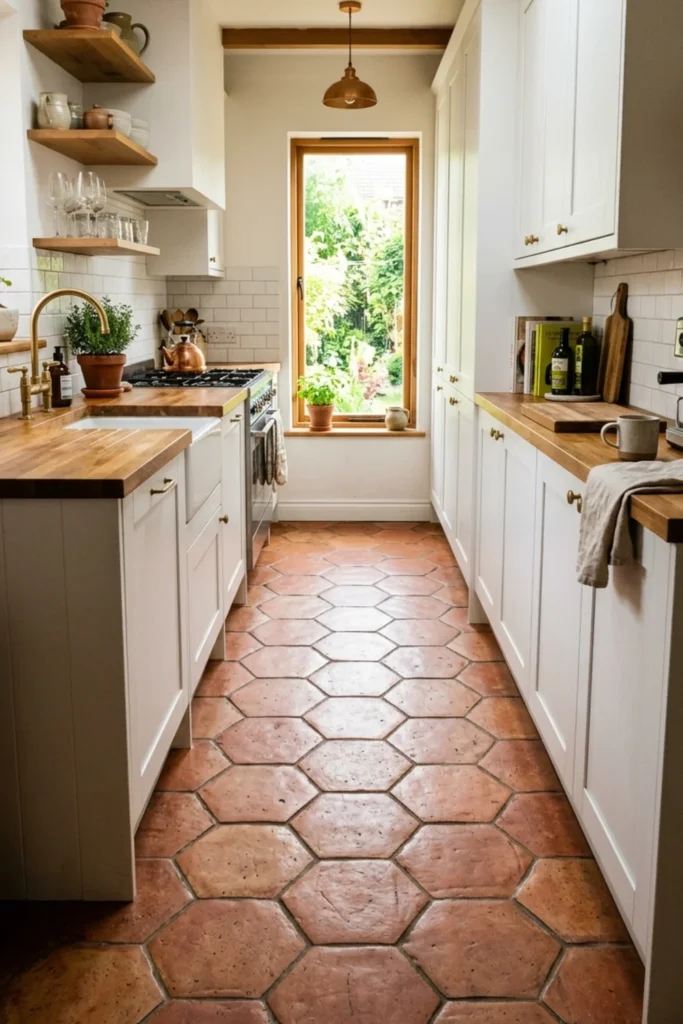
A statement floor tile laid lengthwise — oriented along the corridor rather than across it — is one of the most effective and affordable galley kitchen design strategies for making the space feel longer and more generous.
Large format tiles, herringbone wood or tile patterns, and bold geometric designs oriented along the galley kitchen’s length all draw the eye toward the end of the corridor, creating a sense of visual depth and spatial generosity that tiles laid across the short width actively work against.
Black and white checkerboard, classic terracotta hexagons, dark slate large format tiles, and warm oak-look porcelain planks are among the most popular flooring choices for galley kitchens — each brings a distinct character while serving the same lengthening visual purpose.
Pro Tip: Choose floor tiles in a scale proportional to the galley kitchen’s width — very large format tiles in an extremely narrow galley kitchen can feel overwhelming, while very small tiles create a fragmented, busy effect. A tile width that equals roughly one-third to one-half the kitchen’s total width creates the most visually balanced result.
8. Maximized Vertical Storage to the Ceiling
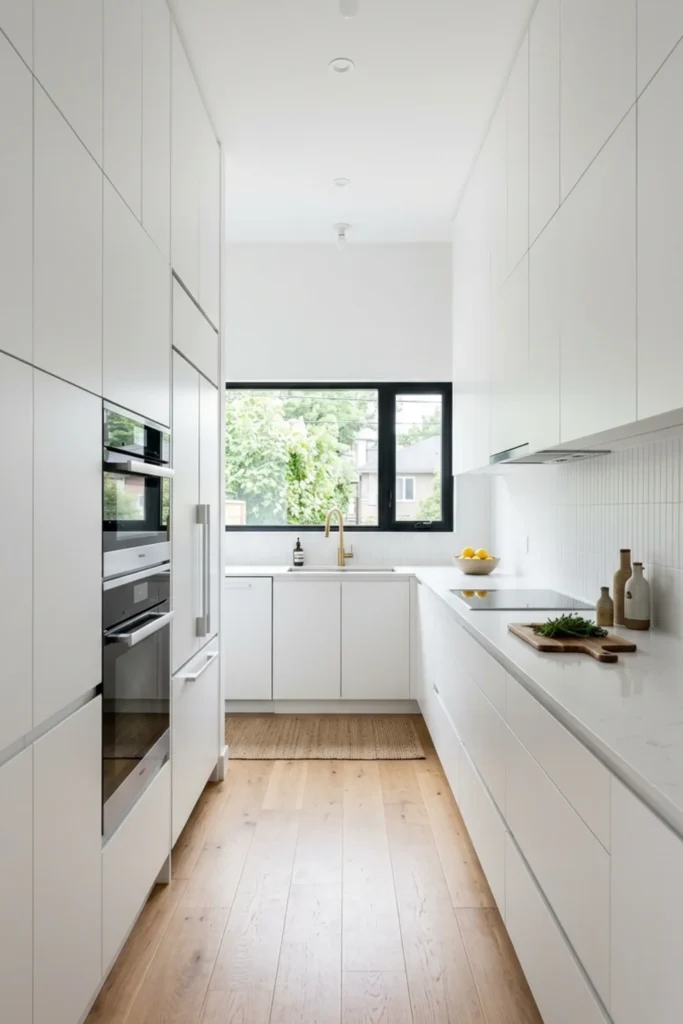
Floor-to-ceiling cabinet storage — extending cabinetry all the way to the ceiling rather than leaving a gap above upper cabinets — is the most space-efficient galley kitchen storage strategy available, adding an entire additional shelf of storage to every cabinet run without consuming any additional floor space.
The gap between standard upper cabinets and the ceiling is one of the most consistently wasted spaces in a galley kitchen — full-height cabinets that reach the ceiling eliminate this dead zone while creating a clean, uninterrupted vertical cabinet face that makes the kitchen feel taller and more considered.
Use the highest ceiling cabinets for rarely accessed seasonal items — large serving platters, holiday equipment, and bulk pantry overflow — accessed by a simple kitchen step stool kept in the galley kitchen for exactly this purpose.
Pro Tip: Specify full-height cabinet doors rather than a fixed top section with a separate small door above standard upper cabinets — tall single-door panels create a cleaner, more seamless visual line from countertop to ceiling and make the galley kitchen feel more architecturally resolved than the two-tier cabinet arrangement standard in most kitchen installations.
9. Window Above the Sink for Natural Light
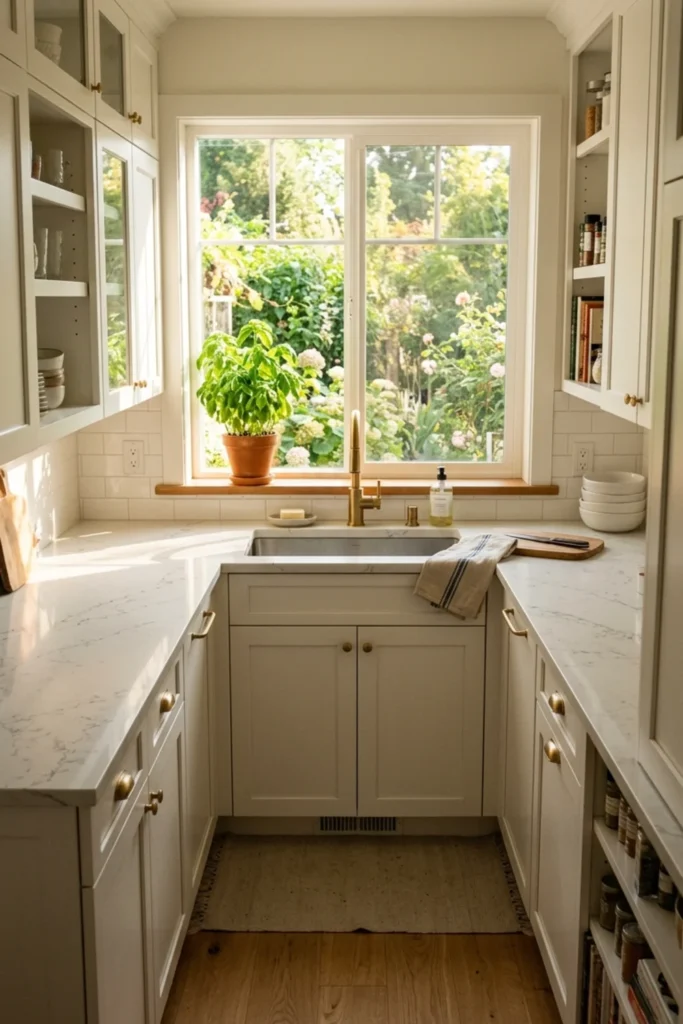
A window positioned above the kitchen sink is the most important natural light source in any galley kitchen — it brings daylight into the working zone where most of the kitchen’s daily tasks happen and creates a focal point at the end or center of the corridor that prevents the space from feeling enclosed.
Even a small window above the sink delivers a disproportionate improvement to the galley kitchen’s atmosphere — natural light transforms the working experience during daytime hours, reduces reliance on artificial lighting, and creates a visual connection to the outside that makes a narrow corridor feel less confining.
If the galley kitchen layout does not permit a window above the sink, a skylight or sun tube in the ceiling directly above the main work zone delivers equivalent natural light benefits without requiring an exterior wall — particularly valuable in interior galley kitchens without direct window access.
Pro Tip: Keep window treatments above a galley kitchen sink minimal or absent entirely — a bare window or at most a simple café curtain covering only the lower half allows maximum natural light into the work zone while providing the visual connection to the outside that makes a galley kitchen feel genuinely pleasant to spend time in.
10. Integrated Appliances for a Seamless Look
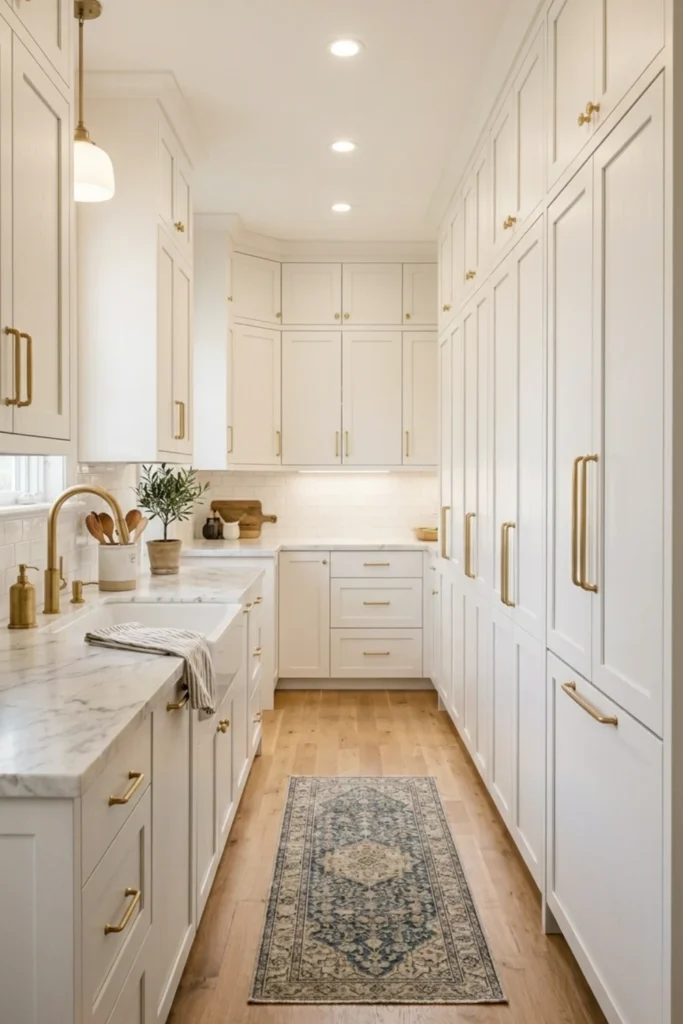
Integrated or panel-ready appliances — refrigerator, dishwasher, and microwave concealed behind cabinet-matching door fronts — are one of the most effective galley kitchen ideas for creating a seamless, uninterrupted cabinet run that makes the narrow space feel cleaner and more expansive.
In a galley kitchen where visual continuity along both walls is critical to the sense of space, protruding stainless steel appliances interrupt the clean cabinet lines and create visual breaks that fragment the corridor and make it feel narrower than it is.
An integrated refrigerator flush with surrounding cabinets is the single most impactful integrated appliance upgrade in a galley kitchen — the refrigerator is the largest appliance in the kitchen and its protrusion into the corridor consumes precious width that flush integration completely reclaims.
Pro Tip: Specify counter-depth or integrated refrigerators in a galley kitchen rather than standard-depth models — even a freestanding counter-depth refrigerator that sits flush with the surrounding cabinetry reclaims 4 to 6 inches of aisle width that significantly improves the daily experience of moving through the galley kitchen during food preparation.
Why a Well-Designed Galley Kitchen Is Worth the Investment
A thoughtfully designed galley kitchen consistently outperforms larger, more open kitchen layouts in functional efficiency — the compact corridor format puts every tool, appliance, and ingredient within a few steps of every other, reducing the wasted movement that larger kitchen layouts impose on daily cooking routines.
Property value is directly affected by the quality of galley kitchen design — a well-executed galley kitchen with quality cabinetry, integrated appliances, and considered storage is valued by buyers as highly as larger kitchen footprints, while a poorly designed galley kitchen is cited as one of the most common deterrents in residential property viewings.
The focused investment required by a galley kitchen renovation — fewer cabinets, less countertop, and a single corridor of flooring compared to a larger kitchen layout — means that a galley kitchen can be finished to a genuinely high specification for a significantly lower total cost than an equivalent quality open-plan kitchen renovation.
Things to Consider Before Designing a Galley Kitchen
Before finalizing any galley kitchen design decisions, measure the corridor width carefully and plan around it — the minimum comfortable galley kitchen width for a single cook is 42 inches between opposing countertop edges, while 48 inches allows two people to work simultaneously without constant negotiation of the shared space.
Think about traffic flow through the galley kitchen — if the corridor connects two frequently used areas of the home, the kitchen will experience pass-through traffic that conflicts with cooking activity. Designing the galley kitchen as a closed or semi-closed space rather than a thoroughfare significantly improves both cooking safety and daily convenience.
Always prioritize storage planning before aesthetic choices in a galley kitchen — the limited wall space and floor area of the format makes storage capacity a genuine constraint that must be maximized through every available strategy before color, material, and style decisions are finalized.
Comparison Table of Galley Kitchen Ideas
| Design Idea | Cost Range | Difficulty | Impact Level | Best For | Maintenance |
|---|---|---|---|---|---|
| Light Color Cabinets | $2,000–$15,000 | Medium | Very High | Any galley kitchen | Wipe clean |
| Open One End | $1,000–$10,000 | High | Very High | Enclosed galley kitchens | Minimal |
| Mirrored or Glossy Backsplash | $200–$2,000 | Low–Medium | High | Narrow galley kitchens | Wipe clean |
| Under-Cabinet LED Lighting | $50–$300 | Low | High | Any galley kitchen | Replace strips |
| Open Shelving One Side | $100–$800 | Low–Medium | High | Any galley kitchen | Dust regularly |
| One-Wall Dark Contrast | $500–$3,000 | Medium | Very High | Any galley kitchen | Wipe clean |
| Statement Floor Tile | $500–$3,000 | Medium | High | Any galley kitchen | Mop regularly |
| Ceiling-Height Cabinets | $1,000–$5,000 | Medium–High | Very High | Storage-limited kitchens | Wipe clean |
| Window Above Sink | $500–$2,000 | High | Very High | Dark or enclosed kitchens | Minimal |
| Integrated Appliances | $2,000–$10,000 | High | Very High | Modern galley kitchens | Standard cleaning |
| Bold Backsplash | $300–$3,000 | Medium | Very High | Any galley kitchen | Seal grout |
| Breakfast Bar or Pass-Through | $500–$5,000 | Medium–High | High | Social galley kitchens | Wipe clean |
| Herb Garden Elements | $20–$300 | Low | Medium | Any galley kitchen | Water regularly |
Recommended Products for a Galley Kitchen
Govee Smart Under-Cabinet LED Light Strip — Warm White
A warm white LED light strip with app-controlled dimming and color temperature adjustment, designed specifically for under-cabinet installation with a strong adhesive backing and low-profile housing. One of the most practical and consistently reviewed galley kitchen lighting upgrades — dramatically improves countertop visibility and evening atmosphere.
Rev-A-Shelf 5WB2-1222-CR Pull-Out Cabinet Organizer
A two-tier pull-out wire cabinet organizer with full extension and soft-close mechanism, designed to transform standard base cabinets into fully accessible storage. Essential for maximizing the efficiency of every cabinet in a galley kitchen where storage space is at a premium and accessibility is critical.
IKEA GRUNDTAL Magnetic Knife Strip and Rail System
A stainless steel magnetic knife strip and wall rail system that mounts on the backsplash wall to hold knives, utensils, and small accessories off the countertop. One of the most space-efficient galley kitchen organization solutions available — frees up precious counter and drawer space by moving the most-used tools to the wall surface.
Frequently Asked Questions About Galley Kitchens
What Is the Ideal Width for a Galley Kitchen?
The minimum functional width for a galley kitchen is 8 feet total — approximately 4 feet of aisle space between two countertop runs of approximately 2 feet each. This provides the minimum comfortable working and passing clearance for a single cook in a residential galley kitchen.
For a two-cook galley kitchen, a total width of at least 10 feet — providing 5 to 6 feet of aisle width between opposing countertops — is strongly recommended. The additional aisle width allows two people to work simultaneously without the constant positional negotiation that narrower galley kitchens impose on shared cooking.
How Do I Make a Galley Kitchen Feel Bigger?
The five most effective strategies for making a galley kitchen feel bigger are light cabinet colors that reflect rather than absorb light, a reflective or mirrored backsplash that visually doubles the room’s width, removing or widening the end wall opening to create visual depth, installing under-cabinet lighting to brighten the work surface, and choosing floor tiles oriented lengthwise to draw the eye along rather than across the corridor.
Removing upper cabinets on one wall and replacing them with open shelving is the single most dramatic intervention for reducing the enclosed quality of a galley kitchen — the visual openness of shelving versus the visual bulk of closed upper cabinets makes an immediate and striking difference to the perceived width and airiness of the space.
Is a Galley Kitchen Layout Good for Cooking?
A galley kitchen is genuinely excellent for cooking — professional chefs consistently prefer galley and corridor kitchen layouts for their efficiency, because the compact arrangement puts every work station, appliance, and ingredient within a very small movement radius. The galley format minimizes wasted steps and maximizes the speed and efficiency of food preparation.
The galley kitchen’s main limitation is social rather than functional — its linear format isolates the cook from the dining and living areas of the home, making it less suited to the open, social cooking culture that many families prefer. Addressing this through an open end, a pass-through window, or a connected peninsula transforms the galley kitchen’s social dynamic while preserving all of its functional advantages.
How Do I Maximize Storage in a Small Galley Kitchen?
The most effective galley kitchen storage strategies for a small space are extending cabinetry to ceiling height to eliminate wasted space above upper cabinets, installing pull-out organizers in base cabinets to access the full cabinet depth, adding a magnetic knife strip and wall rail on the backsplash to move tools off the countertop, and using the inside of cabinet doors with over-door organizers for spices, wraps, and cleaning supplies.
Every vertical surface in a galley kitchen is potential storage — the wall space between upper and lower cabinets, the end walls of cabinet runs, the ceiling above the corridor for hanging pot racks, and the backs of doors all offer additional storage capacity that most galley kitchen designs leave completely unused.