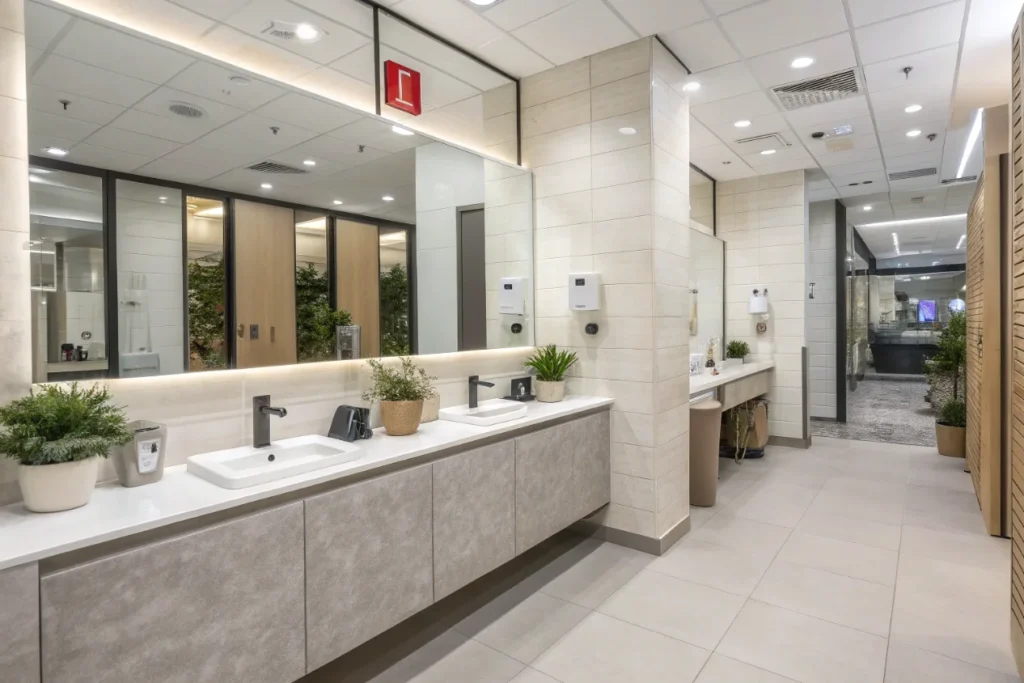
A well-designed office washroom does far more than satisfy a basic facility requirement — it communicates the organisation’s values, contributes directly to employee wellbeing and morale, and leaves a lasting impression on every client and visitor who uses it.
Yet the office washroom is consistently one of the most under-invested spaces in commercial interiors — receiving the budget and attention of a utility room rather than the design care that its daily use frequency and brand communication role genuinely warrant. The gap between what most office washrooms are and what they could be is one of the most overlooked opportunities in workplace design.
Whether you are designing a brand-new commercial fit-out, refreshing an existing facility, or simply looking for practical upgrades that punch above their cost, these office washroom ideas cover the most impactful design and specification choices for facilities of every size, standard, and budget.
List of 13 Best Office Washroom Ideas
1 Full-Height Porcelain Tile for a Premium Commercial Finish
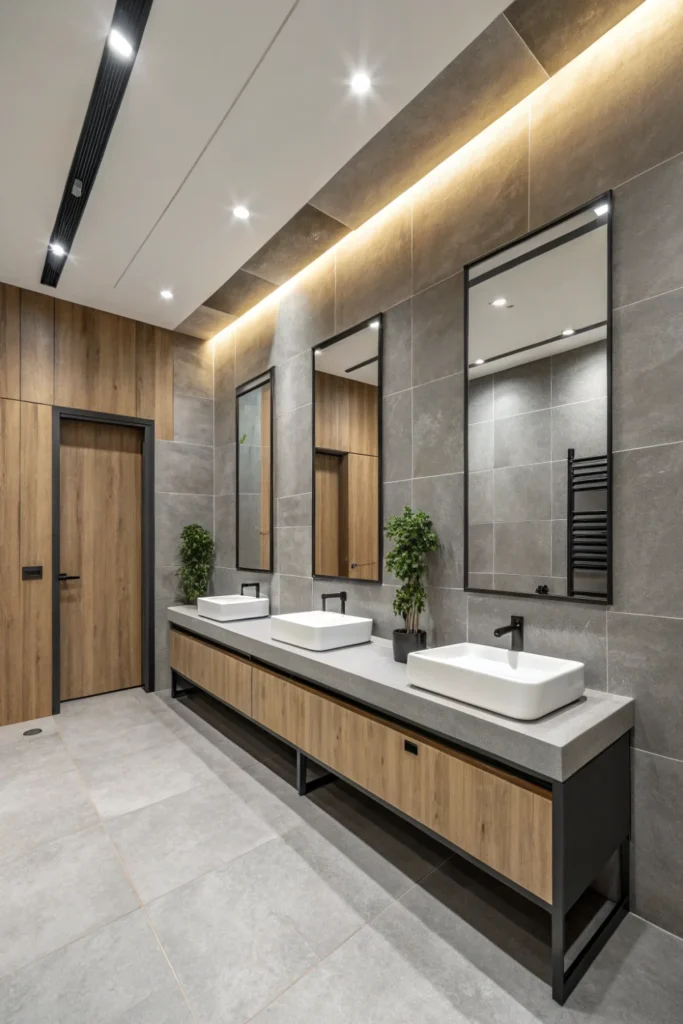
Large-format porcelain tiles — 60x60cm or larger — applied from floor to ceiling in a single consistent material is one of the most specification-forward office washroom design decisions available, creating a surface that is simultaneously premium in appearance, hygienic, easy to clean, highly durable, and visually expansive in a space where all four qualities are non-negotiable commercial requirements.
In an office washroom, the grout-line-minimising quality of large-format tiles is a practical hygiene advantage as much as an aesthetic one — fewer grout lines mean fewer places for moisture, bacteria, and discolouration to accumulate, significantly reducing deep-cleaning frequency and long-term maintenance costs relative to smaller-format tile installations.
Choose a porcelain tile with a slight texture or a matte-satin finish rather than high-gloss for an office washroom floor — polished porcelain becomes extremely slippery when wet and creates a significant slip hazard in a commercial facility, while a textured or satin finish meets commercial slip-resistance standards while still delivering the premium aesthetic of a large-format porcelain specification.
2 Sensor-Activated Fixtures for Hygiene and Efficiency
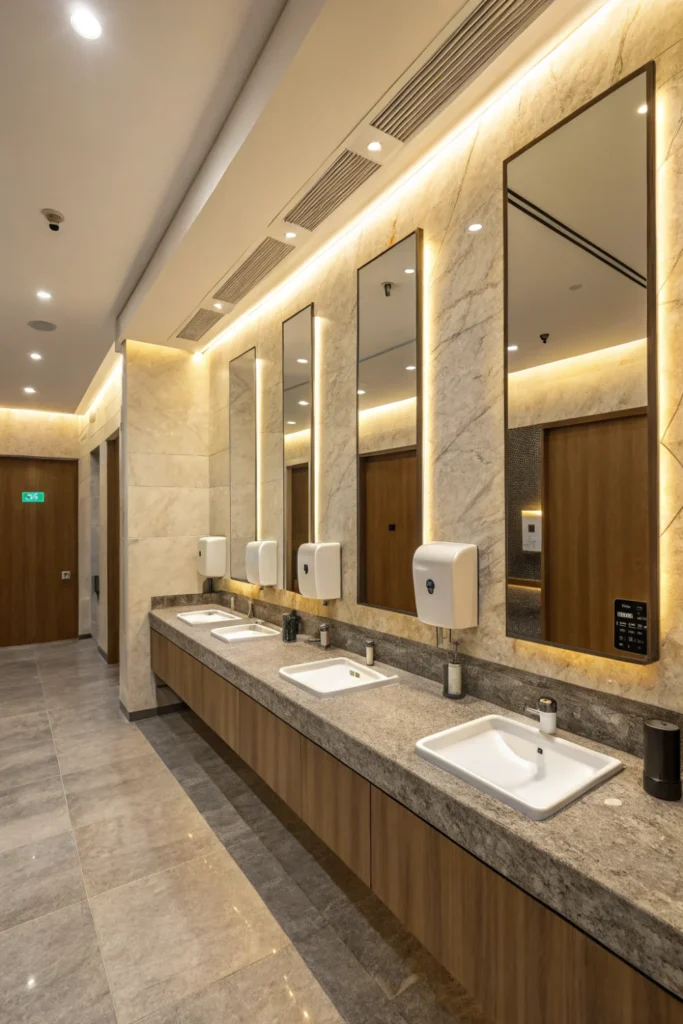
Sensor-activated taps, soap dispensers, hand dryers, and flush systems are the hygiene and sustainability specification standard for any contemporary office washroom — eliminating touch-point contamination, reducing water waste through automatic shut-off, and removing the maintenance burden of manual pump dispensers that run out, jam, and need constant restocking.
Beyond their functional advantages, sensor fixtures communicate a commitment to user hygiene and operational sophistication that manual alternatives cannot — in a client-facing office washroom, sensor-activated fittings are one of the most direct environmental signals of an organisation’s attention to quality and detail that any visitor will register.
Specify sensor taps with an adjustable flow timer of 6–10 seconds rather than the standard 4 seconds — the additional time allows adequate hand rinsing without activating multiple cycles, reducing the frustration of insufficient flow time that users of poorly specified sensor taps consistently report and that creates a negative impression of the facility regardless of its visual quality.
3 Backlit Mirror Wall for Flattering Task Lighting
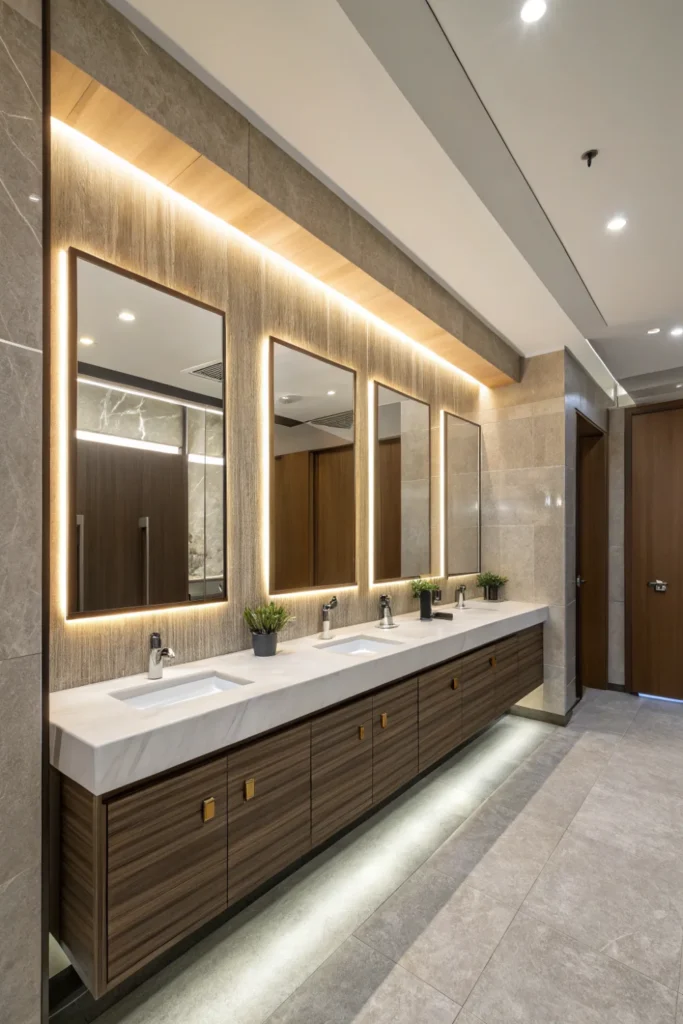
A full-width backlit mirror or a row of individually backlit mirrors above the vanity basins is one of the most functionally impactful office washroom lighting upgrades available — the warm, diffused light radiating from the mirror’s perimeter eliminates the harsh downward shadows that overhead-only lighting creates, producing the flattering, even facial illumination that users genuinely appreciate during grooming and that directly affects how confident people feel when returning to client meetings.
In a commercial office washroom context, backlit mirrors also serve an ambient lighting function — the warm glow from the mirror wall softens the cold overhead lighting that dominates most commercial facilities, creating a more hospitality-inspired atmosphere that communicates quality and care at the moment of first impression.
Specify LED backlit mirrors with a colour temperature of 3000–3500K (warm white) rather than the cooler 4000–5000K range common in commercial fittings — warm white mirrors provide flattering facial illumination that makes users feel confident and well-presented, while cool white mirrors create the unflattering pallor that makes a functional office washroom feel more clinical than comfortable.
4 Integrated Vanity Countertop with Multiple Basins
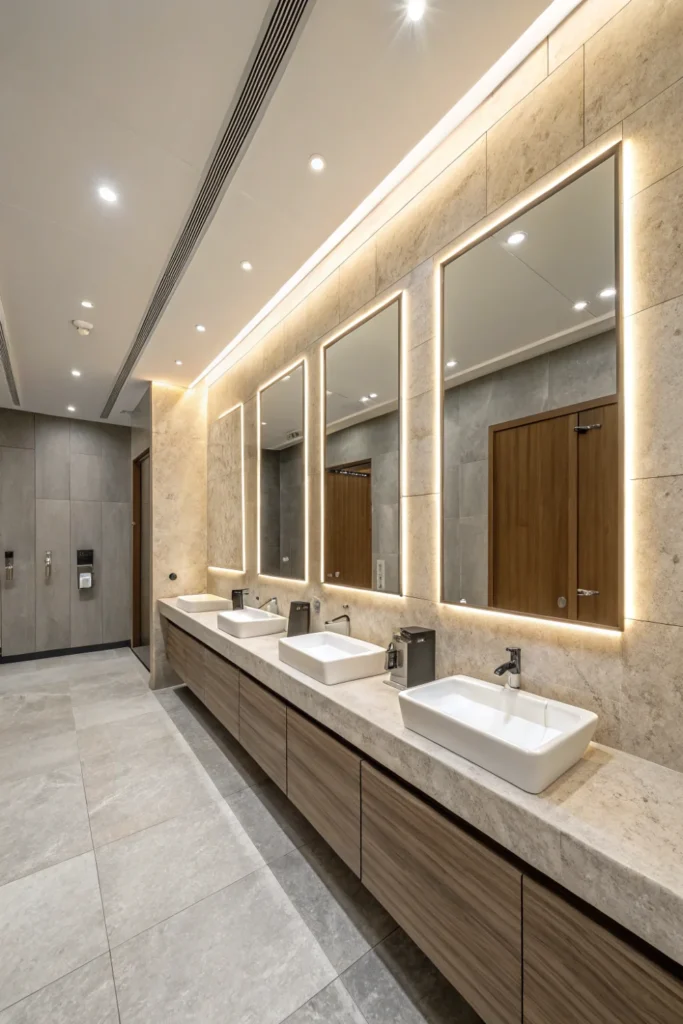
An integrated vanity countertop — a single continuous slab of stone, Corian, or quality composite running the full length of the washroom wall with multiple basins moulded or undermounted into it — is one of the most visually impressive and practically superior office washroom specifications, creating a seamless, jointless surface that is far easier to clean and maintain than individual basin units while communicating a level of design investment that immediately distinguishes the facility.
The absence of seams between basins and counter in a fully integrated specification eliminates the primary accumulation point for water, soap, and contamination in most standard office washroom installations — a practical advantage that compounds over the facility’s lifespan into significant reductions in deep-cleaning labour and long-term surface maintenance costs.
Specify the integrated vanity countertop material in a light, warm neutral — warm white Corian, light sandstone composite, or pale grey quartz — rather than very dark stone, which shows water marks continuously in a commercial washroom environment and requires frequent wiping to maintain its appearance between cleaning cycles.
5 Feature Wall in a Brand Colour or Premium Material
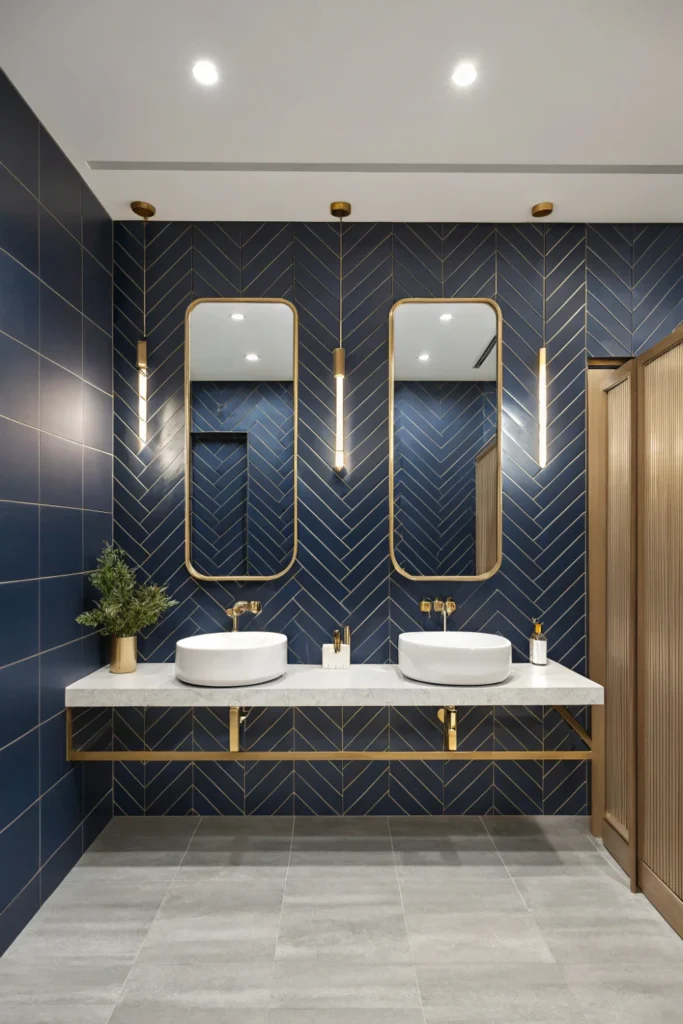
Introducing a feature wall in the organisation’s brand colour or a premium material — a deep navy, charcoal, forest green, or terracotta tile wall; a panel of fluted timber; a stone-cladded accent wall; or even a subtle branded graphic element — transforms an office washroom from a generic utility facility into a branded, designed space that actively communicates the organisation’s identity and aesthetic values.
In a client-facing office washroom particularly, this single design decision has an outsized impact on brand perception — a washroom where the design language clearly connects to the company’s identity communicates design intelligence and consistency of standard that clients register and remember, often more vividly than details of the meeting room they left to use the facility.
Use the brand colour in a muted, material version rather than the vivid digital version for an office washroom feature wall — a deep navy tile reads as sophisticated and premium; a digitally vivid Pantone navy applied directly to the wall can read as flat and graphic. The material translation of a brand colour into tile, stone, or quality paint always produces a more premium result than its direct digital application.
6 Commercial-Grade Hand Dryers Integrated into the Design
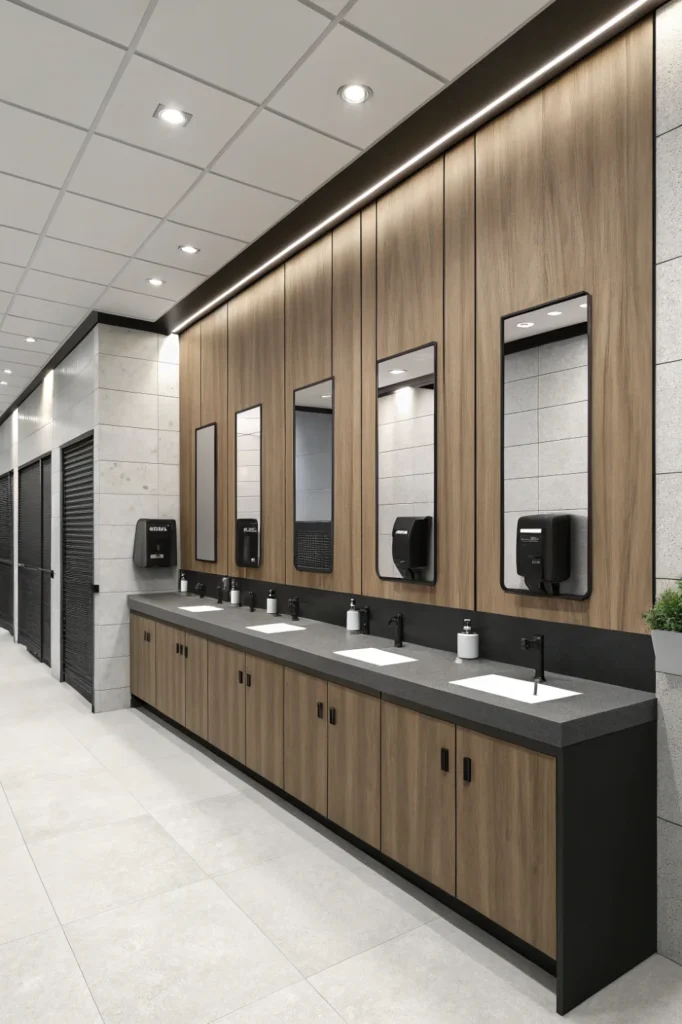
High-speed, low-noise commercial hand dryers — recessed into the wall, surface-mounted in a colour-matched finish, or integrated into the vanity counter — are one of the most practically significant and least glamorous office washroom specification decisions, with enormous cumulative impact on user experience through their noise level, drying speed, hygiene, and visual integration with the facility’s overall design.
In a premium office washroom, hand dryer selection and placement deserves as much design attention as fixture and tile selection — a high-speed, recessed, matte-black hand dryer at counter height reads as part of the vanity design; a surface-mounted beige plastic commercial dryer on a tile wall communicates a mismatch between design aspiration and operational specification that undermines the facility’s overall impression.
Specify hand dryers in the same finish as all other hardware in the office washroom — if the tapware and accessories are matte black, specify matte black dryers; if they are brushed steel, specify brushed steel. The finish match between dryers and tapware is one of the most consistently overlooked office washroom details and one of the easiest to get right with a single specification decision.
7 Scent Strategy — Diffusers and Fresh Air Ventilation
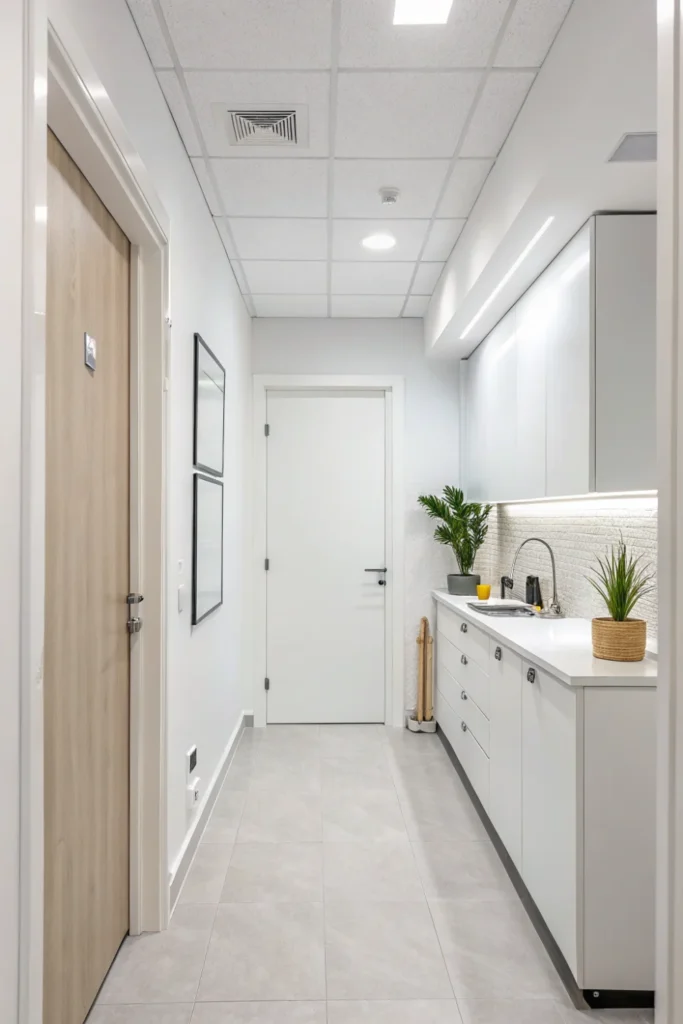
An office washroom scent strategy — combining a properly sized mechanical ventilation system with a subtle, professional-grade reed diffuser or automatic scent diffuser at the entry — is one of the most powerful and most consistently undervalued components of a premium commercial facility, because the olfactory impression of an office washroom shapes the user’s perception of the entire organisation’s standards before any visual detail is consciously registered.
The best office washroom scents are clean, subtle, and professional — white tea, light cedar, fresh cotton, eucalyptus, or a proprietary commercial fragrance rather than the aggressively floral or synthetic scents of standard commercial fresheners. The fragrance should be detectable but not identifiable — a general impression of freshness rather than an obvious scent product.
Invest in mechanical ventilation that exceeds the building code minimum air changes per hour for an office washroom — adequate extraction is the foundation on which all scent strategy is built, and a diffuser in a poorly ventilated space simply masks rather than eliminates odour, which users will detect and which undermines the facility’s quality impression regardless of the fragrance quality.
8 Accessible Design Integrated Seamlessly Into the Aesthetic
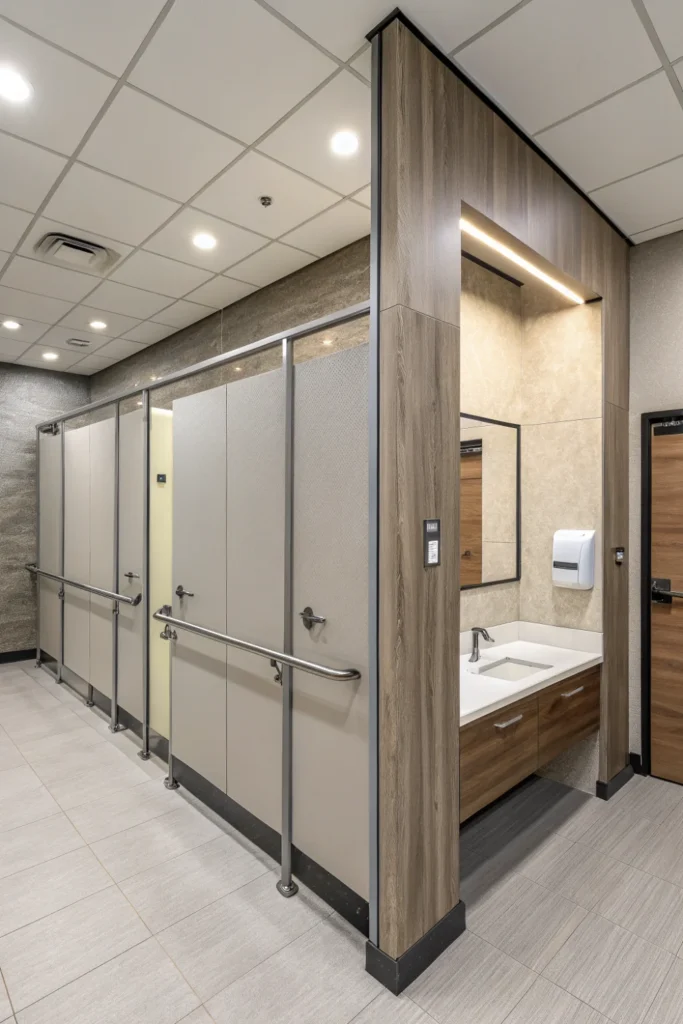
Fully accessible office washroom design — compliant grab rails, a wheelchair-accessible cubicle, lever taps, a lower section of the vanity counter, and adequate turning radius — is both a legal requirement in most commercial jurisdictions and, when properly designed, an opportunity to demonstrate the organisation’s commitment to inclusive design through a facility that serves every user equally well without the accessible elements reading as afterthoughts or clinical additions to an otherwise standard design.
The highest standard of accessible office washroom design integrates compliance elements so naturally into the overall design that they are invisible as accessibility features — grab rails in the same finish as all other hardware, an accessible cubicle with the same quality fixtures as all others, and a counter height variation that reads as a deliberate design feature rather than a mandatory concession.
Specify grab rails in brushed stainless steel or the hardware finish matching the rest of the office washroom rather than in the institutional white or silver of standard accessibility products — the finish match is all that distinguishes an accessible office washroom that looks designed from one that looks retrofitted, and the cost difference between standard and colour-matched grab rails is negligible at specification stage.
9 Smart Toilet Cubicles with Privacy Lighting Indicators
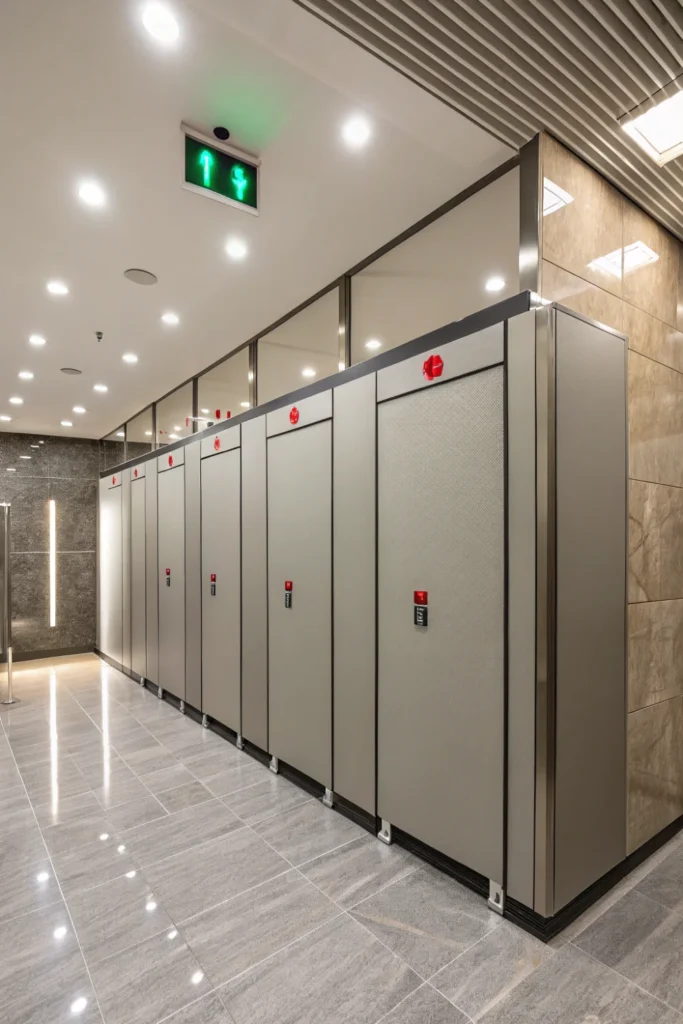
Cubicle partitions with occupancy indicator lighting — a red/green LED indicator visible above each cubicle door or integrated into the door frame — eliminate the awkward and unhygienic practice of pushing on closed cubicle doors to check occupancy, replacing it with a clear, at-a-glance status system that improves the user experience of the office washroom immediately and significantly.
Premium office washroom cubicle systems with floor-to-ceiling partition panels, minimal visible hardware, and high-quality door mechanisms communicate a standard of privacy and personal dignity that standard commercial partitions with visible gaps and flimsy latches do not. In a high-end office context, the cubicle standard directly affects the user’s sense of whether the employer values their comfort and privacy.
Specify cubicle partitions that extend to within 20cm of the floor rather than the standard 30–40cm gap — the shorter gap provides significantly better visual and acoustic privacy without reducing the practical benefits of the gap for ventilation and emergency access, and users consistently rate office washrooms with near-floor partitions as more private and more premium feeling.
10 Plants and Biophilic Elements for Wellbeing
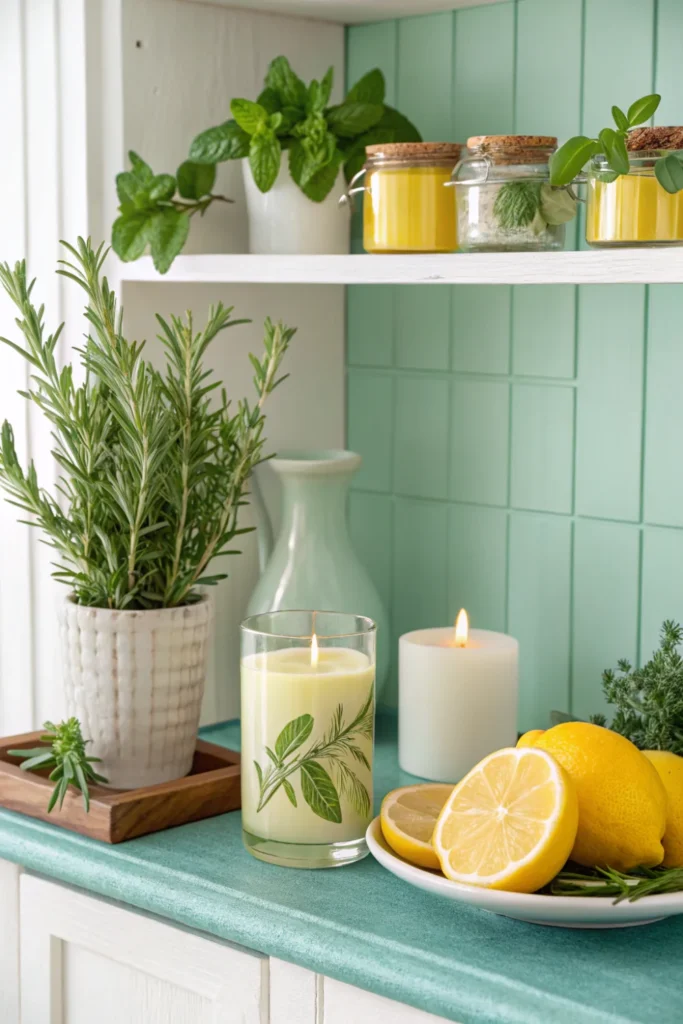
A well-chosen indoor plant or vertical green wall element in an office washroom introduces a quality of living, organic presence that is extraordinarily rare in commercial facilities and immediately makes the space feel more welcoming, human-scaled, and wellbeing-focused — a direct communication of the organisation’s care for the people who use the space daily.
In an office washroom with good natural light or a skylight, a single large architectural plant — a cast iron plant, a ZZ plant, or a snake plant — in a quality ceramic or stone pot creates a focal point of natural beauty that transforms the room’s character completely while requiring minimal maintenance. Without natural light, a high-quality artificial plant in an architectural specimen form achieves most of the same visual benefit without the horticultural challenge.
If natural light is unavailable in the office washroom, install a full-spectrum LED grow light above the plant position specced to look like a design accent light rather than a grow lamp — the plant thrives, the light adds an ambient warm source, and the whole arrangement reads as a designed wellbeing feature rather than a maintenance compromise.
11 Premium Consumables and Dispensers as Brand Touchpoints
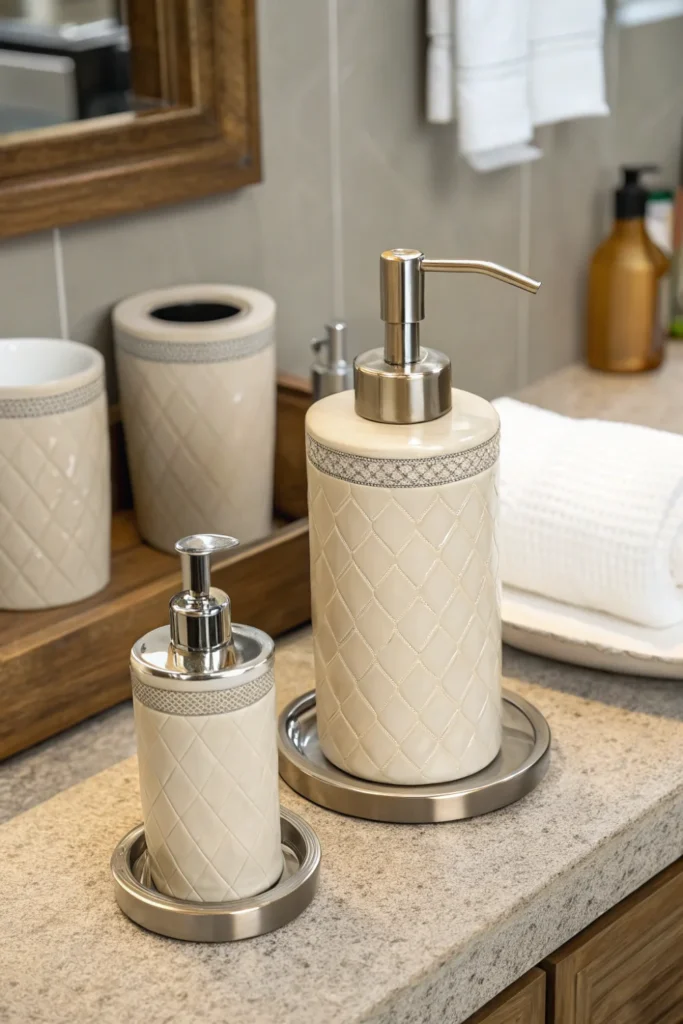
The quality of consumables in an office washroom — the softness of the hand towels or the quality of the paper towel stock, the fragrance and feel of the soap, the presence of hand lotion alongside the hand soap — is one of the most directly felt and most commonly discussed aspects of commercial washroom quality among both employees and visitors, representing a daily brand touchpoint that operates entirely through tactile and olfactory senses.
Premium consumable dispensers — a stainless steel or ceramic soap dispenser rather than a plastic one, a quality paper towel holder with a clean dispensing mechanism rather than a wall-hung plastic box — communicate the same care with the mundane that quality finishes communicate with the permanent, and together they create the impression of a facility where every detail has been considered.
Specify a hand lotion dispenser alongside the soap dispenser in client-facing office washrooms — the provision of hand lotion is one of the most unexpected and genuinely appreciated touches in a commercial facility, read immediately as a gesture of hospitality rather than mere compliance with hygiene standards, and at a consumable cost that is entirely negligible relative to the impression it creates.
12 Acoustic Privacy Through Design and Specification
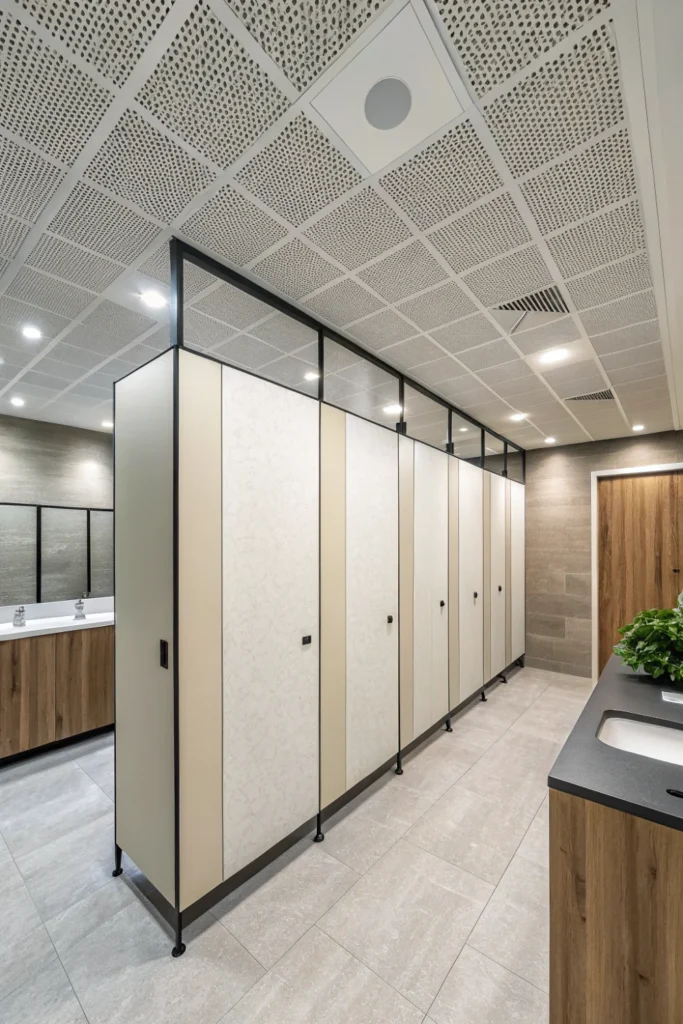
Acoustic privacy in an office washroom — achieved through sound-absorbing ceiling panels, adequate partition height, properly specified door seals, and the strategic placement of a background music or white noise system — addresses one of the most consistently reported sources of discomfort and inhibition in commercial facilities, creating an environment where users feel genuinely private rather than acoustically exposed to colleagues in an adjacent space.
The acoustic quality of an office washroom is inseparable from its psychological quality — a facility where every sound carries through partitions and under doors communicates a lack of consideration for personal privacy that undermines the organisation’s stated values around employee wellbeing regardless of the visual quality of the tile and fixture specification.
Install a low-volume background music system or a pink noise generator in the office washroom rather than relying on ambient building noise for acoustic masking — a consistent low-level audio background improves the perceived privacy of the space dramatically without being consciously audible as music or noise, and it is the single most cost-effective acoustic intervention available in an existing commercial washroom.
13 Waste Management and Sustainability Signage
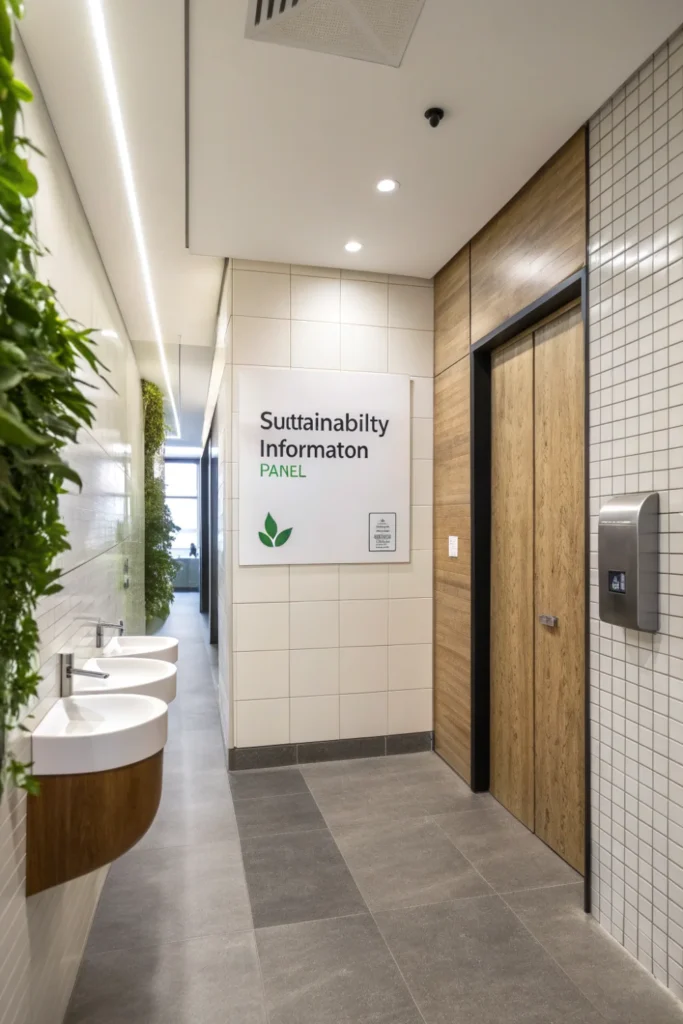
Clearly designed waste management and sustainability messaging in an office washroom — attractive, professionally designed signage explaining recycling provisions, water conservation features, and the building’s environmental credentials — turns a utility space into a communication channel for the organisation’s values while practically improving user behaviour and reducing the environmental footprint of the facility.
In a contemporary office where employees and clients are increasingly values-conscious, a well-designed sustainability narrative in the office washroom communicates the organisation’s commitment to environmental responsibility through a medium — a space every building user visits multiple times daily — that is inherently more credible than a corporate website or reception display.
Commission professionally designed sustainability signage in the office washroom rather than using generic printed sheets or standard commercial signs — the design quality of the signage communicates the same care and professionalism as the design quality of the facility itself, and a poorly designed sign on a well-designed wall creates a contradiction that undermines the entire visual investment in the space.
Why Office Washroom Ideas Are Worth the Investment
Investing in a well-designed office washroom delivers returns that far exceed the cost across three distinct dimensions: employee wellbeing and productivity, client and visitor impression, and long-term operational efficiency. Each dimension justifies the investment independently; together they make a compelling commercial case for treating the office washroom as a strategic priority rather than a compliance requirement.
Research in workplace design consistently shows that the quality of welfare facilities — including the office washroom — directly affects employees’ perception of their employer’s care and respect for them, with measurable impacts on retention, engagement, and the likelihood of recommending the organisation as an employer. The washroom is often cited in employee satisfaction surveys as one of the facilities most directly associated with perceived workplace quality.
From an operational perspective, a well-specified office washroom — with sensor fixtures that reduce water waste, large-format tiles that reduce cleaning time, and integrated consumable dispensers that reduce restocking frequency — achieves lower total cost of ownership over its lifespan than a poorly specified facility, making the upfront design investment recoverable through operational savings within five to eight years of operation.
Things to Consider Before Choosing Office Washroom Ideas
Before specifying any office washroom design direction, establish the facility’s primary user profile — a client-facing washroom in a professional services firm has very different design priorities from an employee-only welfare facility in a manufacturing plant, and confusing these profiles leads to either under-specified client facilities or over-specified operational ones that waste budget without producing commensurate impression value.
Consider the cleaning and maintenance regime that will actually be applied to the office washroom before specifying premium finishes — a polished stone counter in a facility that is cleaned with standard commercial cleaning products will be damaged by acid and abrasives within months, while the same counter in a facility with properly trained cleaning staff and specified-compatible products will remain beautiful for decades. Specify finishes relative to the real maintenance capability, not the ideal one.
Always plan compliance and accessibility requirements first before any aesthetic decisions in an office washroom specification — building regulations, disability access requirements, fire egress, and ventilation standards are non-negotiable parameters that define the available design space, and discovering compliance constraints after aesthetic decisions have been made and materials specified leads to costly redesigns and compromised outcomes. A compliance-first specification order protects the entire office washroom budget.
Comparison Table of Office Washroom Ideas
| Office Washroom Idea | Cost Range | Impact Level | Maintenance Benefit | Best Application | ROI Timeline |
|---|---|---|---|---|---|
| Full-Height Porcelain Tile | $3,000–$20,000 | Very High | High | All offices | 5–10 years |
| Sensor-Activated Fixtures | $1,500–$8,000 | Very High | Very High | All offices | 3–5 years |
| Backlit Mirror Wall | $800–$5,000 | High | Low | Client-facing | Immediate |
| Integrated Vanity Countertop | $2,000–$12,000 | Very High | High | Premium offices | 5–8 years |
| Brand Feature Wall | $1,000–$8,000 | Very High | Low | Client-facing | Immediate |
| Commercial Hand Dryers | $400–$2,500 | High | Very High | All offices | 2–4 years |
| Scent Strategy | $100–$1,000/year | High | Medium | All offices | Immediate |
| Accessible Design Integration | $2,000–$10,000 | Very High | Medium | All offices | Legal compliance |
| Occupancy Indicator Lighting | $500–$3,000 | Medium–High | Low | High-use offices | 2–3 years |
| Plants and Biophilic Elements | $200–$3,000 | High | Low | Premium offices | Immediate |
| Premium Consumables | $50–$200/month | High | Medium | Client-facing | Immediate |
| Acoustic Privacy Design | $500–$5,000 | High | Low | All offices | 2–5 years |
| Sustainability Signage | $200–$1,500 | Medium | Very Low | ESG-focused orgs | Immediate |
Frequently Asked Questions About Office Washroom Ideas
What is the most important investment in an office washroom design?
The single most important investment in an office washroom is the tile specification — it covers more surface area than any other material in the room and its quality, format, and condition determines more of the facility’s perceived standard than any fixture or accessory decision. A premium large-format tile with good lighting communicates quality even with standard fixtures; the same standard tiles with expensive fixtures still read as a mid-range facility because the dominant surface material sets the room’s fundamental quality baseline.
The second most important investment is the lighting specification — the quality and warmth of office washroom lighting affects both the users’ personal experience (how they look and feel in the mirror) and the facility’s overall atmosphere. The combination of premium tile and warm, flattering lighting is the minimum viable specification for an office washroom that makes a genuinely positive impression on employees and clients alike.
How do I make a small office washroom feel larger?
The most effective design strategies for making a small office washroom feel larger are: using large-format tiles on floors and walls without a contrasting border (which removes the horizontal lines that segment the space); installing a full-width mirror or backlit mirror wall above the vanity (which visually doubles the depth of the room); specifying wall-hung toilets and floating vanities that expose the maximum floor area; and using a single consistent light colour throughout walls, floor, and ceiling to dissolve the room’s visible boundaries.
Sensor taps with a wall-mounted rather than deck-mounted specification allow the vanity countertop to be narrower — a narrower counter run preserves more floor width in a small office washroom while the wall-mount tap placement reads as a premium design choice rather than a space-saving compromise, achieving both functional and aesthetic goals simultaneously.
What hardware finish works best in an office washroom?
Brushed stainless steel and matte black are the most commercially durable and practically appropriate hardware finishes for an office washroom — brushed stainless resists fingerprints and water marks better than polished chrome in a high-use environment and maintains its appearance between cleaning cycles with minimal daily wiping, while matte black conceals water spots almost entirely, making it ideal for offices where cleaning frequency does not permit constant buffing of highly polished surfaces.
Brushed brass and warm gold are appropriate in client-facing premium office washrooms where the aesthetic aspiration is hospitality-level rather than standard commercial, but require more frequent maintenance than matte or brushed alternatives to maintain their appearance — the warm oxidation that develops on unlacquered brass in a humid commercial environment needs regular polishing or a lacquered alternative is required, with the understanding that lacquered brass will eventually show wear at high-touch points.
How often should an office washroom be redesigned or refurbished?
A well-specified office washroom with quality tile, durable fixtures, and quality hardware should not require full redesign for fifteen to twenty years — the primary trigger for full refurbishment is typically lease renewal, significant headcount change, or a brand repositioning that makes the existing aesthetic misaligned with the organisation’s current identity rather than material deterioration of a quality installation.
Partial refreshes of an office washroom — updating consumable dispensers, replacing worn accessories, repainting any painted surfaces, and upgrading sensor fixtures to newer technology — typically extend the perceived freshness and quality of a facility by five to eight years at a fraction of full refurbishment cost, and should be considered at the five-to-seven-year point in the facility’s life cycle before full replacement becomes necessary.