
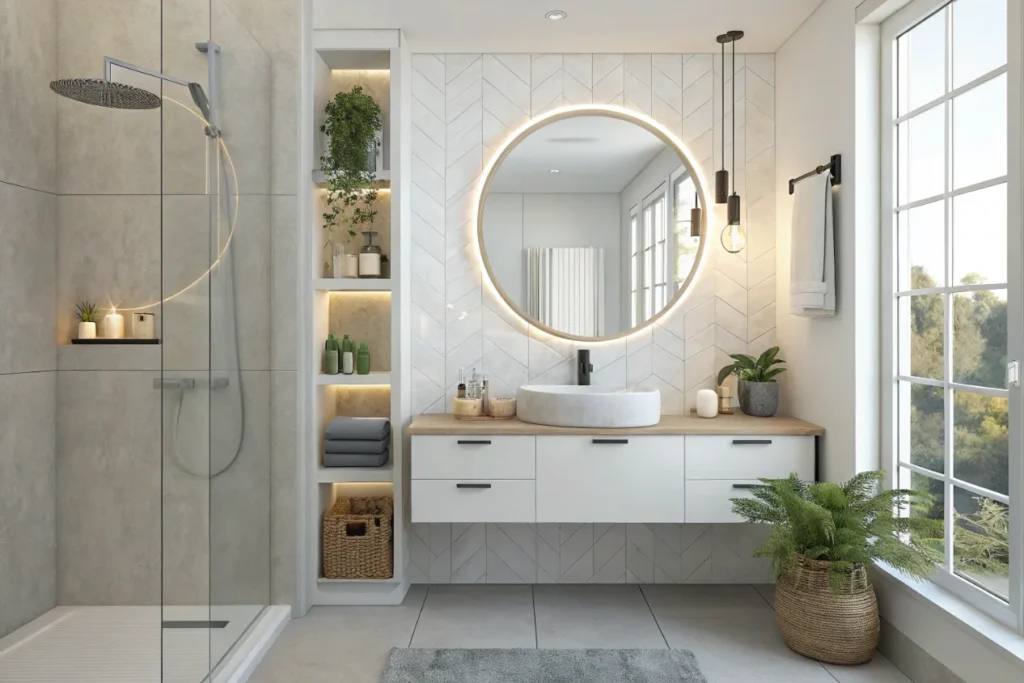
A small aesthetic washroom design proves that limited square footage is never a barrier to a genuinely beautiful bathroom — in fact, the constraint of a compact space often pushes the design to be more intentional, more committed, and ultimately more striking than a larger room with room to spare.
The secret to a small bathroom that looks and feels exceptional is the same regardless of style: every decision must work harder. The tile, the fixture, the mirror, the light — each element needs to contribute to both the function and the aesthetic simultaneously, with no room for the decorative dead weight that larger bathrooms can absorb without noticing.
Whether you are working with a tiny en-suite, a compact powder room, or a narrow guest bathroom, these small aesthetic washroom design ideas will help you transform even the most modest footprint into a space that feels polished, personal, and far more spacious than its dimensions suggest.
List of 10 Best Small Aesthetic Washroom Design Ideas
1 Floor-to-Ceiling Tile in One Continuous Colour
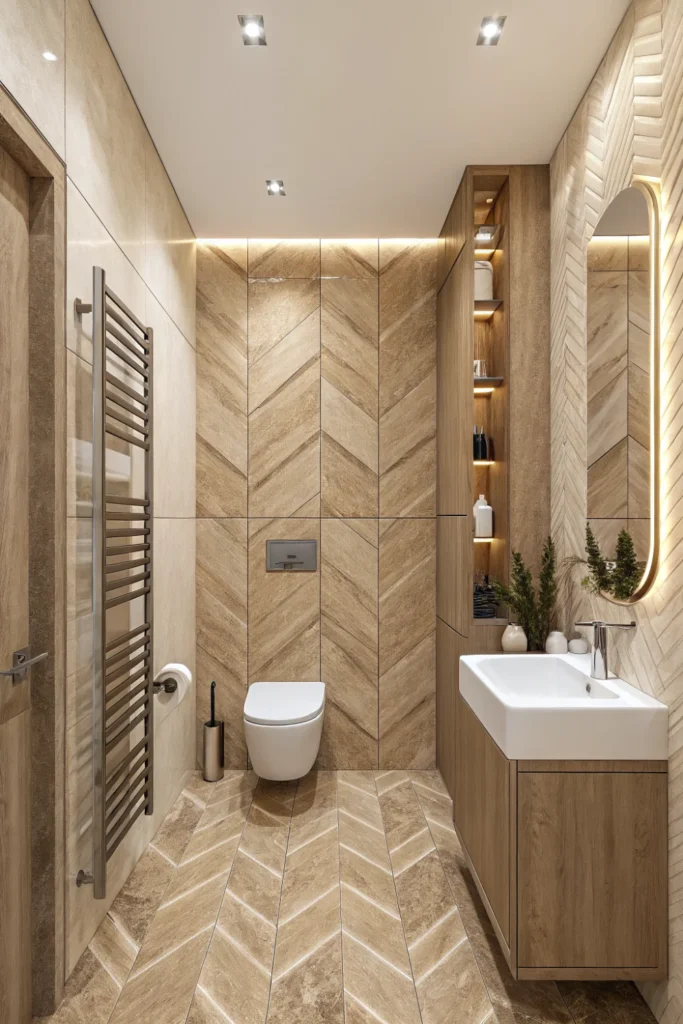
Tiling a small washroom from floor to ceiling in a single continuous colour and material — with no contrasting border, no dado rail divide, and no change of tone between surfaces — is the single most powerful visual trick for making a compact bathroom feel significantly larger, because it eliminates the horizontal lines that segment the room into zones and allows the eye to travel uninterrupted from floor to ceiling.
This tonal monochrome approach to small aesthetic washroom design also produces a polished, designed quality that far exceeds the complexity of its execution — a bathroom where wall and floor tile match is immediately assumed to be more expensive and more considered than one with obvious divisions between surfaces.
Use the same tile on floor and walls but lay them in different orientations — horizontal brick bond on the walls and a herringbone or diagonal pattern on the floor. The shared material unifies the room while the pattern variation adds visual interest and clearly delineates floor from wall without introducing a contrasting colour or border.
2 Jewel-Box Powder Room with Bold Wallpaper
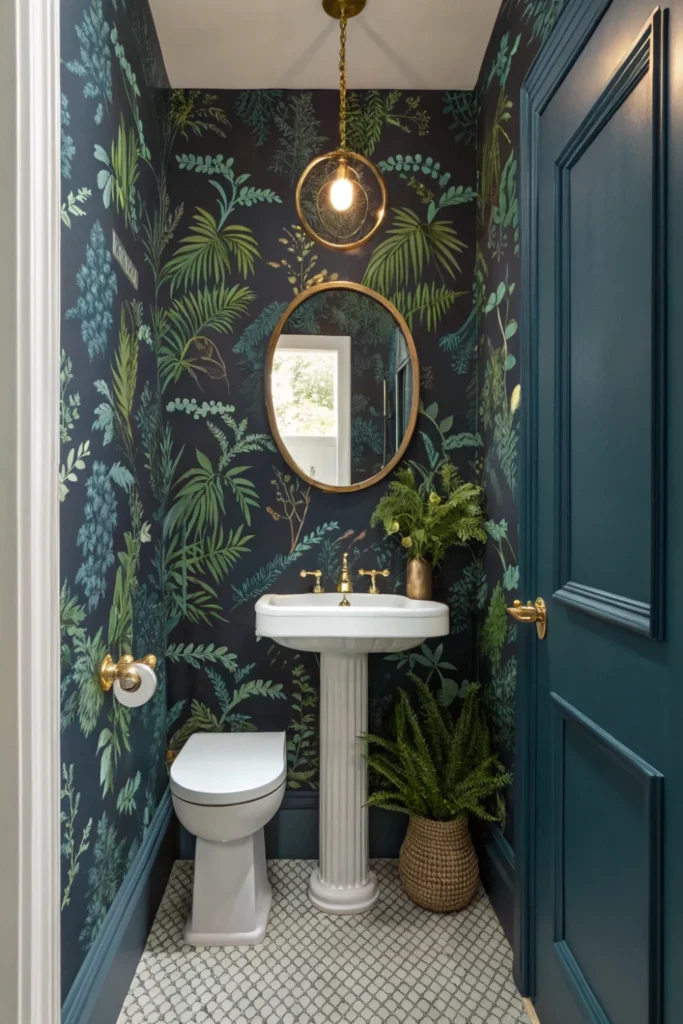
A small powder room or cloakroom is the ideal canvas for a jewel-box aesthetic washroom design — the compact scale that would make a maximalist pattern overwhelming in a larger room becomes precisely what makes it immersive and magical in a tiny one, wrapping the visitor in a fully realised decorative world within just a few square feet.
Floor-to-ceiling botanical, tropical, or geometric wallpaper in a deeply saturated palette, combined with a sculptural wall-mounted basin and a single statement mirror, creates one of the most impactful small washroom design results possible for the investment involved — a room that genuinely stops people in their tracks.
Apply wallpaper on all four walls including the ceiling in a small washroom — the “fifth wall” ceiling treatment completes the immersive jewel-box effect and prevents the pattern from feeling arbitrarily cropped at the cornice line, which is the most common reason beautiful wallpaper in small bathrooms looks unfinished.
3 Frameless Glass Shower Screen for Visual Openness
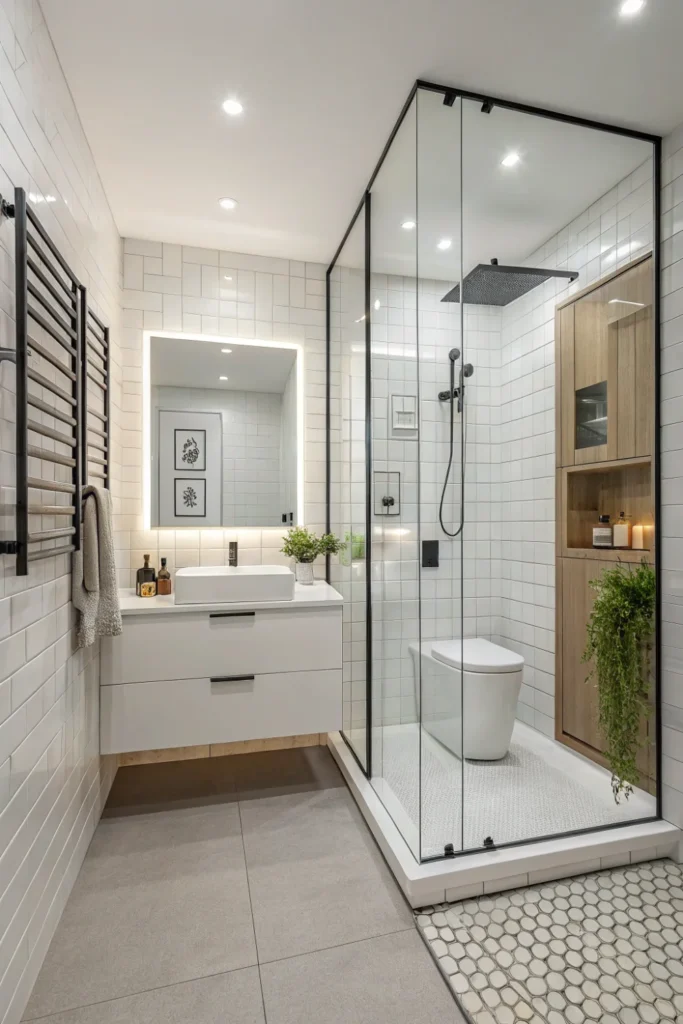
In a small aesthetic washroom design, a frameless glass shower screen or enclosure is far superior to a framed screen, a shower curtain, or a solid wall because its transparency allows the eye to travel through rather than being stopped at the boundary of the shower zone — making the entire room feel like a single open space rather than two separate compartments.
The difference between a framed and frameless screen in a small bathroom is not subtle — the elimination of the aluminium or chrome frame around the perimeter of the glass removes a strong, continuous visual line that would otherwise assert a hard boundary in the room’s smallest and most spatially critical dimension.
Specify a frameless glass shower screen with a walk-in rather than a door where space allows — removing the door hinge mechanism and the arc of the door swing frees both physical and visual space, and a walk-in entry gives the small washroom design a genuinely high-end, spa-like quality.
4 Floating Vanity to Open Up the Floor
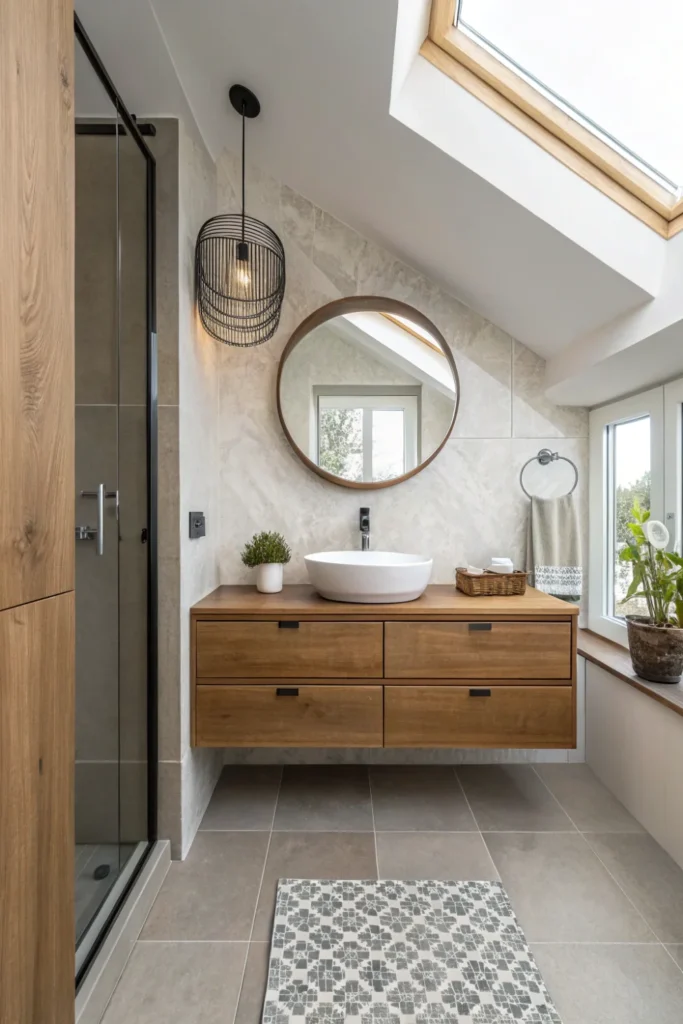
A wall-mounted floating vanity — suspended above the floor with no legs or base cabinet touching the ground — is one of the most transformative small aesthetic washroom design upgrades available, because the visible floor beneath the vanity creates a sense of spatial continuity that makes the room feel wider and less congested than a floor-standing unit of identical size.
The psychological effect of an uninterrupted floor running beneath the vanity is disproportionate to the actual space freed — the eye reads the continuous floor surface as evidence of an uncrowded, designed room, which immediately elevates the perceived quality and spaciousness of the small washroom design.
Choose a floating vanity in a material that is close to the wall colour rather than contrasting strongly with it — a vanity that visually merges with its background recedes from attention, making the floor space feel even more open, while a strongly contrasting vanity colour draws the eye to the unit and emphasises its presence in the limited space.
5 Arched Mirror as an Aesthetic Focal Point
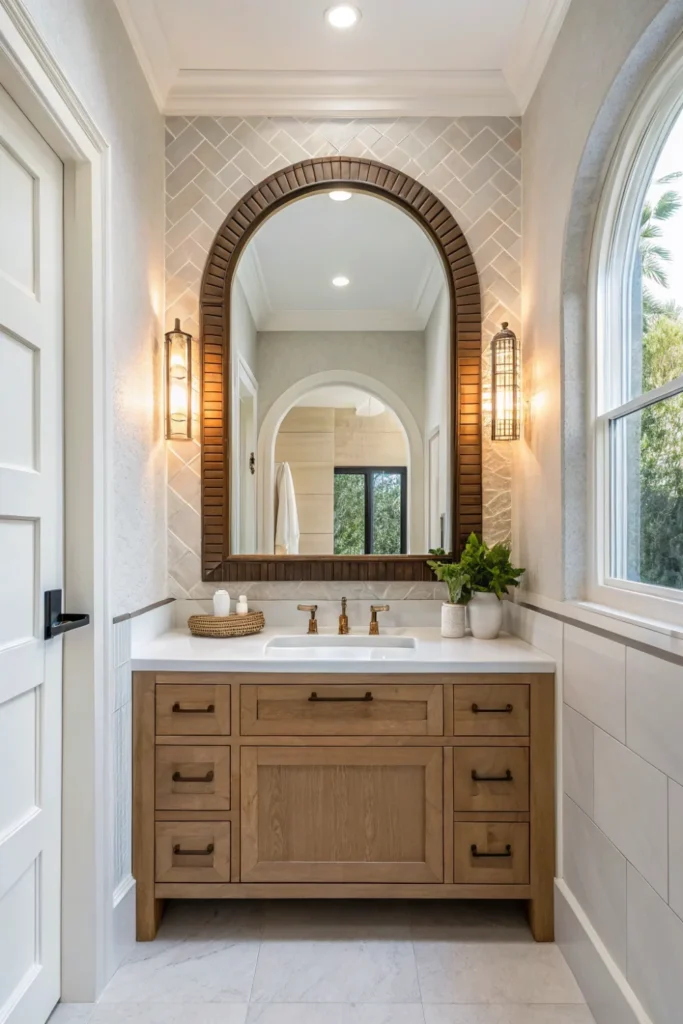
An arched or arch-top mirror is one of the most impactful single accessories in a small aesthetic washroom design — its tall, pointed form draws the eye upward and emphasises the room’s height, its organic curve softens the hard geometry of tile and cabinetry, and its reflective surface simultaneously doubles the room’s perceived depth and light.
The arched mirror has become one of the defining aesthetic signatures of contemporary bathroom design precisely because it performs all three of these functions — spatial, compositional, and decorative — simultaneously. In a small washroom, a mirror that works this hard earns its wall space several times over.
Size the arched mirror generously — at least as wide as the vanity beneath it and as tall as ceiling height allows. An undersized mirror above a vanity looks tentative in any bathroom; in a small washroom where every visual decision needs to pull maximum weight, a large mirror is the only appropriate choice.
6 Recessed Shower Niche for Built-In Storage Aesthetics
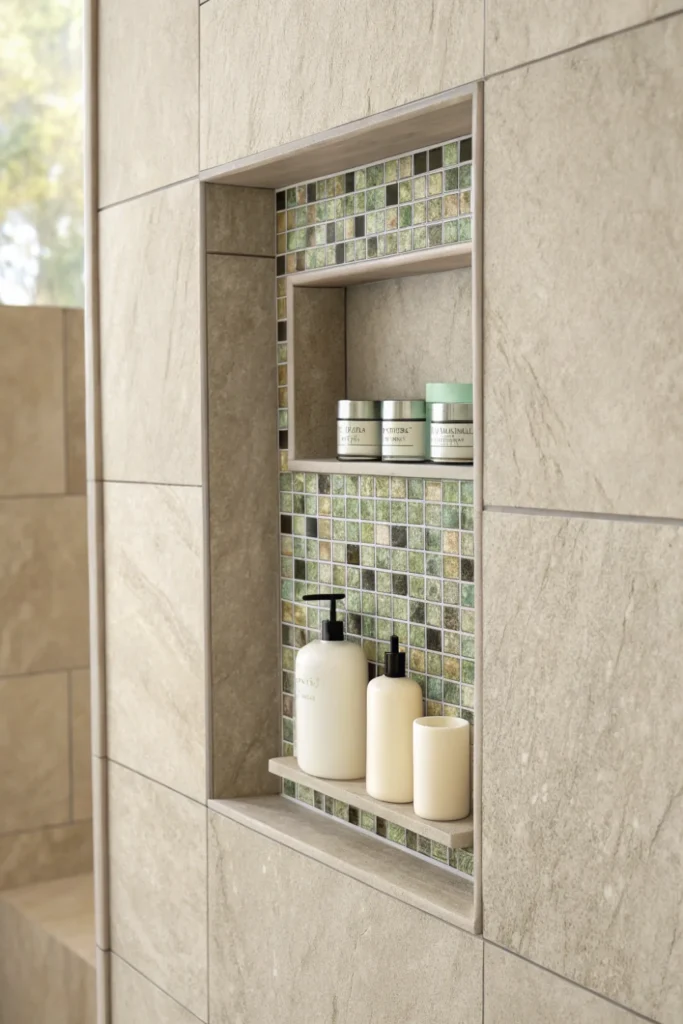
A recessed shower niche — a shelf built into the shower wall flush with the tile surface — is one of the most aesthetically rewarding and practically essential elements of a small aesthetic washroom design, providing organised shower storage without projecting into the already-limited shower space and contributing an architectural detail that elevates the overall design quality of the room.
When tiled in a complementary material or an accent tile that contrasts subtly with the surrounding wall, a shower niche becomes a deliberate design feature — a small internal frame that draws the eye and communicates the care taken with every detail of the small washroom design.
Tile the inside of the shower niche in a different material or orientation from the surrounding wall — a vertical tile stack inside a horizontally tiled niche, or a small mosaic inside a large-format tile surround, creates a detail that reads as intentional and bespoke even in the most compact of small washroom designs.
7 Warm Neutral Palette with Brushed Gold Accents
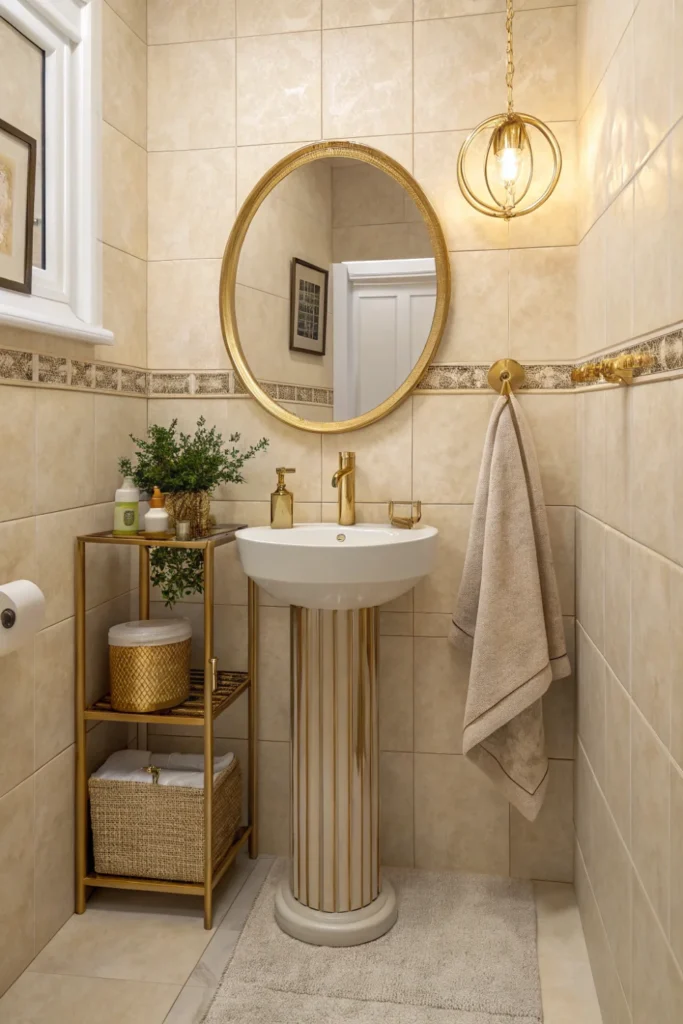
A warm neutral palette — creamy white, warm greige, pale sand, or soft terracotta — combined with brushed gold or warm brass accents in the fixtures and hardware is one of the most reliably beautiful and widely aspirational small aesthetic washroom design combinations, creating a room that feels simultaneously calm, warm, and quietly luxurious.
The warm neutral base keeps the small room feeling light and open while the brushed gold details — tap, towel ring, toilet roll holder, mirror frame — provide the visual warmth and richness that prevent the palette from reading as sterile or cold. Each individual gold element is modest; collectively they create a cohesive decorative thread that runs through the entire small washroom design.
Match all hardware finishes precisely in a small washroom design — mixing brushed gold with polished brass, matte gold, or satin brass in a compact space creates visual noise that a larger bathroom can absorb but a small one cannot. Source every hardware item — tap, towel rail, toilet roll holder, mirror frame, shower fitting — from the same finish category.
8 Penny Tile Floor with Plain Walls for Visual Balance
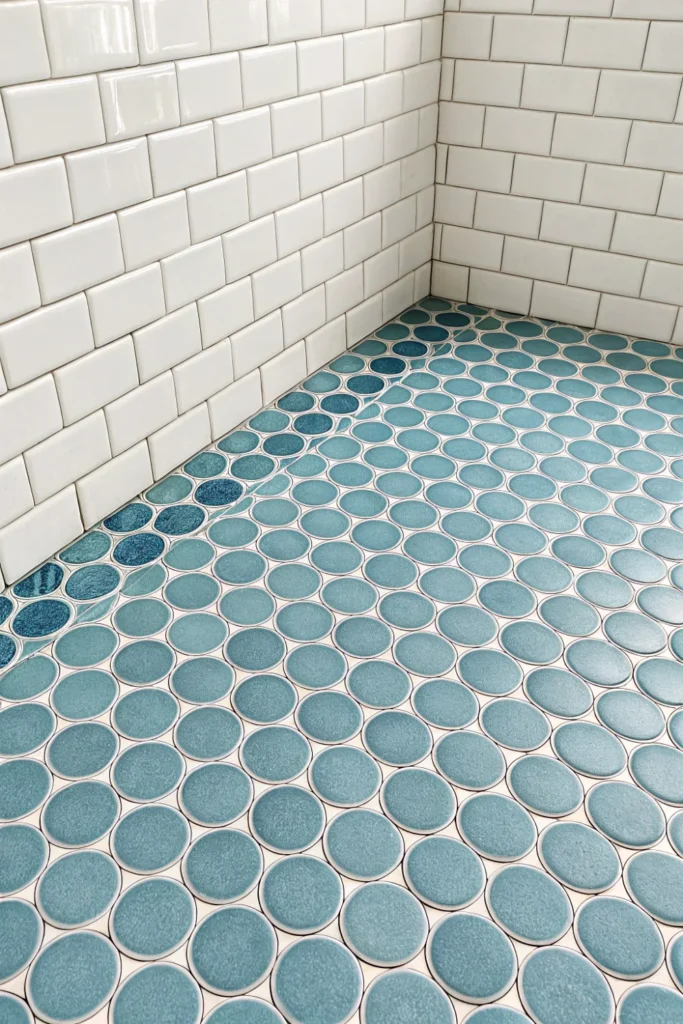
Penny round tiles on the floor paired with plain large-format tiles on the walls is a classic small aesthetic washroom design composition that has proven its staying power across decades — the decorative detail of the penny tile is contained to the horizontal surface where it creates charm and visual interest, while the plain wall tiles keep the vertical surfaces clean and uncluttered, preventing the small room from feeling busy.
The penny tile’s small format also creates an abundance of grout lines that provide natural grip underfoot — making it one of the most slip-resistant decorative floor options available for a compact shower-over-bath or wet room small washroom design.
Choose a grout colour that contrasts with the penny tiles rather than matching them — a white grout with coloured penny tiles or a dark grout with white penny tiles makes the individual penny shapes visible and creates the characteristic pattern that is the entire point of the tile. Matching grout makes penny tiles look like a solid colour from any distance.
9 Vertical Shiplap Panelling for Height and Texture
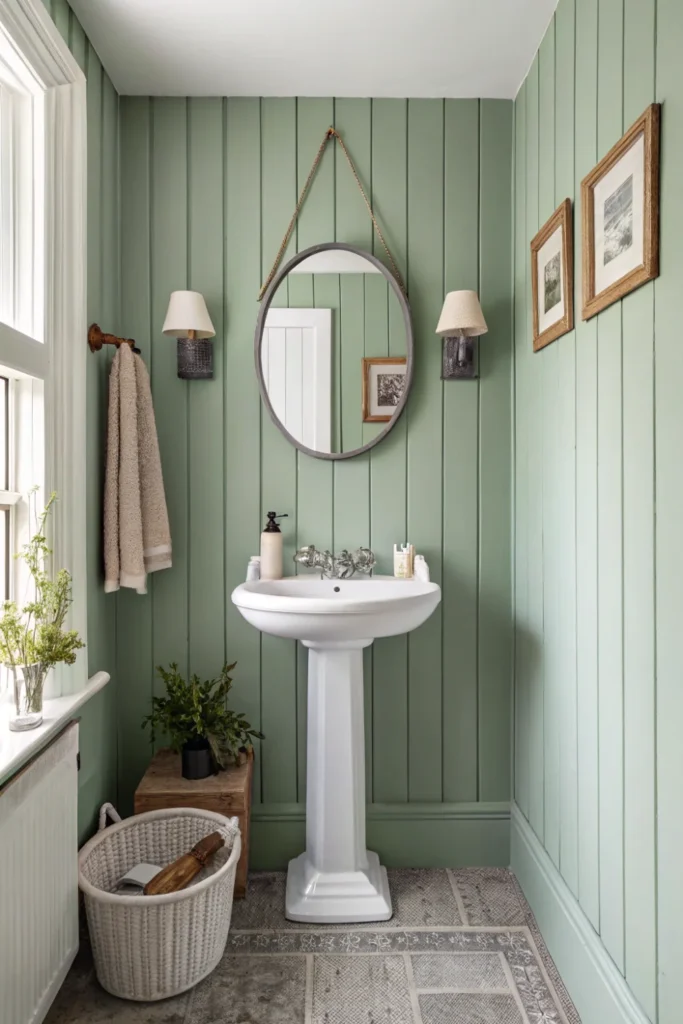
Vertical shiplap or tongue-and-groove wall panelling in a small aesthetic washroom design does something horizontal panelling cannot — its upward-running lines actively draw the eye toward the ceiling, making the room feel significantly taller than it is and creating a sense of vertical spaciousness that is particularly valuable in bathrooms with standard or low ceiling heights.
Painted in the same colour as the wall behind it for a tonal monochrome effect, or in a contrasting white against a coloured wall, vertical panelling adds architectural texture and a quality of crafted permanence to a small washroom that flat painted walls, however carefully coloured, simply cannot provide.
Install vertical panelling to half-height (dado level) rather than full height in a very small washroom — half-height panelling adds the texture and architectural interest of the technique while keeping the upper walls light and uncluttered, which is generally more space-expanding in a very compact bathroom than full-height panelling on all sides.
10 Mirrored Entire Wall to Double the Space
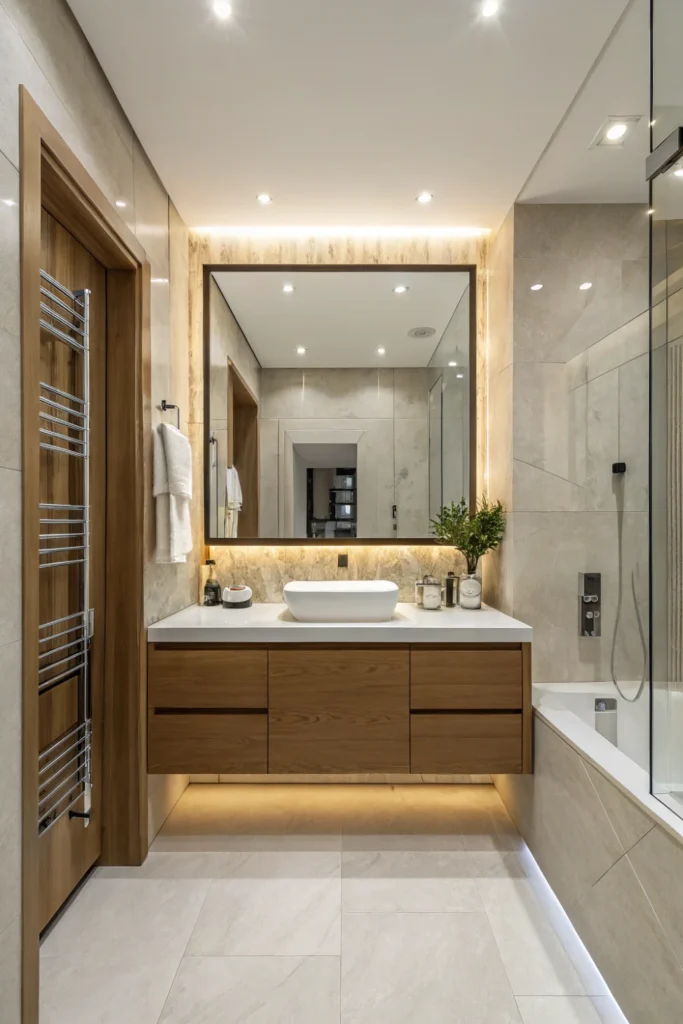
Installing a full mirror wall — a single sheet of mirror or mirror tiles covering an entire wall from floor to ceiling — is the most dramatically effective spatial illusion available to a small aesthetic washroom design, literally doubling the apparent size of the room by creating a reflected image of identical depth and dimension on the other side of the glass.
A mirrored wall positioned on the wall opposite the window captures and reflects natural light into every corner of the small washroom, simultaneously addressing both the space and brightness limitations that most compact bathrooms suffer from — two problems solved with a single surface treatment.
Use a single unjointed mirror sheet rather than individual mirror tiles if at all possible — the seams between mirror tiles create a grid of thin lines across the reflection that fractures the spatial illusion and makes the mirrored wall read as a collection of mirrors rather than a window to another space. One seamless sheet maintains the illusion completely.
Vertical 2:3 small bathroom with a full floor-to-ceiling mirror wall reflecting the entire room, the bathroom appearing twice its actual size in the reflection, floating vanity in the foreground, bright and spacious small washroom design.
Mirror Ideas for Small Bathrooms — Full Wall, Arched and Oversized
Why Small Aesthetic Washroom Design Ideas Are Worth the Investment
Investing in a thoughtfully designed small aesthetic washroom delivers a return that dramatically exceeds the room’s size — property valuers and estate agents consistently note that a well-designed small bathroom adds perceived value to a home that far outweighs the cost of the renovation, particularly when quality materials and considered design choices communicate craftsmanship rather than cost-cutting.
The daily experience of using a beautiful small aesthetic washroom design is genuinely different from using a functional but uninspired one — the care taken with tile, lighting, mirror, and material communicates itself every time the room is used, creating a quality of domestic pleasure that is disproportionate to the bathroom’s square footage.
Compact bathrooms renovated with quality materials and considered small aesthetic washroom design principles also age better than larger bathrooms fitted with budget alternatives — the tile, fixtures, and hardware of a small, well-executed bathroom are being used and cleaned in a smaller area, meaning wear is distributed across fewer surfaces and quality finishes remain beautiful for significantly longer.
Things to Consider Before Choosing Small Aesthetic Washroom Design Ideas
Before making any small aesthetic washroom design decision, measure the room with extreme precision — small bathrooms have zero tolerance for furniture or fixture sizing errors. A vanity that is 5 centimetres too wide in a large bathroom is annoying; in a compact washroom it blocks the door swing, narrows the passageway to an unusable width, or prevents the toilet lid from opening fully.
Consider fixture projection depths carefully in a small aesthetic washroom — a wall-hung toilet projects less from the wall than a floor-mounted model, a basin with a shallower bowl depth leaves more standing space in front of the vanity, and a compact bath with a squarer internal shape provides the same bathing comfort as a longer bath in a shorter overall floor length. Every centimetre of projection matters in a small washroom design.
Plan ventilation and natural light before committing to any aesthetic direction for a small washroom design — a dark moody bathroom with no window and inadequate extraction becomes mouldy within months regardless of how beautiful the tile is, while an adequately ventilated small bathroom in almost any colour or material will remain pristine. Ventilation is the unsexy foundation on which all small aesthetic washroom design rests.
Comparison Table of Small Aesthetic Washroom Design Ideas
| Design Idea | Cost Range | Space Impact | Aesthetic Style | Best Room Size | DIY Friendly |
|---|---|---|---|---|---|
| Floor-to-Ceiling Tonal Tile | $800–$5,000 | Very High | Minimal / Modern | Any small room | Partial |
| Jewel-Box Wallpaper | $150–$800 | Medium (visual) | Maximalist / Bold | Tiny powder room | Yes |
| Frameless Glass Screen | $400–$2,000 | Very High | Any modern style | Any | No |
| Floating Vanity | $300–$2,500 | Very High | Contemporary | Any | Partial |
| Arched Mirror | $80–$600 | High (visual) | Transitional / Boho | Any | Yes |
| Recessed Shower Niche | $200–$800 | High (practical) | Any | Any with shower | No |
| Warm Neutral + Brushed Gold | $200–$3,000 | Medium | Luxe / Classic | Any | Partial |
| Penny Tile Floor | $300–$1,200 | Medium | Vintage / Classic | Any | Partial |
| Vertical Shiplap Panelling | $150–$1,000 | High (visual) | Cottage / Farmhouse | Any | Yes |
| Full Mirror Wall | $200–$1,500 | Very High | Modern / Glam | Any | Partial |
| Dark Moody Aesthetic | $500–$4,000 | Medium (intimate) | Dramatic / Cosy | Any | Partial |
| Scallop / Curved Tile | $400–$2,500 | Medium | Artisan / Boho | Any | Partial |
| Shelf Ledge + Vessel Basin | $200–$1,500 | Very High | Minimal / Gallery | Tiny rooms | Partial |
Frequently Asked Questions About Small Aesthetic Washroom Design Ideas
What makes a small washroom look aesthetic and not just small?
The distinction between a small washroom that looks aesthetic and one that simply looks small comes down to intentionality — every surface, fixture, and accessory in an aesthetic small washroom has been chosen in conscious relationship to every other element, creating a room that feels designed rather than fitted. A small room where every decision has been made deliberately reads as refined and considered; a small room where decisions have been made by default reads as constrained and unresolved.
Practically, the three most impactful moves are: choosing a clear aesthetic direction and committing to it fully rather than mixing conflicting styles; investing in quality fixtures and hardware even when cutting costs on structure; and ensuring the lighting is warm, layered, and properly considered rather than relying on a single functional overhead source.
Which tiles make a small aesthetic washroom look bigger?
Large-format tiles — 60x60cm or larger — in a light, warm neutral tone with minimal grout lines make a small washroom look significantly bigger than it is, because fewer grout lines mean fewer visual interruptions and the large tile surface reads as a continuous plane rather than a segmented mosaic of smaller pieces. Extending the same large-format tile from floor to wall without a border amplifies this effect further.
A continuous tonal scheme using the same tile across floor and walls is the single most effective tiling strategy for maximising perceived space in a small aesthetic washroom design. Where the floor tile matches the wall tile in colour even if not in exact format, the room’s visual boundaries dissolve and the space feels architecturally resolved rather than constrained.
How do I add personality to a small aesthetic washroom without making it feel cluttered?
The most effective way to add personality to a small aesthetic washroom design without clutter is to concentrate decorative investment on permanent surfaces — a beautiful tile, a distinctive mirror shape, a quality fixture finish — rather than on accessories and objects that accumulate on already-limited surfaces. Personality built into the fabric of the room is permanent and clutter-free; personality built from accessories requires constant maintenance to stay curated.
If accessories are used, limit them to three to five items maximum and group them on a tray or shelf so they read as a single composed element rather than individual scattered objects. A beautiful soap dispenser, a small plant, and one decorative vessel on a marble tray read as a curated vignette; the same three items spread across the vanity surface read as clutter.
Can a dark colour scheme work in a small aesthetic washroom design?
Yes — a dark colour scheme in a small washroom works beautifully when the design fully commits to the darkness rather than trying to mitigate it. The key is to embrace the intimacy the dark colour creates rather than fighting it with inadequate lighting or pale accessories that create an uncomfortable tension between the bold colour choice and the apparent desire to lighten the room.
Warm, layered lighting is the single most important supporting decision in a dark small aesthetic washroom design — multiple warm light sources at different heights transform a dark bathroom from claustrophobic to atmospheric. A single overhead light in a dark bathroom will feel oppressive; the same dark bathroom with a wall sconce, a backlit mirror, and a low-level accent source will feel like a private spa.