
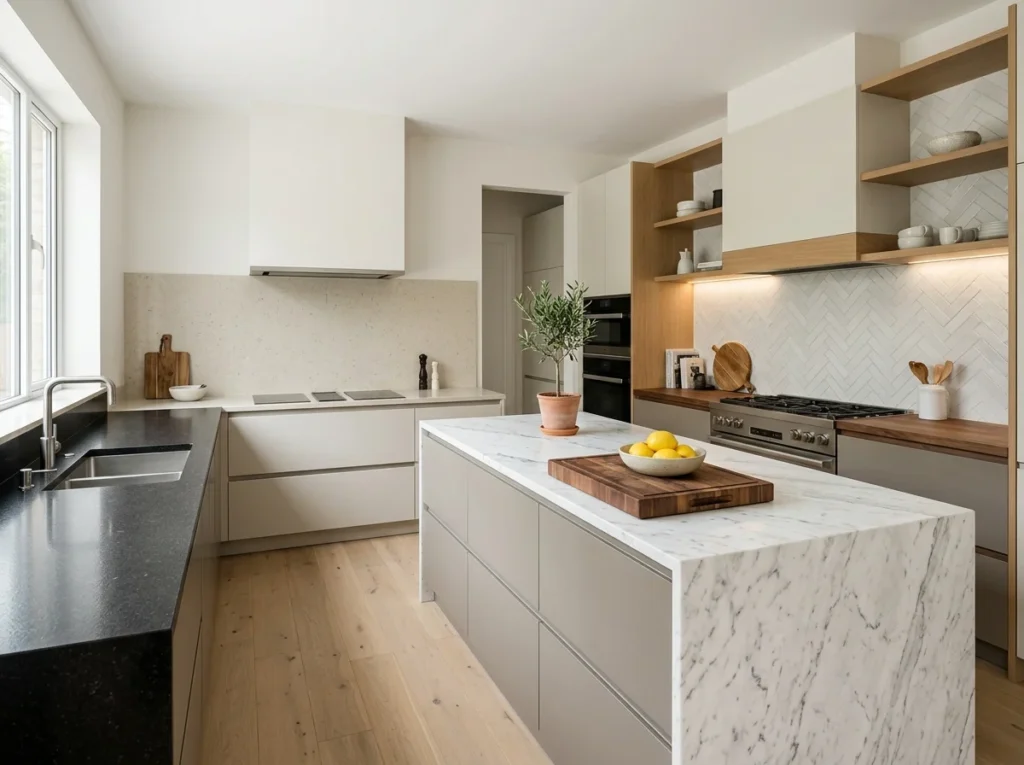
Choosing the right kitchen countertops is one of the most important and consequential decisions in any kitchen renovation. The countertop is the most touched, most used, and most visually prominent surface in the room — its material, color, and finish affect everything from daily cooking comfort to long-term maintenance demands.
From the timeless elegance of natural marble to the practical durability of engineered quartz and the warm character of butcher block, the range of available kitchen countertop materials has never been broader or more design-forward. Every material brings a distinct combination of beauty, durability, and care requirements that suit different households and lifestyles.
This guide covers the best kitchen countertops materials and ideas that kitchen designers and home cooks actually recommend — with practical tips, honest comparisons, and product picks to help you choose a surface that will look and perform beautifully for years to come.
List of 10 Best Kitchen Countertops
1. Quartz Engineered Stone Countertops
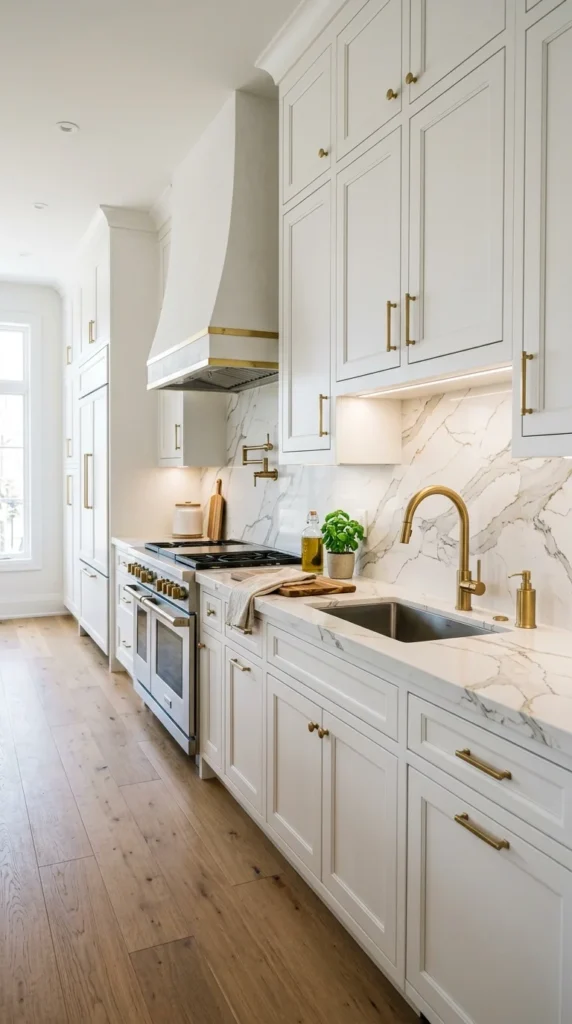
Quartz engineered stone countertops are the most popular kitchen countertop material in contemporary home design — and with good reason. Combining the aesthetic richness of natural stone with the practical benefits of a non-porous, low-maintenance engineered surface, quartz delivers on both beauty and performance simultaneously.
Available in an extraordinary range of colors and vein patterns — from pure Calacatta white with dramatic gold veining to subtle greige and deep charcoal — quartz kitchen countertops suit every interior direction from minimalist modern to traditional and maximalist. The best quartz designs are nearly indistinguishable from natural marble at typical viewing distances.
Because quartz is non-porous, it requires no sealing, resists staining from wine, coffee, and cooking oils, and handles daily kitchen use without the careful maintenance that natural stone demands — making it the most practical choice for busy family kitchens where the countertop sees heavy daily use.
Pro Tip: Request a full slab layout drawing from your fabricator before quartz kitchen countertops are cut — seeing exactly where the vein pattern will fall across your specific layout, where joins will appear, and how the pattern will mirror or flow across different sections allows you to make informed aesthetic decisions that the finished installation will reflect for years.
2. Natural Marble Countertops
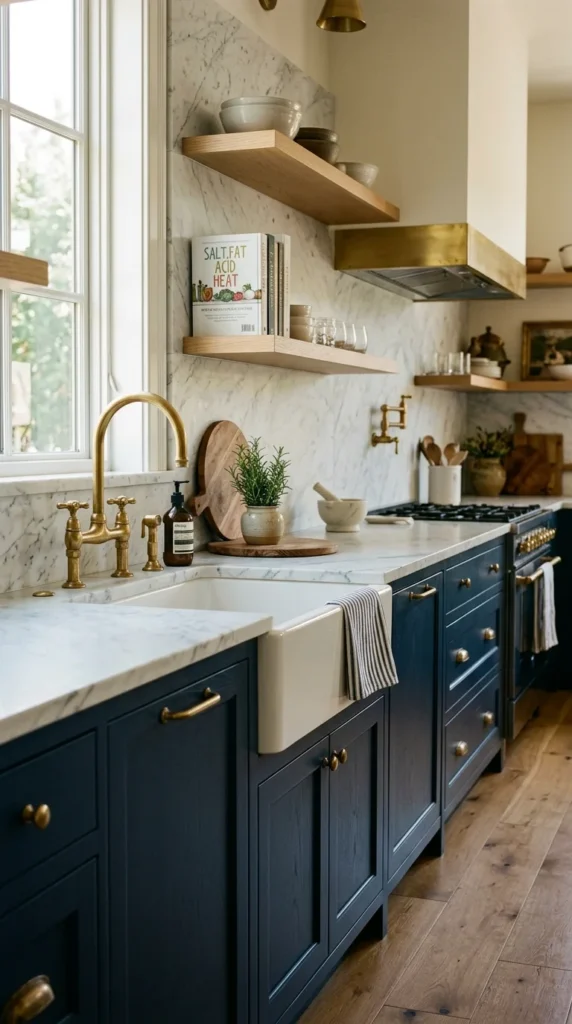
Natural marble kitchen countertops are the most timelessly beautiful and emotionally resonant surface choice available — the genuine geological origin, unique veining, and luminous depth of real marble creates kitchen countertops that no engineered alternative fully replicates, regardless of how sophisticated the reproduction.
Carrara, Calacatta, and Statuario marble are the most sought-after varieties for kitchen countertops — each offers a distinct balance of white ground tone and grey or gold veining that creates a surface of extraordinary visual richness. The variation between individual slabs means no two marble kitchens are ever identical.
The honest consideration with marble kitchen countertops is their porosity and susceptibility to etching from acidic substances — lemon juice, vinegar, and wine can etch the surface and create dull spots over time. For homeowners who accept this natural aging as part of marble’s character rather than a defect, marble remains one of the most rewarding kitchen countertop choices available.
Pro Tip: Seal marble kitchen countertops with a penetrating stone sealer immediately after installation and every 6 to 12 months thereafter — consistent sealing significantly reduces staining risk and slows the etching process, extending the pristine appearance of marble kitchen countertops in an active cooking environment.
3. Butcher Block Wood Countertops
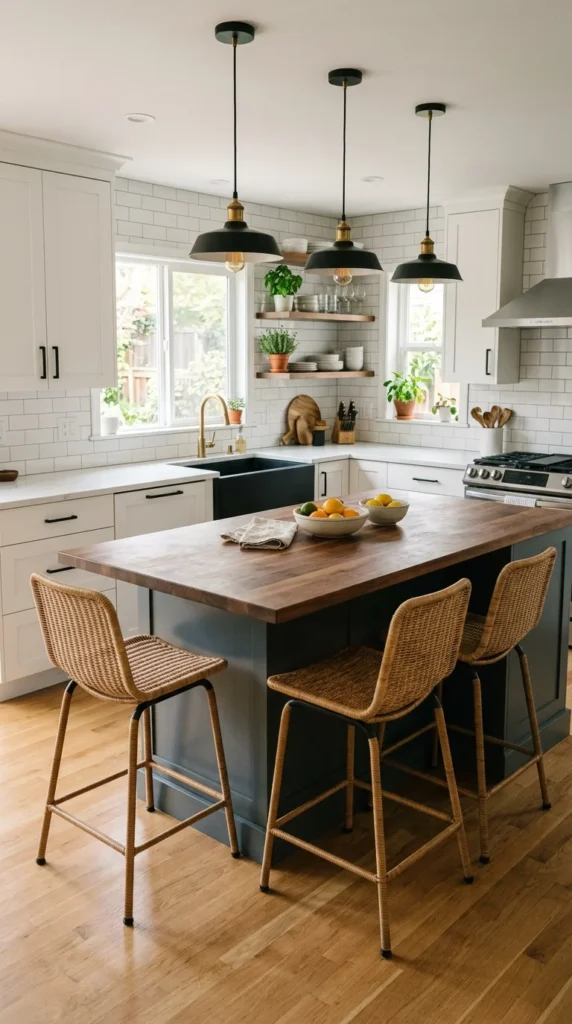
Butcher block wood countertops are the warmest and most organically beautiful of all kitchen countertop choices — they bring genuine natural warmth, a tactile richness, and a functional cutting surface that no stone or engineered material can offer in the same format.
Maple, walnut, and teak are the most popular wood species for butcher block kitchen countertops — maple is the most durable and lightest in color, walnut is the richest and darkest, and teak has natural oils that make it the most moisture-resistant species for a kitchen environment where water contact is constant.
Butcher block kitchen countertops work beautifully as a complete countertop surface, as an island top only, or as a breakfast bar extension from a main stone or quartz countertop — the combination of a stone main counter with a butcher block island section is one of the most popular and visually satisfying kitchen countertop design choices.
Pro Tip: Oil butcher block kitchen countertops with food-safe mineral oil monthly for the first year of installation — the initial frequent oiling period allows the wood to reach full oil saturation, after which quarterly maintenance oiling is sufficient to maintain the surface’s water resistance and deep, rich color indefinitely.
4. Granite Countertops
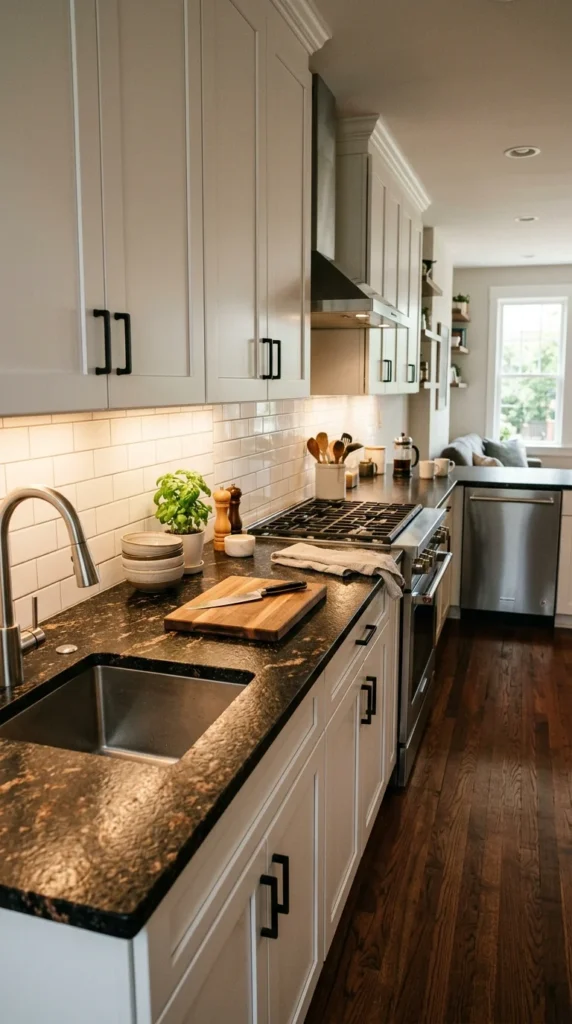
Granite kitchen countertops are the original natural stone countertop choice — extraordinarily hard, heat resistant, and available in a wider range of colors and patterns than any other natural stone, granite remains one of the most durable and value-retaining kitchen countertop investments available.
The natural crystalline structure of granite creates kitchen countertops with flecks, veins, and movement that are genuinely unique to each slab — no two granite kitchen countertops are identical, and the material’s natural pattern creates a visual richness that immediately elevates the kitchen’s aesthetic quality.
Black galaxy, white ice, Santa Cecilia, and Verde Ubatuba are among the most popular granite varieties for kitchen countertops — each offers a distinct color story and pattern complexity that suits different cabinet colors, flooring materials, and kitchen aesthetics.
Pro Tip: Choose a honed rather than polished finish for granite kitchen countertops in a busy family kitchen — honed granite has a matte, smooth surface that hides scratches, fingerprints, and water marks significantly better than the high-gloss polished finish, making it a more practical choice for surfaces that see constant daily cooking activity.
5. Porcelain Slab Countertops
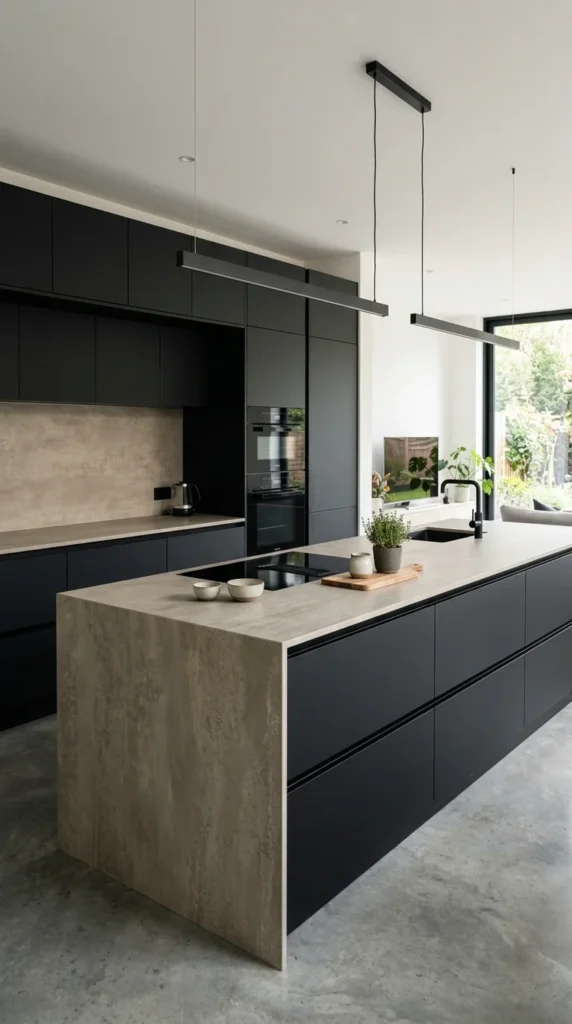
Porcelain slab kitchen countertops — large format sintered stone panels manufactured under extreme heat and pressure — are the most technically advanced and durability-forward kitchen countertop choice available today, offering extraordinary scratch, stain, and heat resistance in a format that mimics natural stone beautifully.
Brands like Neolith, Dekton, and Lapitec manufacture porcelain slab kitchen countertops in panels up to 10 feet long with virtually no visible joins — creating the most seamless countertop installation possible across even the longest kitchen counter runs.
Porcelain slab kitchen countertops are UV stable, meaning they do not fade or discolor in direct sunlight — a significant practical advantage over natural stone and quartz options for kitchens with south-facing windows or direct sun exposure throughout the day.
Pro Tip: Specify a matte or satin finish for porcelain slab kitchen countertops rather than high gloss — polished porcelain shows every fingerprint, water spot, and smear almost immediately after cleaning, requiring constant wiping to maintain its appearance in a high-use kitchen environment where matte finishes are dramatically more forgiving.
6. Concrete Countertops
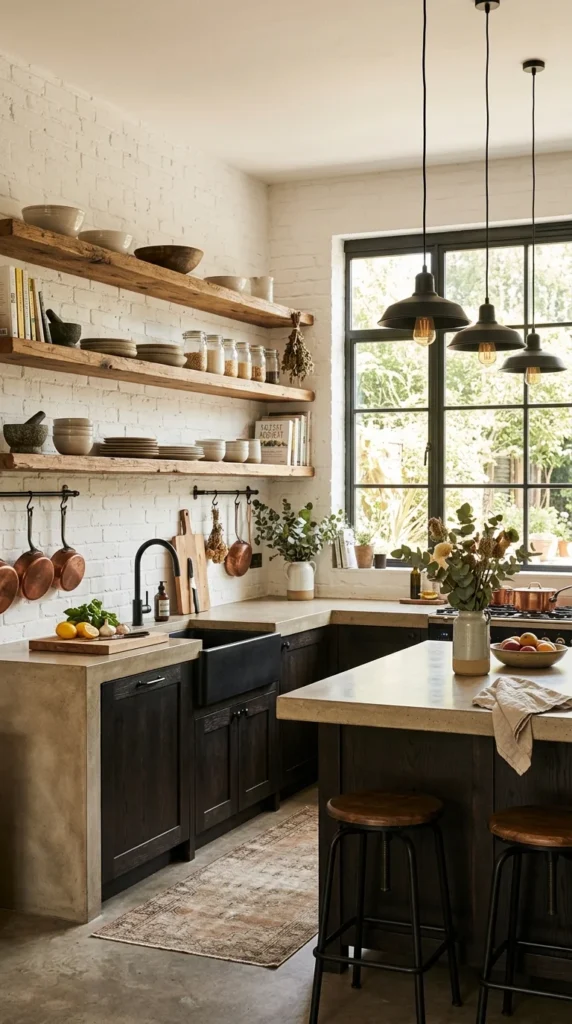
Concrete kitchen countertops bring an industrial, artisan quality to the kitchen that no other material replicates — each concrete pour is unique, and the surface can be cast into any shape, tinted to any color, embedded with aggregates, and finished to any texture from smooth and polished to raw and organic.
The appeal of concrete kitchen countertops lies in their complete customizability and genuine handcrafted quality — unlike stone slabs that are cut from existing material, concrete countertops are formed specifically for the kitchen they will inhabit, making them the most bespoke kitchen countertop option available.
Sealed concrete kitchen countertops in warm charcoal, pale sand, and warm cream tones are among the most architecturally interesting and design-forward choices for contemporary, industrial, and organic modern kitchen aesthetics.
Pro Tip: Apply a penetrating concrete sealer followed by a topcoat sealant to concrete kitchen countertops immediately after installation — unsealed concrete is highly porous and will stain from oil, wine, and acidic substances within hours of kitchen use. Proper sealing and annual resealing maintenance are non-negotiable requirements for concrete kitchen countertops in an active cooking environment.
7. Soapstone Countertops
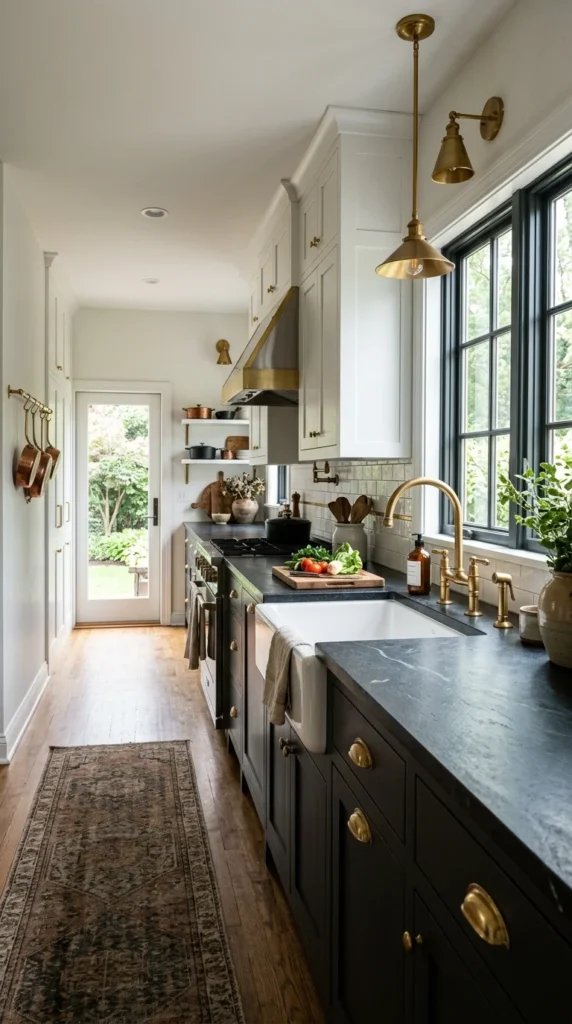
Soapstone kitchen countertops are among the most historically authentic and characterful natural stone choices available — this dark, dense metamorphic rock has been used in kitchens and laboratories for centuries because of its extraordinary heat resistance, non-porosity, and dramatic visual presence.
Dark charcoal to blue-grey soapstone develops a rich, deep patina over time — when treated with mineral oil, the stone darkens and develops a beautiful matte luster that many homeowners find more appealing than the original raw surface, making soapstone kitchen countertops one of the few surfaces that genuinely improve with age and use.
Unlike marble and granite, soapstone is completely non-porous and requires no sealing — it is naturally resistant to staining, bacteria, and chemicals, making it one of the most hygienic and genuinely low-maintenance natural stone kitchen countertop choices.
Pro Tip: Embrace the natural nicks and scratches that soapstone kitchen countertops develop over time — unlike harder stones where surface damage is permanent, soapstone scratches can be sanded out with fine-grit sandpaper and re-oiled to restore the surface completely, making it a uniquely repairable kitchen countertop material.
8. Stainless Steel Countertops
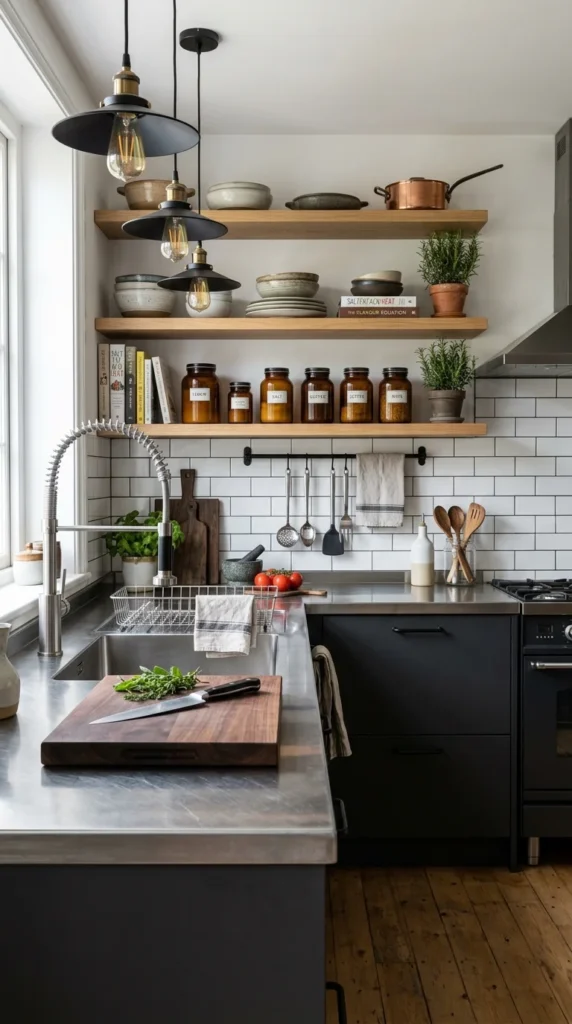
Stainless steel kitchen countertops bring professional culinary credentials and genuine functional excellence to a residential kitchen — the material used in every Michelin-starred restaurant kitchen is available for home installation and delivers unmatched hygiene, heat resistance, and durability.
Brushed stainless steel is the most popular finish for residential kitchen countertops — the directional brushed texture hides scratches and fingerprints significantly better than mirror-polished stainless and creates a warm, professional quality that suits both industrial and contemporary kitchen aesthetics.
A stainless steel countertop integrated with a seamless undermount sink is one of the most hygienically perfect and practically efficient kitchen countertop configurations available — the absence of any seam between countertop and sink eliminates the most common point of bacterial accumulation in a kitchen surface.
Pro Tip: Clean stainless steel kitchen countertops in the direction of the brushed grain rather than in circular or cross-grain motions — cleaning against the grain creates visible circular scratches that accumulate over time and permanently alter the appearance of the brushed texture in a way that same-direction cleaning never causes.
9. Terrazzo Countertops
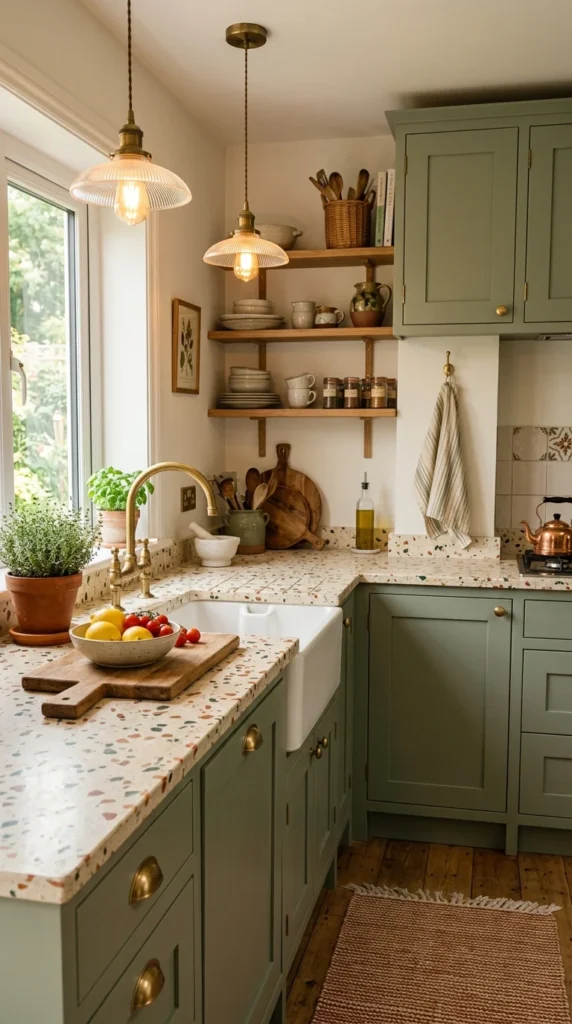
Terrazzo kitchen countertops are one of the most characterful and color-rich surface choices currently experiencing a major design revival — the chips of marble, quartz, glass, and stone embedded in a cement or epoxy matrix create a uniquely playful, speckled surface that brings graphic pattern and personality to the kitchen.
Custom terrazzo kitchen countertops can be designed with specific chip sizes, colors, and matrix tones to complement any kitchen palette — a white matrix with warm terracotta and cream chips suits organic modern kitchens, while a dark grey matrix with white and sage chips suits contemporary and industrial directions.
Terrazzo is naturally dense and non-porous in its epoxy resin form, making it one of the most hygienic and stain-resistant kitchen countertop materials available — a significant practical advantage alongside its considerable aesthetic appeal.
Pro Tip: Choose precast terrazzo tile countertops rather than poured-in-place terrazzo if budget is a consideration — precast terrazzo tiles at 12 to 24 inch formats can be fabricated and installed at a fraction of the cost of a custom poured installation while delivering the same aesthetic character and surface quality.
10. Quartzite Countertops
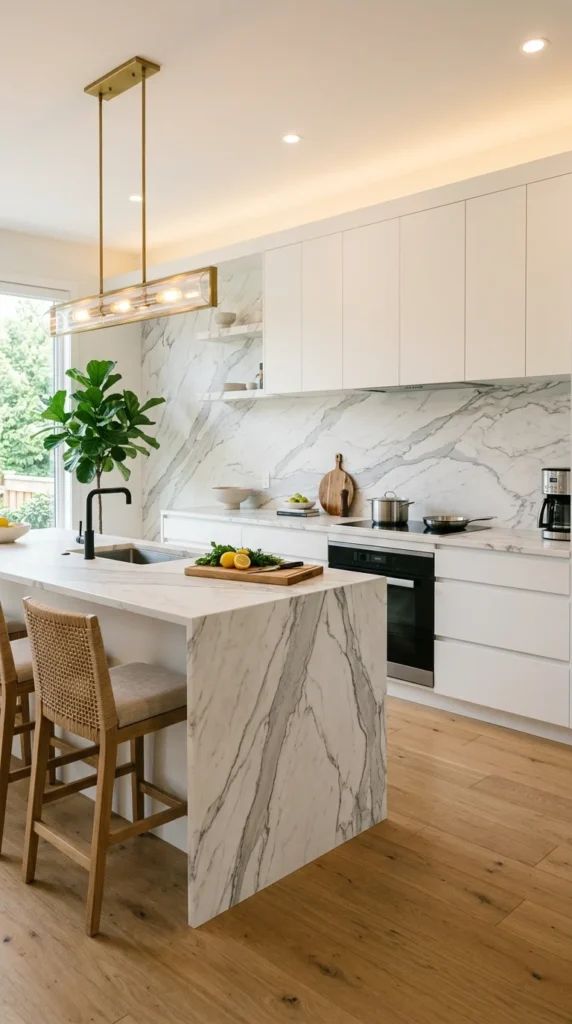
Quartzite kitchen countertops are the natural stone choice that combines the visual beauty of marble with the hardness and durability of granite — a genuinely unique position in the kitchen countertop material spectrum that makes quartzite one of the most sought-after and rapidly growing surface categories.
Super White, Sea Pearl, and Fantasy Brown quartzite are among the most popular varieties for kitchen countertops — each offers stunning natural veining and color movement in a surface that is significantly harder and more scratch-resistant than marble, making quartzite kitchen countertops genuinely more practical for active cooking environments.
Because quartzite is a metamorphic rock formed from sandstone under extreme geological pressure, its surface hardness often exceeds that of granite — it resists scratching from kitchen knives and utensils more effectively than both marble and many quartz engineered stones.
Pro Tip: Test a quartzite sample with a few drops of lemon juice on the surface for 30 minutes before purchasing — some quartzite varieties contain calcite veins that etch under acid exposure just as marble does, while truly pure quartzite does not. This simple test reveals whether the specific slab you are considering has marble-like calcite content before you commit to a kitchen countertop installation.
Why Investing in the Right Kitchen Countertops Is Worth It
Kitchen countertops are the most financially impactful single material investment in any kitchen renovation — they cover more visible surface area than any other element, they are touched and used more frequently than any other kitchen surface, and their quality and appearance directly determine the perceived value of the entire kitchen.
Property value is directly and significantly influenced by kitchen countertop quality — real estate professionals consistently cite kitchen countertops as one of the top three features that buyers evaluate and compare when assessing property value, and upgrading from laminate to quality stone or engineered surfaces delivers a return on investment that consistently exceeds 70 percent of the upgrade cost.
The daily functional impact of beautiful, well-specified kitchen countertops extends beyond aesthetics — a properly sized, well-sealed, and appropriately finished countertop makes every cooking session physically easier and more enjoyable, reduces cleaning time and effort, and creates a working environment that makes the kitchen a genuinely pleasurable place to spend time.
Things to Consider Before Choosing Kitchen Countertops
Before selecting any kitchen countertop material, honestly assess your household’s cooking intensity and maintenance willingness — a household that cooks extensively with acidic ingredients needs a non-etching surface like quartz or quartzite rather than marble, and a household that cannot commit to regular sealing and conditioning needs an engineered rather than natural material.
Think carefully about the color and undertone of your chosen countertop relative to your cabinet color — the relationship between countertop and cabinet color is the single most important aesthetic decision in a kitchen, and choosing a countertop with undertones that conflict with the cabinet finish creates a subtle but persistent visual dissonance that no amount of accessory styling can fully resolve.
Always view full-sized slab samples in your actual kitchen under its specific lighting conditions before committing to any natural stone or engineered kitchen countertop — small 6-inch samples in a showroom under commercial lighting can look dramatically different from a full installed slab under your kitchen’s specific natural and artificial light.
Comparison Table of Kitchen Countertops
| Countertop Material | Price Range | Durability | Maintenance | Heat Resistance | Stain Resistance |
|---|---|---|---|---|---|
| Quartz | $50–$120/sq ft | Very High | Very Low | Medium | Very High |
| Natural Marble | $60–$200/sq ft | Medium | High | Medium | Low–Medium |
| Butcher Block | $40–$100/sq ft | High | Medium | Low | Medium |
| Granite | $45–$150/sq ft | Very High | Low | Very High | High |
| Porcelain Slab | $60–$130/sq ft | Very High | Very Low | Very High | Very High |
| Concrete | $65–$135/sq ft | High | Medium–High | High | Medium |
| Soapstone | $70–$120/sq ft | High | Very Low | Very High | Very High |
| Stainless Steel | $80–$150/sq ft | Very High | Low | Very High | High |
| Terrazzo | $50–$120/sq ft | High | Low | Medium | High |
| Quartzite | $60–$180/sq ft | Very High | Low–Medium | High | High |
| Recycled Glass | $50–$100/sq ft | High | Medium | Medium | High |
| Dekton | $70–$140/sq ft | Exceptional | Very Low | Exceptional | Exceptional |
| Laminate | $8–$30/sq ft | Medium | Very Low | Low | Medium |
Frequently Asked Questions About Kitchen Countertops
What Is the Most Durable Kitchen Countertop Material?
Dekton ultra-compact surface and high-quality porcelain slab are the most technically durable kitchen countertop materials available — both are essentially impervious to scratching, staining, heat damage, and UV fading, outperforming every other material including granite and quartz on combined durability metrics.
For natural stone kitchen countertops, granite is the most durable option — its crystalline hardness resists scratching, it tolerates heat from hot pots, and with proper sealing it provides decades of reliable kitchen service without the etching vulnerability that affects marble and some quartzite varieties.
What Kitchen Countertop Is Easiest to Maintain?
Quartz engineered stone and Dekton are the easiest kitchen countertops to maintain — both are non-porous, require no sealing, resist staining from virtually all common kitchen substances, and clean completely with just warm water and mild dish soap. Their maintenance requirements are essentially limited to regular wiping after use.
Stainless steel and soapstone are the easiest natural and metal kitchen countertop materials to maintain — soapstone requires only occasional mineral oil application rather than sealing, and stainless steel requires only directional wiping with a damp cloth to maintain its brushed surface appearance.
How Thick Should Kitchen Countertops Be?
The standard thickness for kitchen countertops is 3cm (approximately 1.25 inches) for natural stone and quartz — this thickness provides the structural rigidity and visual weight that quality kitchen countertops require without the excessive mass and cost of thicker slabs.
2cm (approximately 0.75 inch) kitchen countertops are available at lower cost but require plywood substrate support across the full countertop area to prevent cracking under point loads — the thinner profile is less commonly specified for kitchen countertops because the visible edge reveals the thinner slab and can appear less substantial than the standard 3cm.
How Do I Choose a Kitchen Countertop Color?
The most reliable approach to choosing kitchen countertop color is to select a countertop with at least one tone that appears in the kitchen’s cabinet color — a warm undertone in the countertop that echoes a warm undertone in the cabinetry creates cohesion, while conflicting undertones create a persistent visual tension that is difficult to resolve with accessories.
Light countertops on dark cabinets and dark countertops on light cabinets are the two most consistently successful and design-forward kitchen countertop color relationships — the contrast creates drama and visual definition that monochromatic same-tone combinations rarely achieve with equal impact.