
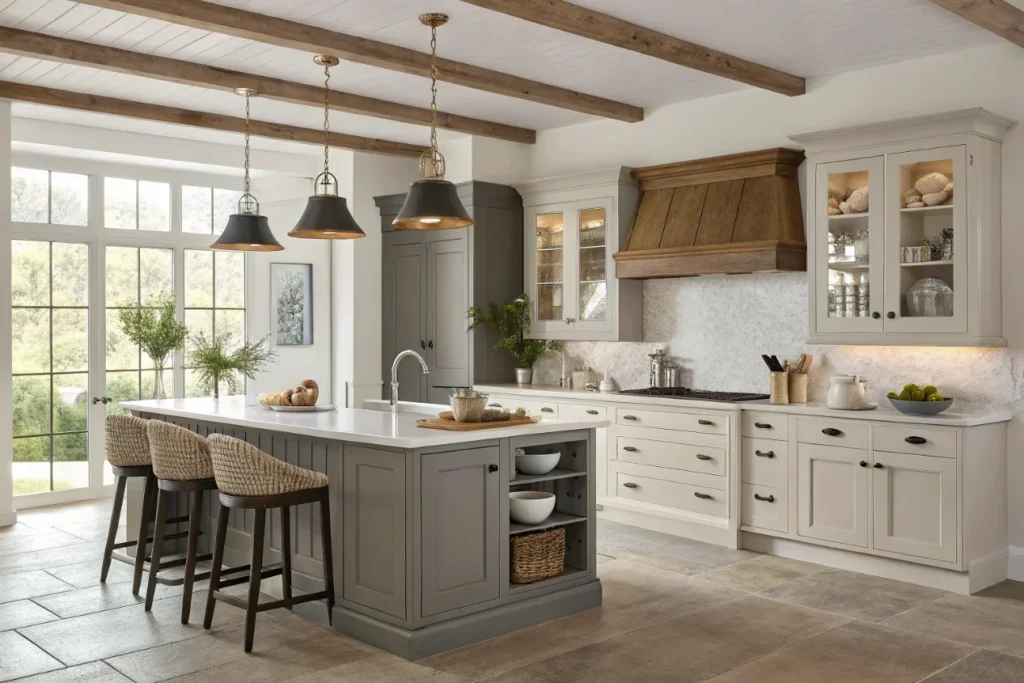
Great interior design kitchen thinking goes far beyond choosing cabinet colours and countertop materials — it is the art of making a kitchen that works beautifully as a functional space, a social gathering point, and a considered expression of the home’s overall design identity all at once.
The most admired kitchens in the world share a quality of intentionality: every decision — from the layout and lighting to the hardware finish and the backsplash tile — has been made in conscious relationship to every other decision, producing a room that feels cohesive, complete, and genuinely personal rather than assembled from a showroom catalogue.
Whether you are planning a full renovation, refreshing an existing kitchen, or simply seeking to elevate what you already have, these interior design kitchen ideas cover the most impactful design moves across every style, from contemporary minimal to warm maximalist, to help you build a kitchen you’ll love for decades.
List of 15 Best Interior Design Kitchen Ideas
1 Statement Range Hood as a Sculptural Centrepiece
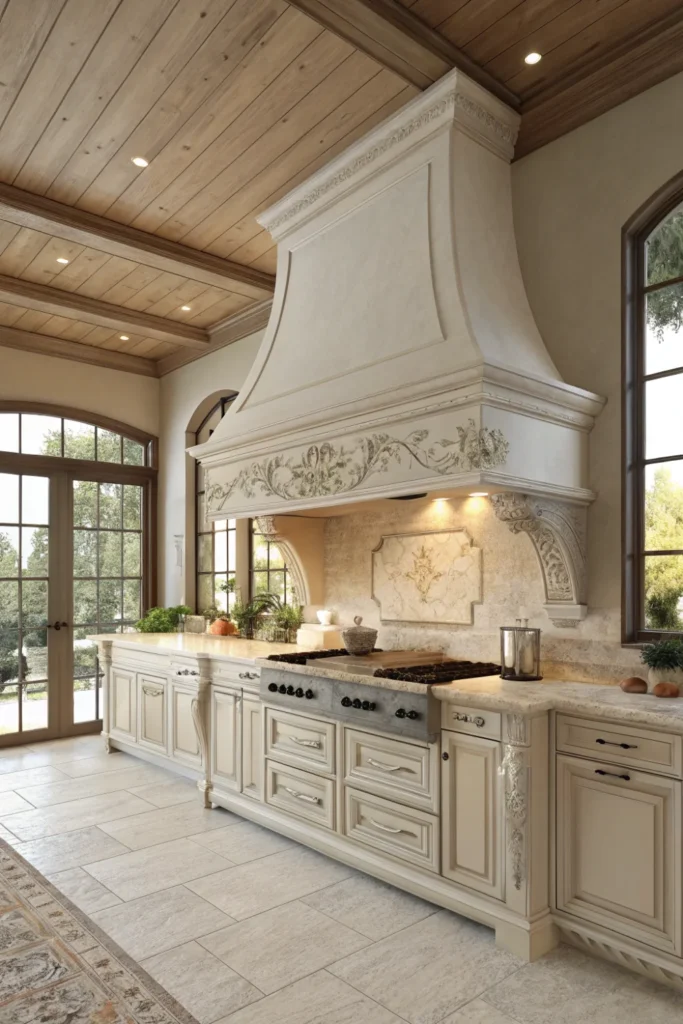
A bespoke or architecturally designed range hood — in plaster, stone, hand-hammered copper, concrete, or custom steel — elevates the cooker wall from a functional necessity into the most visually powerful element of the entire interior design kitchen, drawing the eye immediately and communicating the room’s design ambition in a single fixture.
In contemporary kitchen interior design, the range hood has become the equivalent of a fireplace mantel — the natural focal point around which the rest of the room’s design is organised. A custom plaster hood integrated seamlessly with the ceiling, a dramatic hammered copper canopy, or a sculptural concrete chimney each make an unmistakably bold design statement.
The scale matters enormously: a hood that is too small for the cooking surface looks tentative, while one that extends generously beyond the hob and rises confidently toward the ceiling looks decisive and architectural — the correct approach for a serious interior design kitchen statement.
Commission a custom plaster range hood in the same colour as the ceiling — when the hood and ceiling are tonally unified, the hood reads as a sculptural architectural extrusion rather than a furniture piece, which is the most sophisticated possible interior design kitchen treatment for a cooking focal wall.
2 Waterfall Island Countertop in Stone or Quartz
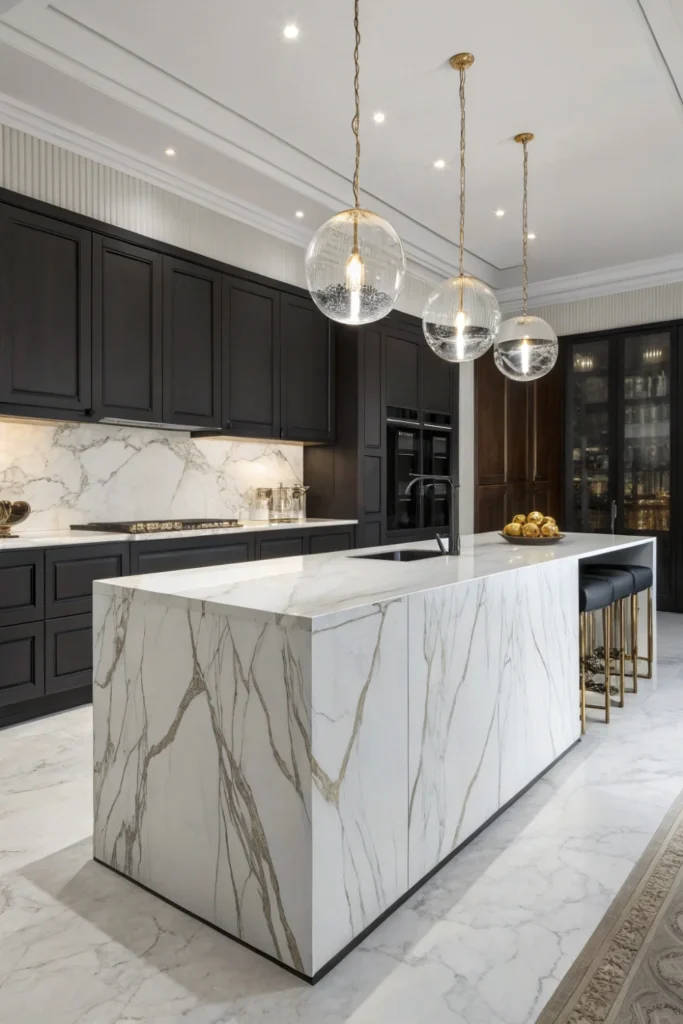
A waterfall island countertop — where the stone or quartz surface continues vertically down one or both sides of the island to the floor in a seamless unbroken panel — is one of the most visually striking and materially luxurious interior design kitchen features available, transforming a functional kitchen island into a sculptural object that anchors the entire room.
The waterfall detail is particularly dramatic in bookmatch stone — where two consecutive slabs from the same block are opened like a book, creating a mirrored veining pattern across the horizontal and vertical surfaces simultaneously. The effect is geological art with a kitchen function.
Use a mitered edge joint rather than a butt joint where the horizontal countertop meets the vertical waterfall panel — the mitered 45-degree cut makes the stone appear continuous and monolithic without a visible seam, while a butt joint reveals a line that breaks the illusion of a single flowing piece.
3 Coloured Cabinetry with Tonal Hardware
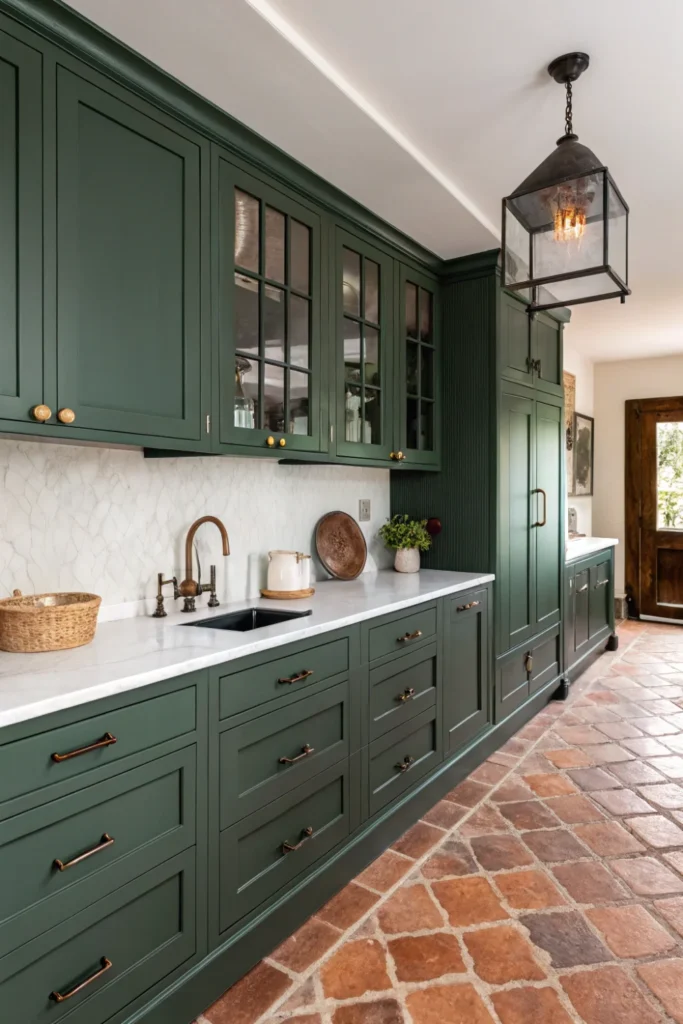
Moving beyond white and grey into deliberate, saturated cabinet colour — forest green, deep navy, warm terracotta, dusty sage, matte black, or rich burgundy — is one of the most transformative interior design kitchen decisions available, giving the room a strong chromatic identity that white cabinetry simply cannot provide.
The key to coloured cabinetry that feels sophisticated rather than bold for boldness’s sake is the hardware choice: tonal hardware — handles and knobs in a finish that is in the same colour family as the cabinet (dark bronze on dark green, warm brass on terracotta, matte black on charcoal) — creates a cohesive, designed quality that contrasting hardware cannot match.
Sample coloured cabinet paint on a full door panel in your actual kitchen light before committing — kitchen lighting is almost never the same as a paint shop’s fluorescent tubes, and the same colour can read as sophisticated in warm natural light and garish under cool overhead LEDs.
4 Layered Lighting Design — Ambient, Task, and Accent
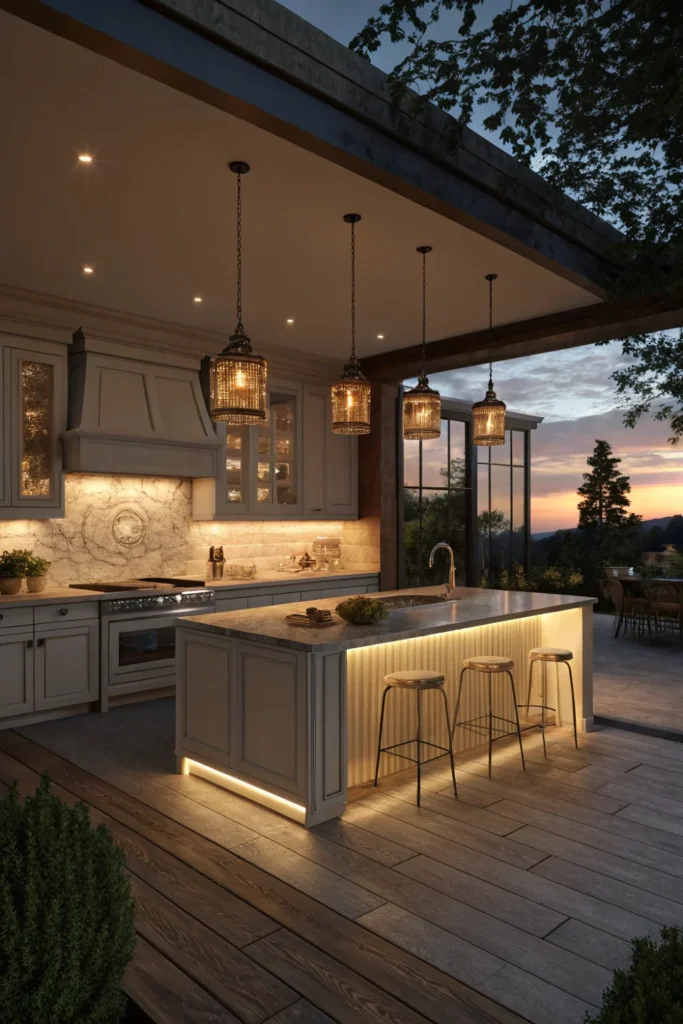
A properly layered kitchen lighting scheme — combining ambient ceiling light, directional task lighting over prep areas, and accent lighting inside cabinets or beneath open shelves — is one of the most technically impactful and frequently overlooked interior design kitchen investments, transforming the mood, functionality, and perceived quality of the room at every hour of the day.
Most kitchens are lit by a single recessed ceiling grid or pendant fixture that does everything poorly — it creates flat, shadowless light that is simultaneously too bright for atmosphere and not bright enough for precision cutting and cooking. A layered approach uses different circuits on separate dimmers so the kitchen can shift from task-bright at lunchtime to warm and ambient during an evening dinner party.
Install all kitchen lighting circuits on individual dimmers from the outset — it costs very little at build stage and is prohibitively expensive to retrofit later, but the ability to dial ambient, task, and accent lighting independently is what separates a professionally designed kitchen from a functional one.
5 Open-Plan Kitchen with a Considered Zone Layout
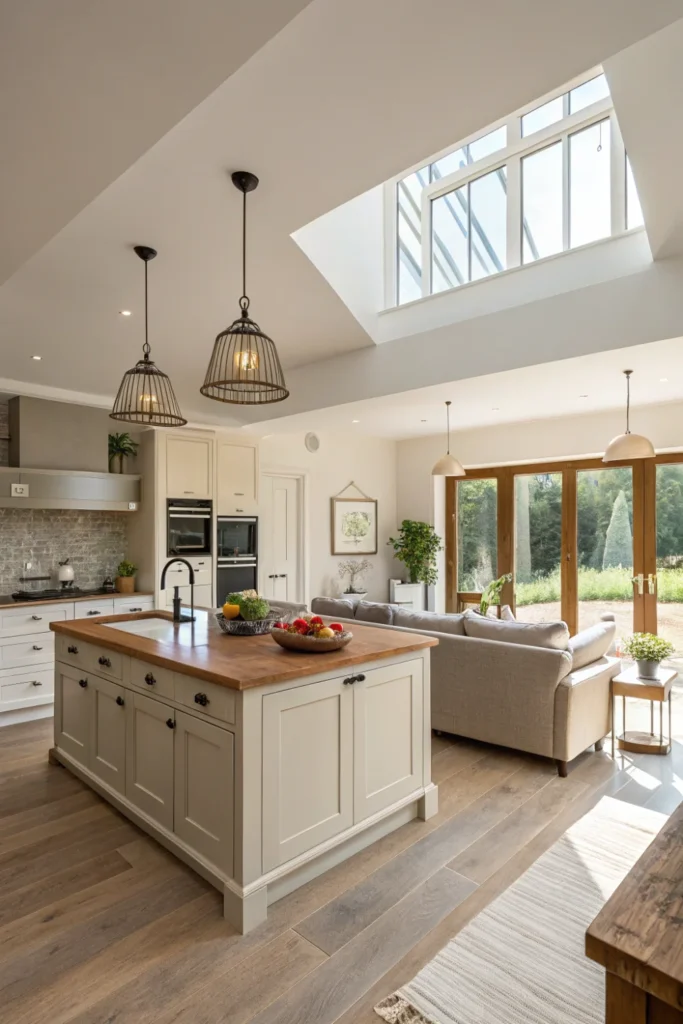
The most liveable open-plan interior design kitchen layouts are those where distinct functional zones — cooking, preparation, cleaning, storage, and socialising — are each clearly defined within the open space, creating a kitchen that flows between activities without confusion, clutter, or the domestic noise of one zone visually contaminating another.
The classic professional approach is to separate the “wet” zone (sink, dishwasher) from the “hot” zone (hob, oven) from the “cold” zone (fridge, pantry) and route the circulation between them in a logical triangle or sequence that minimises unnecessary movement during cooking.
In a genuinely well-designed open-plan kitchen, the social zone — island seating, a banquette, or a breakfast bar — sits at the perimeter of the working kitchen triangle, close enough for conversation but outside the path of active cooking traffic.
Define each zone visually as well as functionally — a change in ceiling height, a different pendant light type, a material transition in the floor, or a shift from closed to open cabinetry can delineate kitchen zones in an open plan without physical walls, preserving the openness while creating spatial clarity.
6 Full-Height Splashback in Dramatic Stone or Large Format Tile
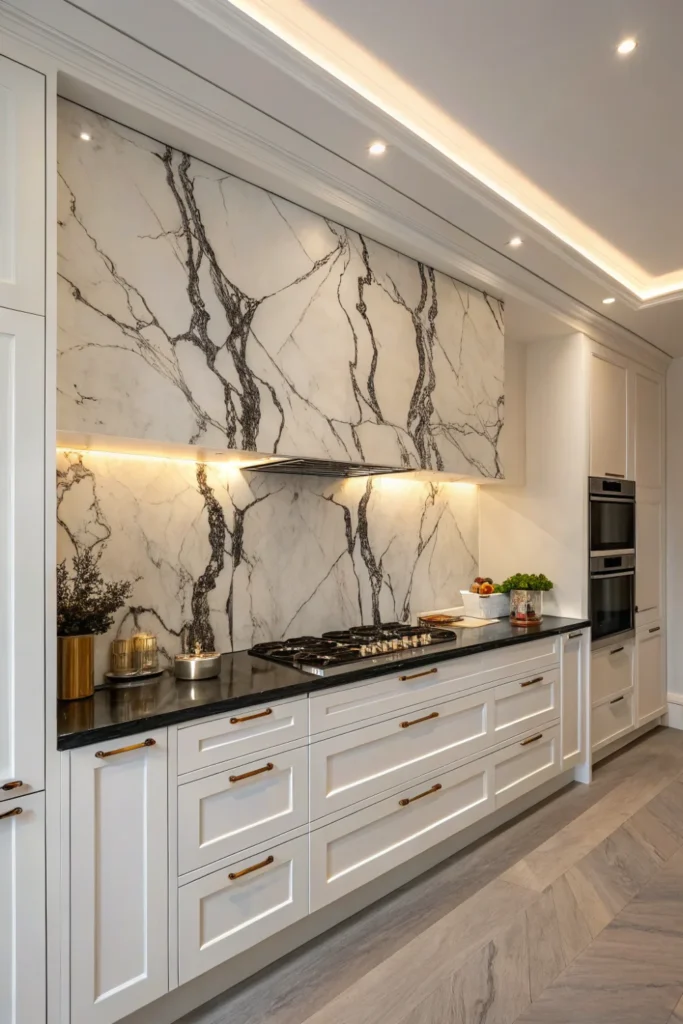
Extending the kitchen backsplash from countertop to ceiling in a single material — a slab of dramatic stone, large-format porcelain, smoked glass, or a full run of bold encaustic tile — is one of the most architecturally confident interior design kitchen moves, eliminating the awkward gap between backsplash and upper cabinets and treating the cooking wall as a continuous designed surface.
A full-height stone splashback is particularly impactful when the stone is bookmatched — a single dramatic sheet of marble or quartzite running from counter to ceiling creates a geological mural that transforms the cooker wall into the room’s most memorable feature.
Extend the full-height splashback beyond the width of the cooking zone by at least 30 centimetres on each side — a splashback that terminates exactly at the edge of the hob looks like a precise functional installation, while one that extends generously beyond it looks like an interior design decision, which is the intended effect.
7 Integrated Butler’s Pantry or Scullery
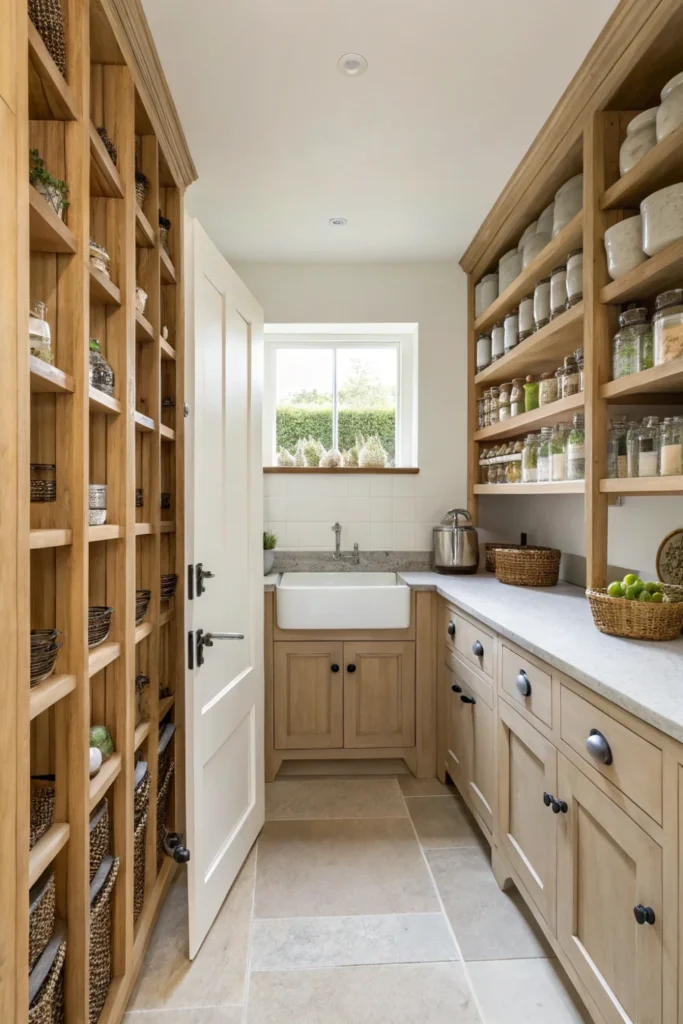
An integrated butler’s pantry or scullery — a secondary kitchen space behind a door or around a corner from the main kitchen — is one of the most coveted and practical interior design kitchen features in contemporary home design, allowing the primary kitchen to remain permanently display-ready while all the unglamorous work of food storage, appliance use, and dishwashing happens out of sight.
In smaller homes, a pantry as compact as 1.5 metres deep can still accommodate a second sink, a dishwasher, shelving for dry goods, a tall fridge, and counter space for small appliances — removing all of these elements from the primary kitchen transforms it into a room that functions like a showroom permanently.
Design the butler’s pantry with deliberate contrast to the main kitchen — if the primary kitchen is sleek and minimal, the pantry can be more utilitarian and open-shelved. The contrast makes the transition between the two spaces feel purposeful rather than inconsistent.
8 Handmade or Artisan Tile for the Backsplash
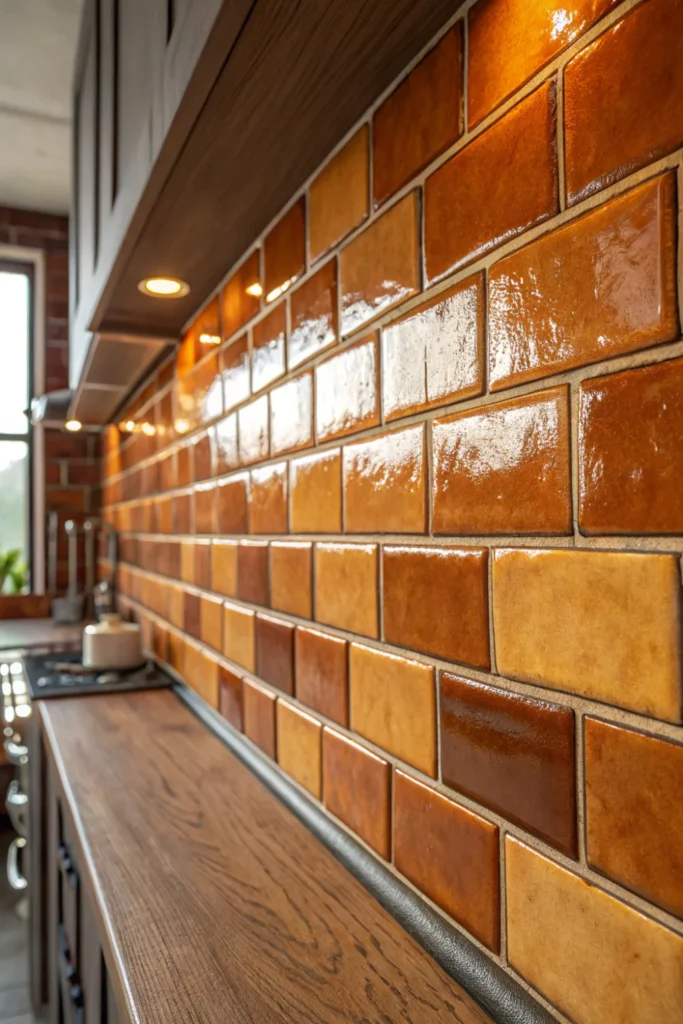
Handmade ceramic, zellige, or encaustic tile in the kitchen backsplash brings an irreplaceable quality of human craft and material individuality to the interior design kitchen — the slight variation in shape, the undulating glaze surface, and the tonal depth of hand-fired ceramics create a visual richness that machine-made tiles, however beautiful, cannot replicate.
Artisan tiles work as both a full-wall treatment and as a strategic accent — a single run of handmade tiles between the counter and upper cabinets, or a feature panel behind the hob, introduces the warmth and personality of craft without the cost of a full installation.
Order 20% more handmade tiles than your calculated coverage requires — hand-made tiles have significantly higher variation in size and breakage rate during cutting than factory tiles, and ordering from a new batch later will not produce an exact colour match due to natural glaze variation between firings.
9 Concealed Appliance Zone for a Clean Aesthetic
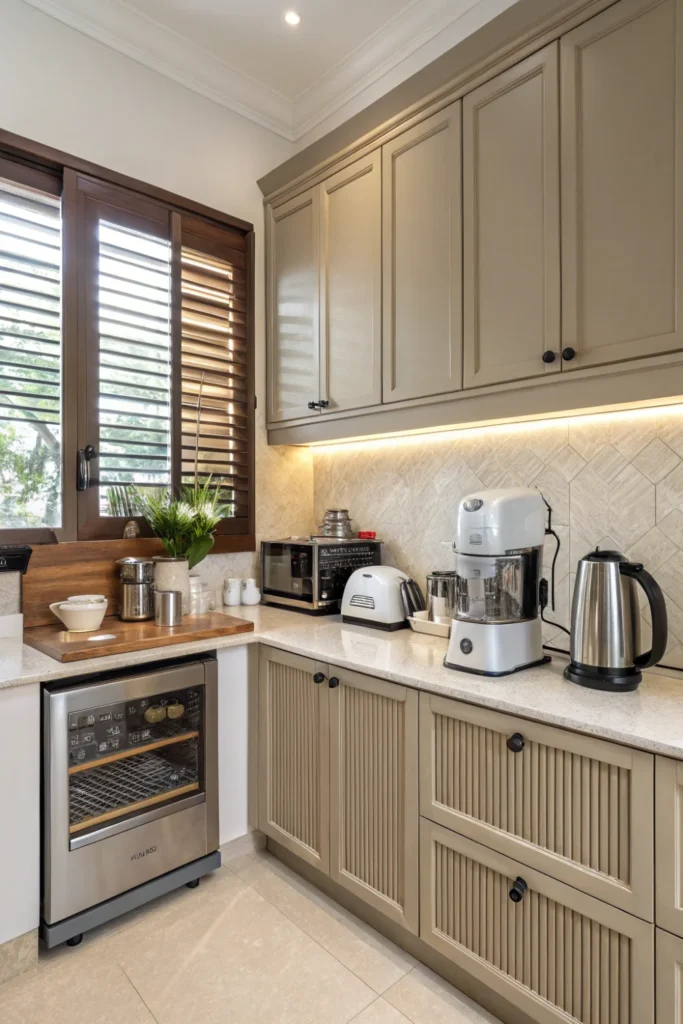
Creating a dedicated concealed appliance zone — a section of cabinetry with tambour shutters, bi-fold doors, or a simple pocket door that slides across to hide the toaster, kettle, coffee machine, and other small appliances — is one of the most practically impactful interior design kitchen moves for maintaining the visual clarity of a designed kitchen during everyday use.
This technique, widely used in professional kitchen interior design, acknowledges the reality that most kitchens are photographed empty but lived-in full of appliances and allows for both states to coexist — the kitchen performs in both “display” mode and “working” mode without compromise.
Run power outlets inside the appliance zone along the back wall so appliances can remain plugged in permanently — the entire value of a concealed appliance zone evaporates if appliances have to be unplugged, moved, and relocated every time they are used.
10 Warm Material Mix — Brass, Marble, and Aged Timber
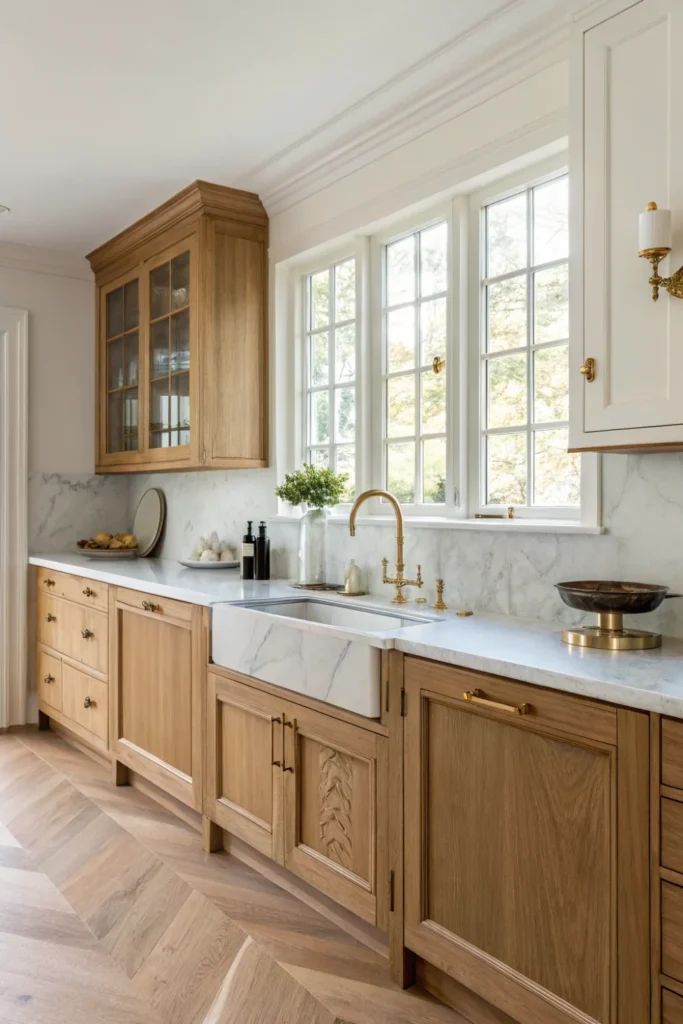
The most enduringly beautiful interior design kitchens are those built on a deliberate warm material mix — the combination of aged brass hardware, marble or stone countertops, and warm-toned timber in the cabinetry, shelving, or flooring creates a layered, rich interior that is both timeless and deeply liveable.
Brass and marble have a natural affinity rooted in their complementary warm tones — the yellow gold of aged brass and the warm white veining of Calacatta marble sit in the same colour family, while the hard coolness of stone and the soft warmth of brass provide a material contrast that keeps each looking its best by comparison.
Choose unlacquered or living brass hardware rather than lacquered brass for a kitchen interior design scheme — unlacquered brass develops a rich, organic patina over years of handling that improves continuously, while lacquered brass eventually chips and looks worse than unlacquered from day one as the coating deteriorates unevenly.
11 Bespoke Storage Solutions Designed Around Your Habits
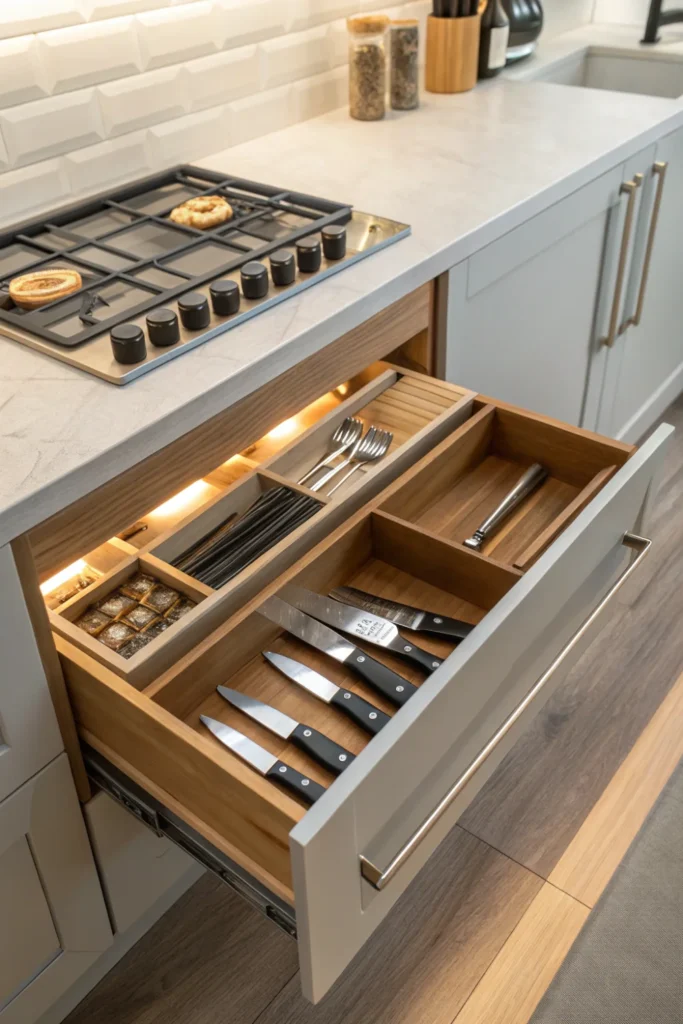
The interior design kitchens that function most beautifully are those where the storage is designed specifically around the habits, equipment, and cooking style of the people using them — deep drawers sized for Le Creuset casseroles, a knife drawer with a custom insert, a pull-out spice rack positioned beside the hob, a built-in charging station, a specific shelf for the stand mixer.
This level of bespoke storage design requires upfront investment in time — listing every item that will live in the kitchen, categorising by frequency of use, and mapping each category to a specific cabinet location — but the result is a kitchen where everything has a precise home and daily cooking becomes an effortlessly organised activity.
Even within a standard kitchen carcass system, custom internal fittings — drawer dividers, door-mounted racks, pull-out larder frames, and bin systems — can create the same functional performance as a fully custom kitchen at a fraction of the cost.
Before finalising any kitchen interior design storage layout, spend one week noting every time you go to a drawer or cabinet and it frustrates you in your current kitchen — those friction points are the most valuable design information available and should each have an explicit solution in the new design.
12 Concrete or Terrazzo Flooring for Texture and Character
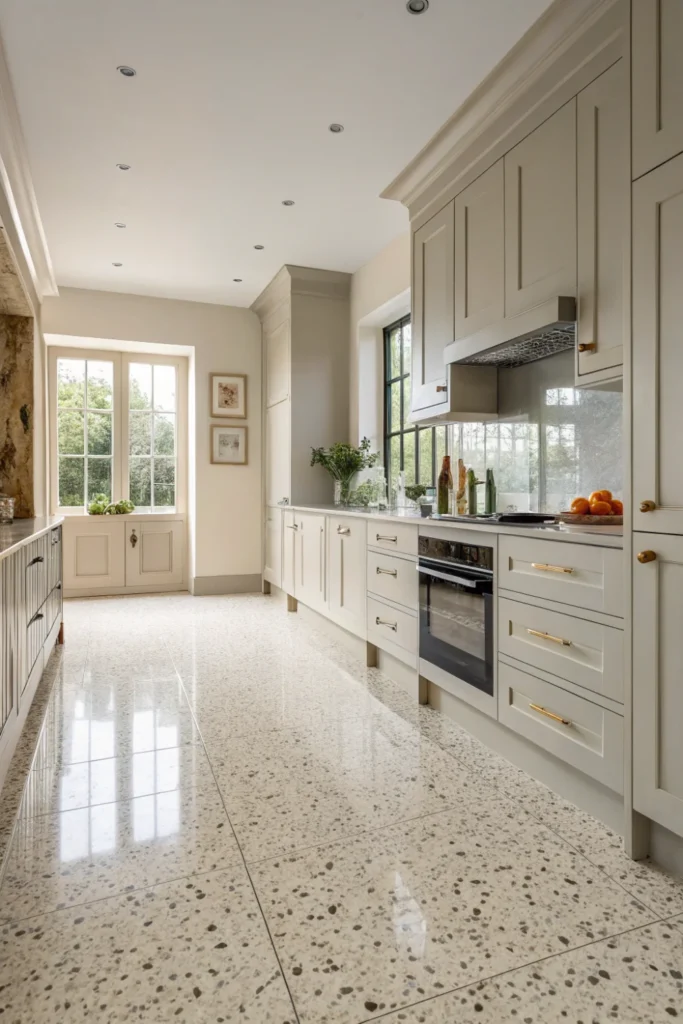
Polished concrete or terrazzo flooring in a kitchen brings a sophisticated, material-forward quality to the interior design that ceramic tile, luxury vinyl, and engineered wood rarely achieve — the aggregate depth of terrazzo and the seamless monolithic quality of polished concrete both create floors that are as decoratively powerful as any feature wall.
Terrazzo in particular has had a remarkable design renaissance in high-end kitchen interior design — available in large poured-in-place slabs or in pre-made tiles, its characteristic aggregate of marble, glass, and stone chips creates a unique, non-repeating pattern at every scale that makes it one of the most genuinely individual flooring choices available.
Seal polished concrete and terrazzo kitchen floors with a quality penetrating stone sealer before use, and re-seal annually — both materials are porous by nature and will permanently absorb oils, wine, and coffee without protection, but with proper sealing they are among the most durable and beautiful kitchen floors available.
13 Indoor-Outdoor Kitchen Connection Through Glazing
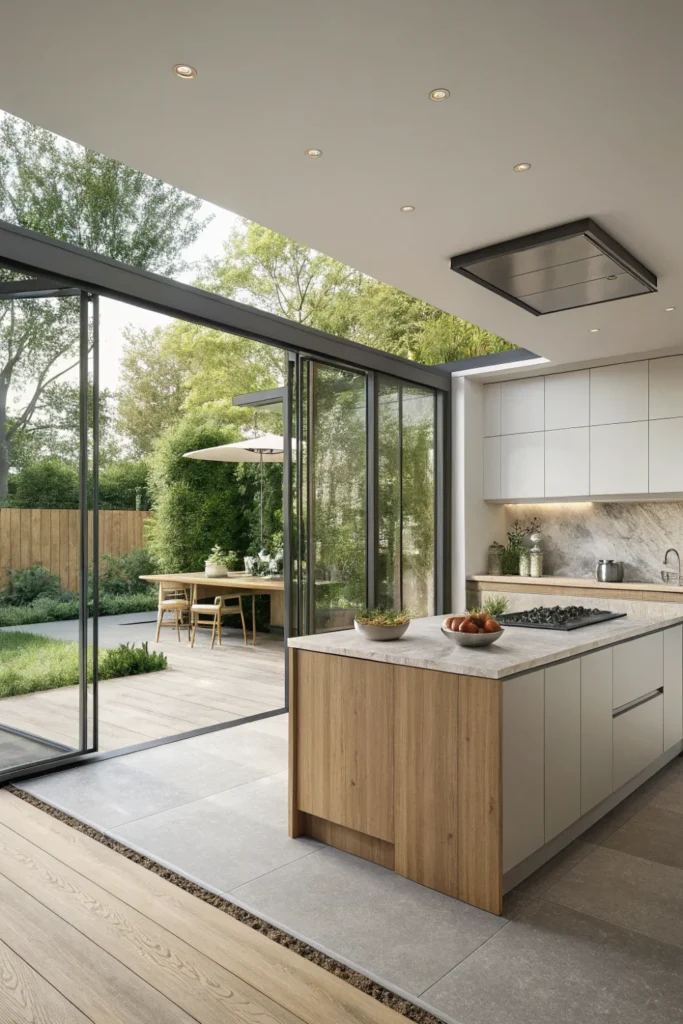
Creating a direct visual and physical connection between the kitchen and an outdoor space — through full-height glazed bifold doors, a large picture window above the sink, or a sliding glass wall opening to a terrace or garden — is one of the most spatially transformative interior design kitchen moves, borrowing the visual depth of the landscape to make the kitchen feel significantly larger and more alive.
The kitchen-to-garden connection also transforms how the kitchen is used — when the outdoors is immediately accessible, morning coffee naturally migrates to the terrace, summer entertaining flows between the kitchen island and an outdoor dining area, and the relationship with natural light, seasons, and weather becomes part of the daily kitchen experience.
Position the kitchen sink on the wall facing the outdoor connection wherever the layout permits — the act of washing up is immediately elevated by looking into a garden rather than a wall, and the natural light from the window or glazed door above the sink dramatically reduces the need for artificial task lighting during daylight hours.
14 Scullery-Style Open Shelving Display Wall
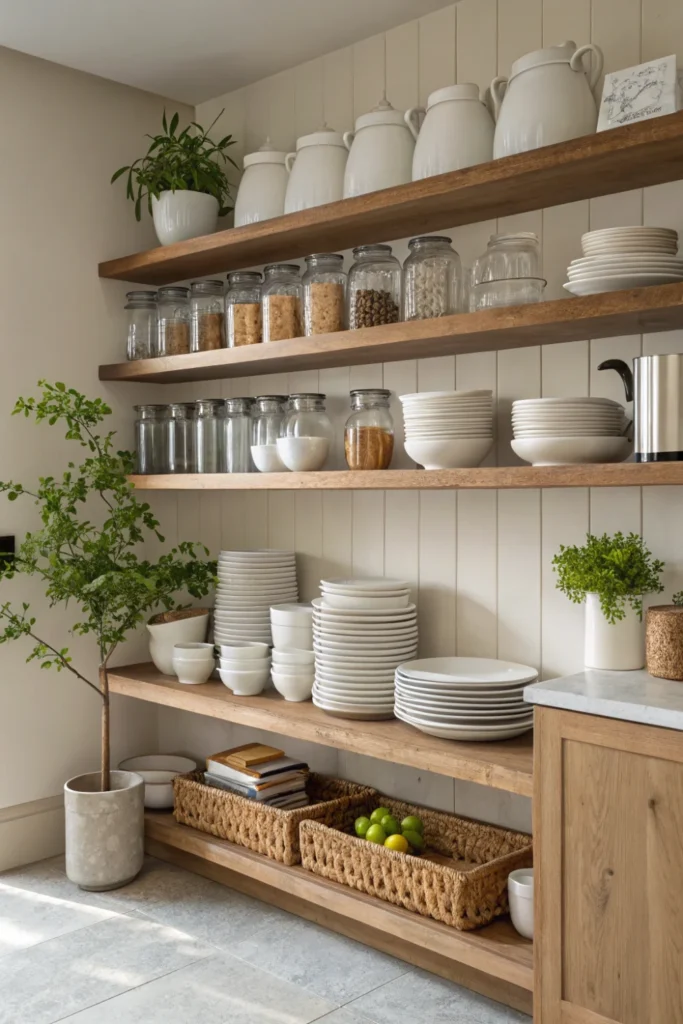
A full display wall of open shelving styled with matching crockery, cookbooks, glass storage jars, and carefully chosen kitchen objects — replacing an entire run of upper cabinets — creates one of the most visually warm and personally expressive interior design kitchen treatments available, turning the storage wall into a curated display that communicates who the cook is and what they value.
The discipline required to maintain an open shelf display wall in a kitchen is not insignificant — everything must be consistently neat, visually cohesive, and regularly edited — but the reward is a kitchen with genuine warmth and personality that closed-door cabinetry, however beautiful, simply cannot deliver.
Invest in matching crockery sets in two or three colours for the open shelf display wall — the visual impact of twelve matching white plates stacked on a shelf is dramatically more powerful than twelve mismatched ones, and uniform crockery is the single highest-impact and lowest-cost styling decision for an open shelf kitchen.
15 Bold Ceiling Treatment — Paint, Plaster, or Timber
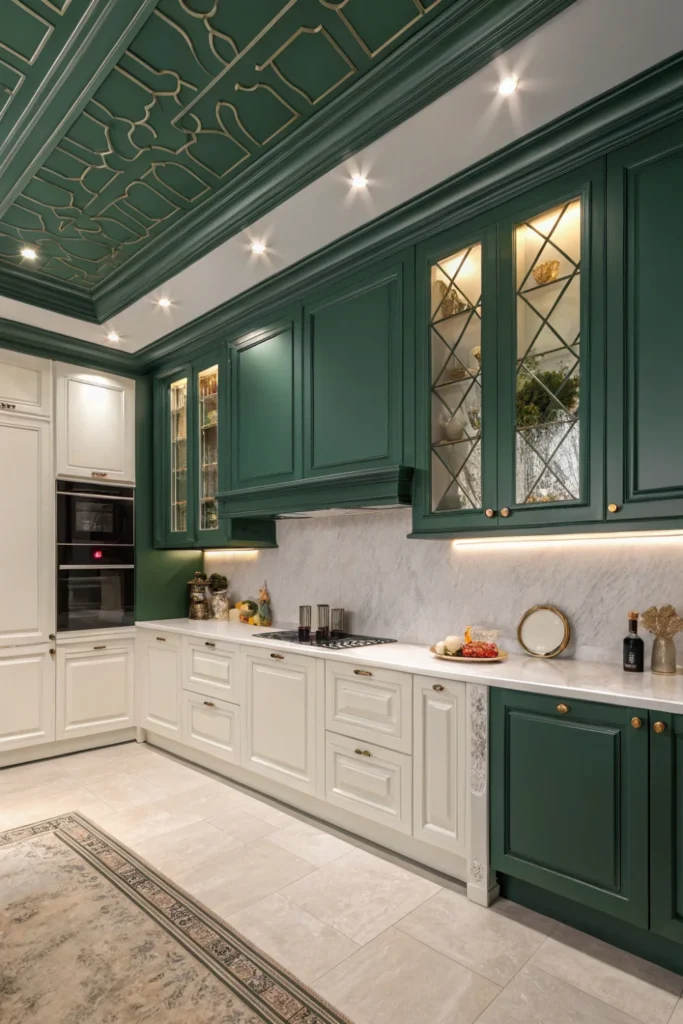
The kitchen ceiling is the most consistently overlooked surface in interior design — treating it as the fifth wall rather than a blank overhead plane opens up one of the most powerful design opportunities in the room. A dark-painted ceiling, a limewash plaster finish, exposed timber boarding, or a coffered detail transforms the ceiling from background into a deliberate design layer that gives the kitchen genuine architectural character.
In a kitchen with open shelving, pendant lights, and a statement range hood, a bold ceiling treatment completes the room’s vertical design story, tying together all the elements between floor and ceiling into a cohesive interior design kitchen composition that reads as fully resolved rather than stopping at eye level.
Paint a kitchen ceiling in the same colour as the upper cabinets — when ceiling and cabinets share a tone, the upper cabinetry appears to recede into the ceiling and the room feels wider and more open, while a contrasting ceiling creates a visual lid that emphasises the room’s boundaries rather than dissolving them.
Why Interior Design Kitchen Ideas Are Worth the Investment
A professionally considered interior design kitchen consistently delivers the highest return on investment of any room in the home — estate agents across price brackets agree that the kitchen is the single room that most directly influences buyer decisions and property valuations, and a kitchen that has been thoughtfully designed rather than merely fitted commands a measurable premium.
The daily quality-of-life benefits of a well-designed kitchen are equally compelling — research consistently finds that the kitchen is the most socially active room in most homes, and the quality of its design directly affects how comfortable, confident, and creative the people who cook and gather in it feel. An interior design kitchen that is beautiful, organised, and well-lit makes cooking a genuinely pleasurable activity rather than a task to be completed.
Long-term, investing in quality materials and considered interior design kitchen decisions — stone countertops, solid timber cabinetry, quality hardware, and proper electrical planning — produces kitchens that improve with age and require fewer replacements over decades, making them significantly better value over time than lower-quality installations that need refreshing every five to eight years.
Things to Consider Before Choosing Interior Design Kitchen Ideas
Before committing to any interior design kitchen direction, establish a clear hierarchy of priorities — layout and storage first, material quality second, aesthetics third. The most beautiful kitchen in the world will be a source of daily frustration if the layout forces inefficient movement patterns or the storage is inadequate for the household’s actual needs.
Consider how the kitchen relates to the rest of the home before selecting a design direction — a kitchen that is architecturally and materially coherent with the living spaces it connects to reads as a designed whole, while a kitchen in a completely different aesthetic register from the adjacent rooms creates a jarring transition that undermines both spaces. The most successful interior design kitchens are those that feel like a natural continuation of the home’s design language.
Always budget for the invisible elements first — adequate electrical circuits and sockets in the right locations, properly designed ventilation for the cooking range, quality plumbing behind the walls, and good under-cabinet and task lighting — before allocating money to visible finishes. A kitchen with impeccable tile and poor wiring will be a constant source of frustration; a kitchen with simple finishes and excellent technical infrastructure will perform beautifully every single day.
Comparison Table of Interior Design Kitchen Ideas
| Design Idea | Cost Range | DIY Friendly | Design Impact | Best Kitchen Style | Longevity |
|---|---|---|---|---|---|
| Statement Range Hood | $800–$8,000 | No | Very High | Any | Permanent |
| Waterfall Island Countertop | $2,000–$15,000 | No | Very High | Contemporary | Permanent |
| Coloured Cabinetry | $200–$12,000 | Partial | Very High | Any | 10–15 years |
| Layered Lighting Design | $400–$3,000 | Partial | Very High | Any | Permanent |
| Open-Plan Zone Layout | $3,000–$25,000 | No | Very High | Any | Permanent |
| Full-Height Splashback | $500–$8,000 | Partial | Very High | Contemporary / Luxury | Permanent |
| Butler’s Pantry / Scullery | $2,000–$15,000 | No | Very High | Any | Permanent |
| Handmade / Artisan Tile | $400–$4,000 | Partial | High | Any | Permanent |
| Concealed Appliance Zone | $300–$2,500 | Partial | High | Modern / Minimal | Permanent |
| Warm Material Mix | $500–$10,000 | Partial | Very High | Transitional / Classic | 20+ years |
| Bespoke Storage | $500–$6,000 | Partial | High | Any | Permanent |
| Concrete / Terrazzo Floor | $800–$6,000 | No | Very High | Contemporary / Industrial | Permanent |
| Indoor-Outdoor Connection | $3,000–$20,000 | No | Very High | Any with outdoor space | Permanent |
| Open Shelving Display Wall | $100–$1,500 | Yes | High | Any | Permanent |
| Bold Ceiling Treatment | $50–$3,000 | Partial | High | Any | 10+ years |
Recommended Products for Interior Design Kitchen Ideas
Farrow & Ball Estate Eggshell — Cookbook of Kitchen Colours ~$55–$110 per tin
Farrow & Ball’s kitchen-specific Estate Eggshell range is the most consistently recommended paint system for interior design kitchen cabinetry by professional designers — the formulation is specifically engineered for high-use surfaces, resisting moisture, grease, and cleaning products while preserving the extraordinary depth and complexity of their pigment-rich colours. Shades like Hague Blue, Railings, Mizzle, and Card Room Green have each become defining interior design kitchen colours of the past decade precisely because their tonal complexity reads differently in every light condition throughout the day.
DeVol Kitchens Aged Brass Hardware Collection ~$15–$80 per piece
DeVol’s aged unlacquered brass hardware is widely regarded as the finest kitchen cabinet hardware available for a warm, timeless interior design kitchen aesthetic — each handle, knob, and cup pull is cast in genuine brass and left unlacquered so that it develops a rich, organic patina through daily handling that no coated brass can replicate. The collection spans plain cylinder pulls, cup handles, and decorative knobs in profiles that suit everything from Shaker and Georgian cabinetry to flat-front contemporary doors, making it one of the most versatile and long-lasting hardware investments available for a considered kitchen design.
Davide Oppizzi Handmade Ceramic Tile Studio ~$40–$120 per sq ft
For kitchens where the backsplash is the primary interior design statement, handmade ceramic tiles from specialist studios like Davide Oppizzi deliver the tactile depth, colour variation, and artisan quality that define truly exceptional interior design kitchen backsplash work — each tile is individually formed and fired, producing the characteristic surface undulation and glaze depth that machine tiles cannot achieve regardless of price. Available in a range of earthy and jewel-toned glazes, these tiles reward close inspection and improve photographically and in person as light conditions change throughout the day.
Frequently Asked Questions About Interior Design Kitchen Ideas
What is the most important element of interior design kitchen planning?
The kitchen layout — specifically the work triangle between the hob, sink, and refrigerator — is the single most important element of interior design kitchen planning, because no amount of beautiful material, lighting, or cabinetry can compensate for a layout that makes cooking genuinely inefficient or frustrating. Layout determines how the kitchen functions every day; everything else determines how it looks and feels.
After layout, storage planning is the second most critical element — a kitchen with insufficient or poorly located storage will look cluttered and disorganised within weeks regardless of its design quality. Every item that will live in the kitchen should have an assigned, accessible home before the first cabinet is specified.
How do I find my interior design kitchen style?
The most reliable way to identify your interior design kitchen style is to collect reference images over two to four weeks without self-editing — saving everything that resonates visually regardless of whether you think it suits your home. When you review the collection, the common threads in material, colour, light quality, and level of visual complexity reveal your genuine aesthetic preferences more reliably than any style quiz or showroom visit.
Look particularly for what the images you love have in common beyond surface styling — whether you are drawn to warm or cool materials, minimal or layered complexity, natural or engineered surfaces, and strong colour or neutral restraint — these four axes define the core of your interior design kitchen sensibility more accurately than any named style category.
How much should I budget for a full interior design kitchen renovation?
A realistic interior design kitchen renovation budget varies enormously by market and scope, but a general professional guideline is to allocate 5–15% of the home’s total value for a kitchen renovation that represents genuine quality — enough to commission well-designed cabinetry, quality stone or composite countertops, proper appliances, and a considered lighting scheme without cutting corners on the invisible elements.
Within whatever budget is available, the professional priority order is: layout and plumbing first, electrical and lighting second, cabinetry and storage third, countertops and splashback fourth, appliances fifth, and decorative finishes last. The items at the top of this list are the most expensive to correct after completion; the items at the bottom are the most rewarding to upgrade when budget allows.
Can interior design kitchen ideas work in a rented home?
Many of the most impactful interior design kitchen ideas for rented homes require no permanent modification — replacing cabinet hardware with quality alternatives (and storing the originals for reinstallation), adding a freestanding kitchen island, installing peel-and-stick patterned tile over existing backsplash, introducing quality pendant lighting on plug-in fittings, and adding open shelving on freestanding units or with minimal-damage wall fixings all deliver significant design impact without touching the rental’s permanent fabric.
Soft furnishing and styling choices — a quality blind or curtain at the kitchen window, matching ceramic canisters, a well-chosen fruit bowl, coordinated textiles, and a curated collection of displayed cookware — collectively transform the feeling of a standard rental kitchen into something that reflects genuine design taste and personal style, all without a single screw in a landlord’s wall.