
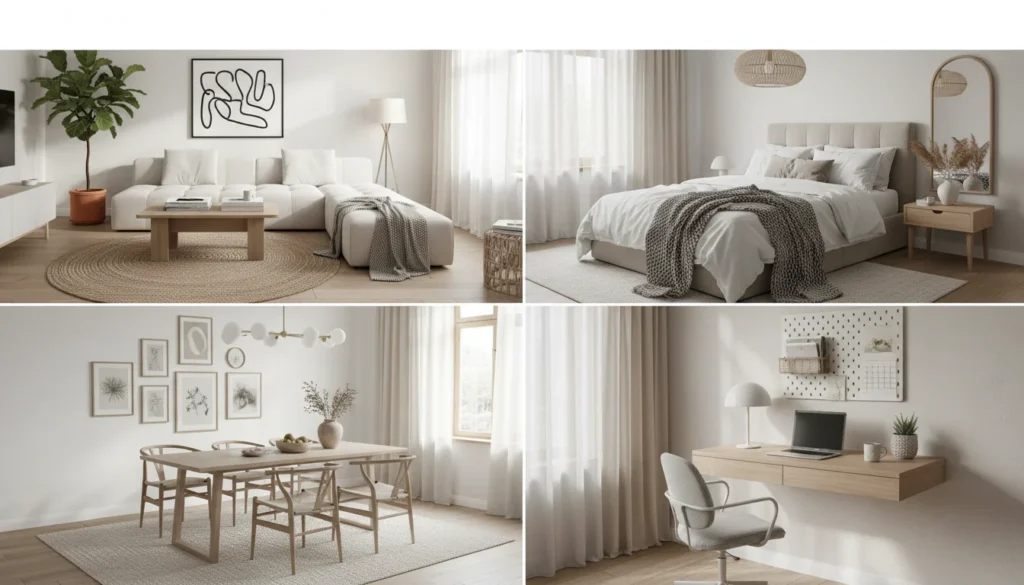
Great house interior decor is the art of making every room in your home feel intentional, personal, and beautiful — not just on the day it is styled, but every ordinary day that follows when life fills the space and the design has to perform without a photographer present.
The homes that feel most compelling and liveable share a quality of considered decision-making — a cohesive palette that flows from room to room, materials chosen for their tactile quality as much as their appearance, furniture scaled correctly to the architecture, and personal objects displayed with enough editorial restraint to let each one be appreciated.
Whether you are starting from scratch, refreshing a tired room, or pulling together a home that has accumulated over the years without a clear design thread, these house interior decor ideas cover the most transformative and practical approaches for every room, budget, and style preference.
List of 15 Best House Interior Decor Ideas
1 Establish a Whole-Home Colour Palette Before Decorating Any Single Room
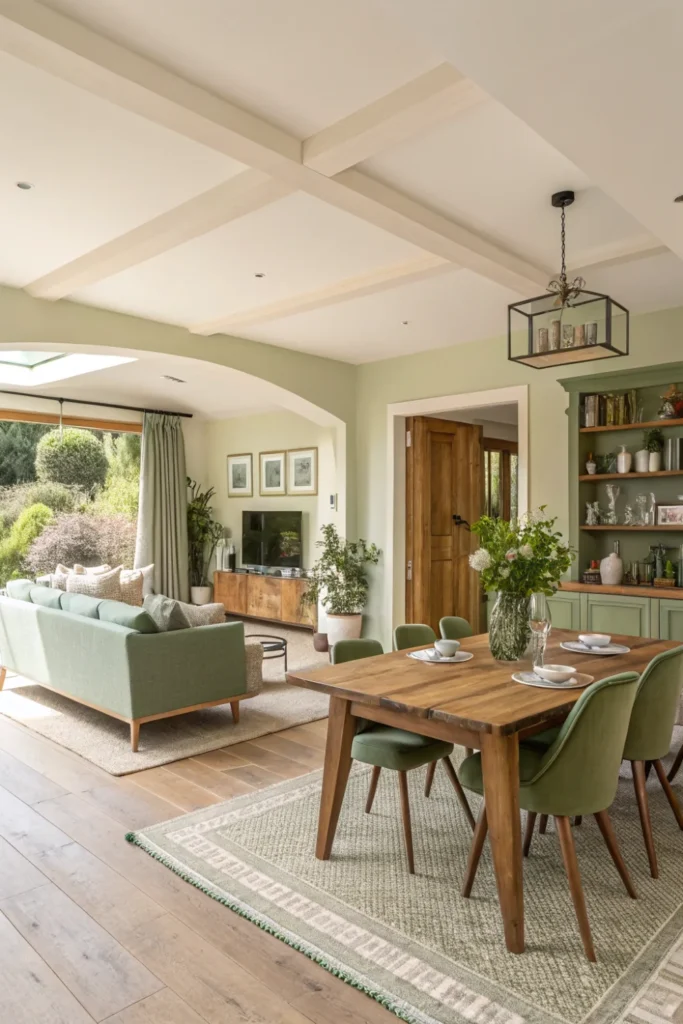
The single most impactful foundation of beautiful house interior decor is a cohesive whole-home colour palette — a family of three to five colours that flows through every room of the house via walls, textiles, and accents, creating a home that feels architecturally unified rather than a collection of unrelated spaces each decorated separately.
A practical approach is to choose one anchor neutral (the primary wall colour that will appear in most rooms), one warm accent (a deeper tone for feature walls, cushions, and rugs), one cool accent (for balance), and one natural material colour (wood, stone, or rattan that appears as furniture or accessories throughout). Every decorating decision in every room should reference this palette.
Take paint swatches from every room in your home and lay them side by side — if you cannot see a clear colour family running through them, that disconnection is what makes the home feel visually restless when you move between rooms. The palette fix is almost always simpler than people expect.
2 Statement Sofa as the Living Room’s Design Anchor
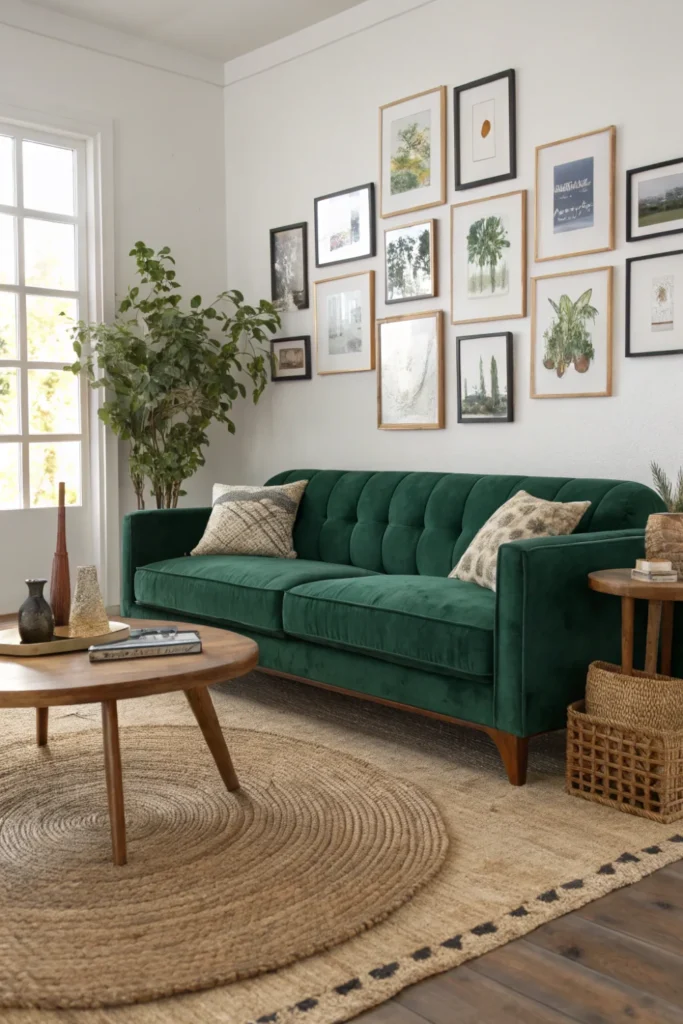
In most homes, the living room sofa is the single largest piece of furniture and the one item that most strongly sets the room’s design tone — choosing a genuinely beautiful, well-proportioned sofa in a considered colour, texture, and profile is therefore one of the highest-leverage house interior decor investments available.
A sofa in a deliberate colour — deep velvet green, dusty rose, warm camel leather, or terracotta linen — immediately establishes the room’s personality and gives every other decor decision a chromatic anchor to work from. A sofa in a neutral that has not been carefully selected simply disappears and leaves the room without a design centre of gravity.
Invest in a sofa with quality frame construction and high-resilience foam cushions — a sofa used daily for ten to fifteen years needs to perform structurally as well as aesthetically, and a beautiful sofa that sags within three years is both a financial and a decorative failure.
Test sofa fabric samples in your actual room light before ordering — fabric colours that appear sophisticated in a showroom’s controlled lighting can read as muddy, cold, or unexpectedly vivid in your home’s specific combination of natural and artificial light.
3 Layered Rug Technique to Define Zones and Add Warmth
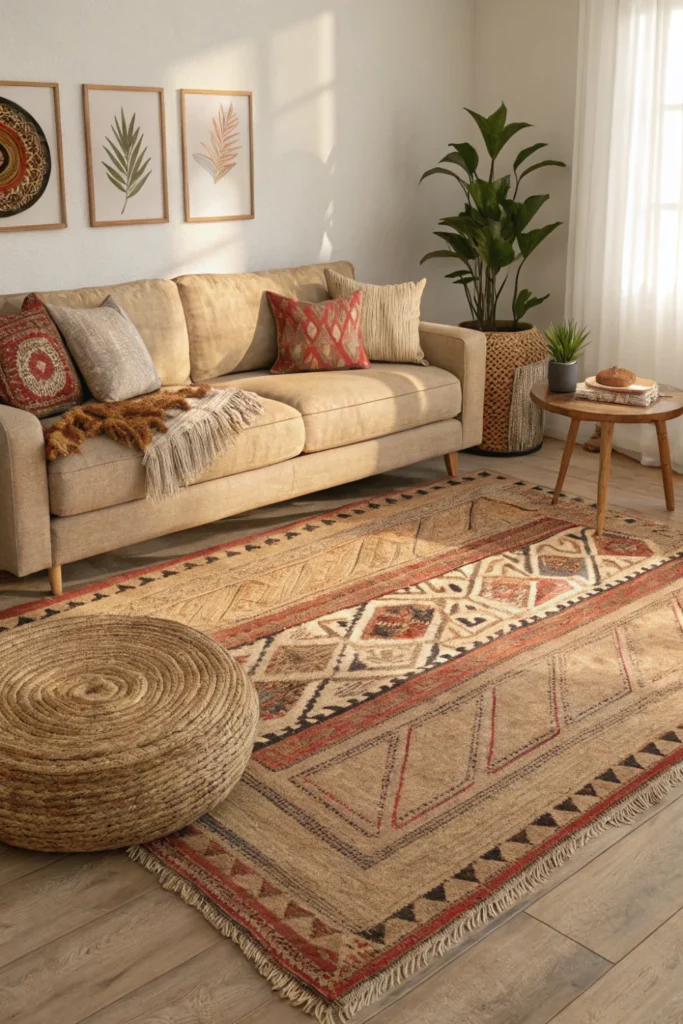
Layering a smaller patterned or textured rug over a larger neutral base rug is one of the most effective house interior decor techniques for adding warmth, depth, and visual interest to a living room, bedroom, or dining space — the combination of two textures and scales creates a richness that a single rug, however beautiful, cannot replicate.
The classic combination layers a flat-woven jute, sisal, or wool rug as the base, then adds a smaller Moroccan, geometric, or shaggy rug on top. The layering also solves a common sizing dilemma — a base rug large enough to anchor the furniture arrangement, with a second smaller rug to add pattern and texture in the seating zone.
Use rug tape or a non-slip mat between layered rugs — without it, the top rug will migrate constantly, which not only looks untidy but creates a genuine trip hazard. Proper anchoring means the layered arrangement stays composed and intentional rather than gradually slipping apart.
4 Curated Gallery Wall as a Personal Design Statement
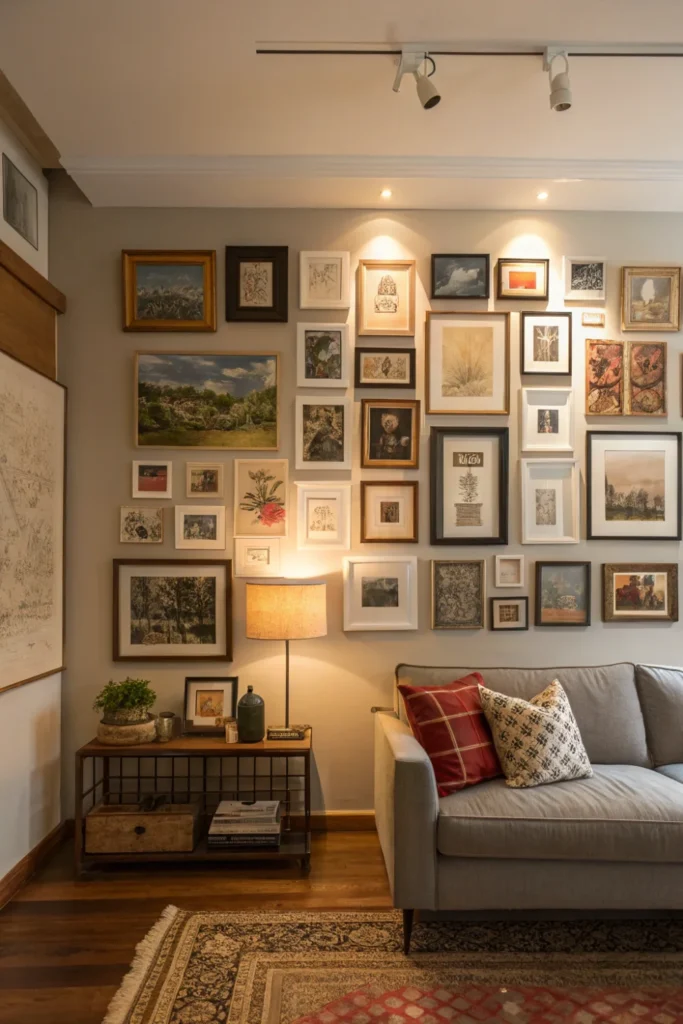
A thoughtfully assembled gallery wall of art, photography, prints, and objects is one of the most personally expressive house interior decor elements in any home — it turns a flat wall surface into a narrative display that communicates who lives in the house, what they value, and where they have been in a way that no single purchased artwork can achieve.
The most compelling gallery walls mix media deliberately — an original painting alongside a framed family photograph, a typographic print beside a small mirror, a sculptural wall object next to a pressed botanical — creating a composition that feels collected rather than curated from a single source.
Trace each frame on paper, cut out the shapes, and tape the paper templates to the wall with painter’s tape before hammering a single nail — this allows you to adjust the overall composition and spacing freely until it is exactly right, without committing to holes that are difficult to fix if the arrangement doesn’t work.
5 Architectural Moulding and Panelling for Character
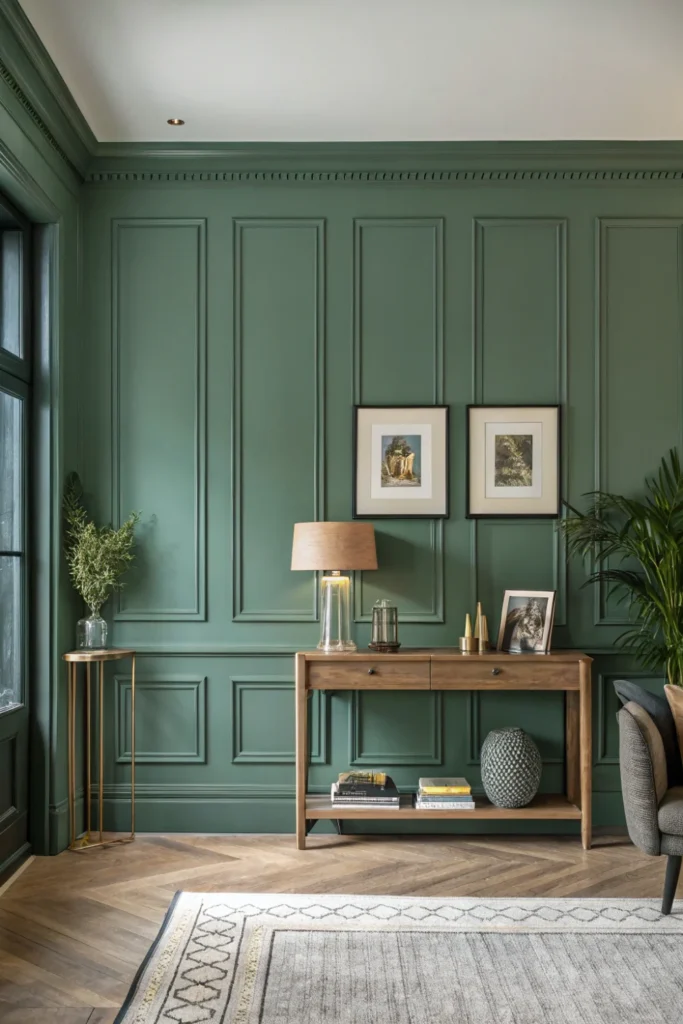
Wall panelling, picture rails, dado rails, cornicing, and ceiling roses are the house interior decor architectural details that most reliably transform the perceived quality of a room — they add depth, shadow, and a sense of crafted permanence that paint and furniture cannot replicate, making even a standard new-build room feel like it has heritage and architectural weight.
Modern panelling is more accessible than ever — MDF panel kits, self-adhesive moulding strips, and peel-and-stick dado rails mean that the panelled-wall effect can be achieved in a weekend for a few hundred dollars, creating a result that most people assume required a skilled joiner and a significant budget.
Half-height wainscoting, full-height vertical shiplap, geometric raised panel patterns, and classic picture-frame moulding in a grid are all distinct approaches with very different aesthetic characters — from farmhouse to Georgian to contemporary — allowing the technique to serve virtually every house interior decor style.
Paint both the panelling and the wall behind it in the same colour — a tonal monochrome panelled wall reads as architecturally sophisticated and contemporary, while panelling painted in a contrasting colour to the wall behind it reads as more traditional and period-specific. Choose based on which aesthetic you are pursuing.
6 Intentional Lighting Design Across Every Room
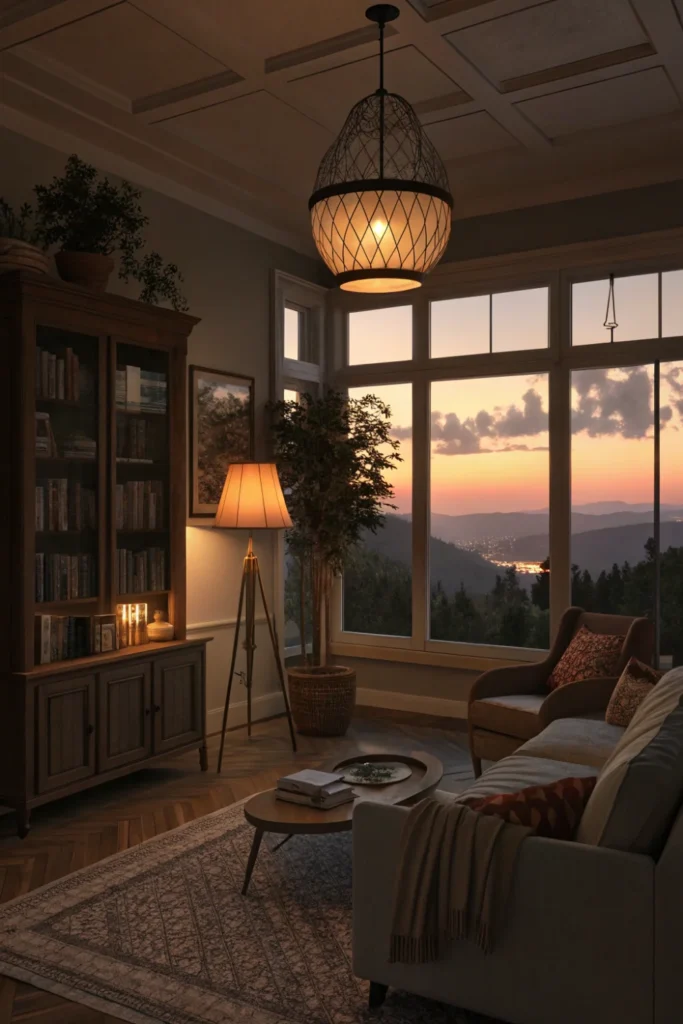
The quality of lighting is the single element of house interior decor that most immediately and dramatically affects how a room feels — the difference between a room lit by a single central overhead fitting and one with properly layered ambient, task, and accent lighting is the difference between a room that feels functional and one that feels designed, warm, and genuinely beautiful.
Every room in a well-decorated home should have at least three lighting sources operating on separate switches or dimmers: a primary ambient source (ceiling fixture or floor lamp), a task source (reading lamp, desk light, under-cabinet lighting), and an accent source (table lamp, wall sconce, or LED strip). The ability to combine these in different configurations for different times of day is what gives a room genuine atmospheric range.
Replace every ceiling overhead fitting in your home with a pendant, chandelier, or semi-flush fixture that directs some light upward toward the ceiling as well as downward — uplighting bounces off the ceiling and creates a soft ambient glow that is far more flattering and liveable than the harsh downward pool of a recessed spot alone.
7 Indoor Plants as Living Architecture
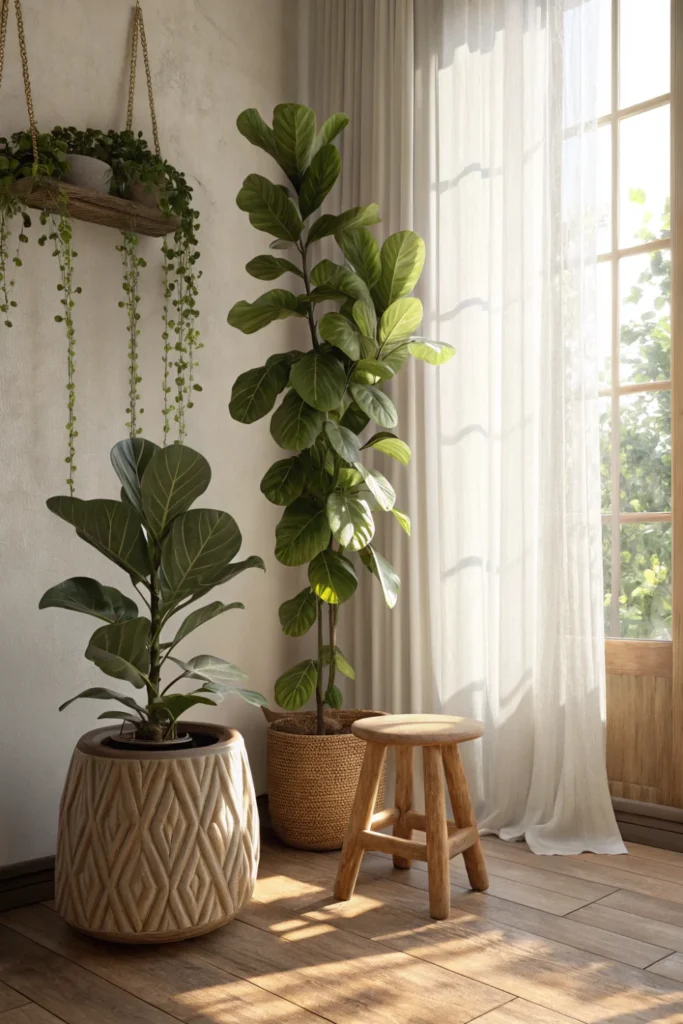
Strategically placed indoor plants — particularly large-scale architectural specimens like fiddle-leaf figs, monstera deliciosa, olive trees, and tall Ficus lyrata standards — are one of the most transformative house interior decor additions available, bringing scale, organic movement, living colour, and a quality of life that no inanimate object can introduce into a room.
The key is thinking of plants as furniture-scaled design elements rather than accessories — a single large plant in the corner of a living room, positioned to fill an empty height zone between the furniture level and the ceiling, does the structural work of defining that corner as a space rather than leaving it as a visual void.
Group plants in odd numbers — one, three, or five — and vary the heights dramatically within the grouping. A tall floor plant beside a medium-height plant on a stool beside a low trailing plant on a shelf creates a visually dynamic composition that a row of same-height plants cannot achieve regardless of the species used.
8 Bedroom Sanctuary Design — Textiles and Calm
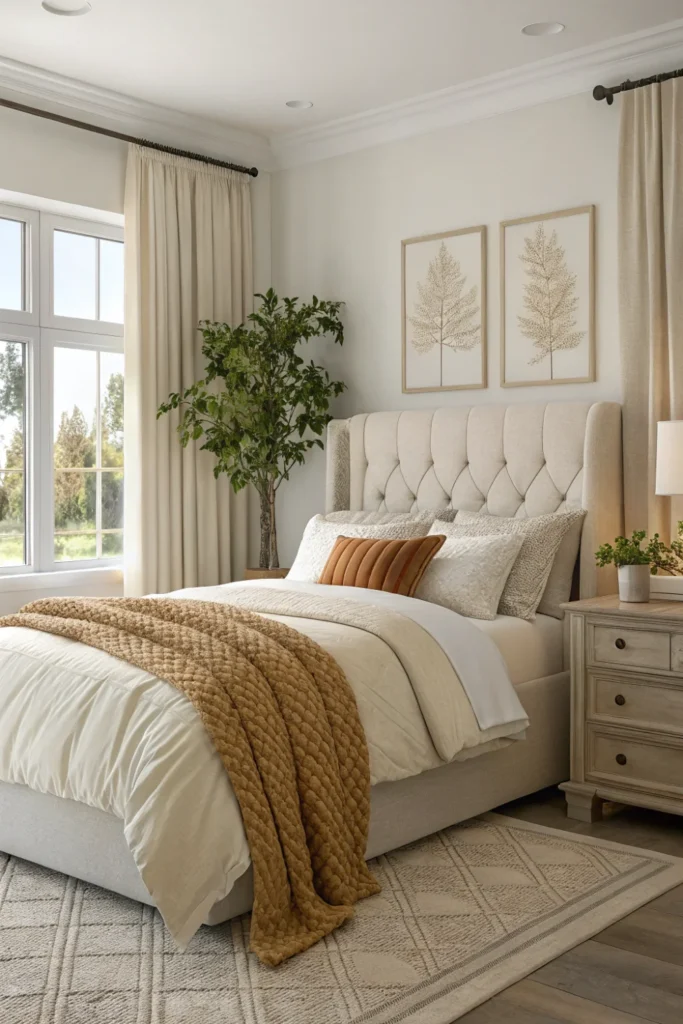
The most important principle of beautiful house interior decor in the bedroom is that the room should prioritise calm, sensory comfort, and sleep quality above all other design considerations — every material, colour, light level, and accessory choice should be evaluated against the question of whether it makes the room more or less conducive to rest.
Achieving this means investing in quality bedlinen in natural fibres — linen, cotton percale, or sateen — in a palette of soft, muted tones, then layering additional textures in quilts, throws, and pillows that invite touch and warmth. The bed itself should look as physically inviting as it is visually considered.
Limit bedroom decor to three texture categories maximum — smooth (bedlinen, a glossy nightstand), woven (a throw, a rug), and natural (a plant, a wooden frame). More texture categories than this creates visual complexity that works against the room’s primary purpose of facilitating relaxation and rest.
9 Bookshelf Styling as a Room’s Character Display
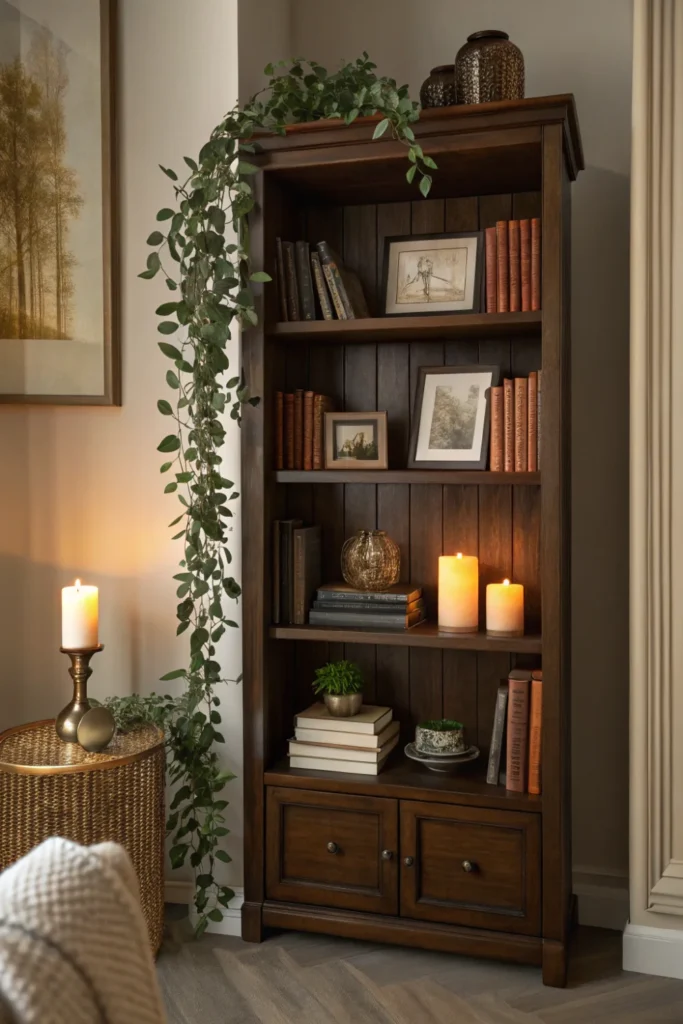
A beautifully styled bookshelf — whether a built-in floor-to-ceiling run or a freestanding unit — is one of the most revealing and personally communicative house interior decor elements in any home, because books, objects, and the way they are arranged together tell the story of who lives in the house more directly than any other decorating decision.
Professional shelf styling alternates books (both vertical and horizontal) with decorative objects at regular intervals, creates depth by placing smaller objects in front of books, introduces occasional empty space to let the eye rest, and maintains a loose colour coherence within each shelf section without being so rigidly organised that it looks like a display case rather than a lived-in library.
Mix volumes and scales deliberately — a tall stack of horizontal books creates a plinth for a small sculpture, a large format art book laid flat becomes a surface for a candle, a framed photograph leaned casually against the spine of a vertical book feels found rather than placed.
Remove all dust jackets from hardback books before styling a shelf — the naked cloth or paper covers underneath are almost always more beautiful in colour and typography than the commercially designed jackets, and a shelf of de-jacketed books has a quietly sophisticated quality that very few people implement but everyone notices.
10 Wallpaper as a Bold Decorative Commitment
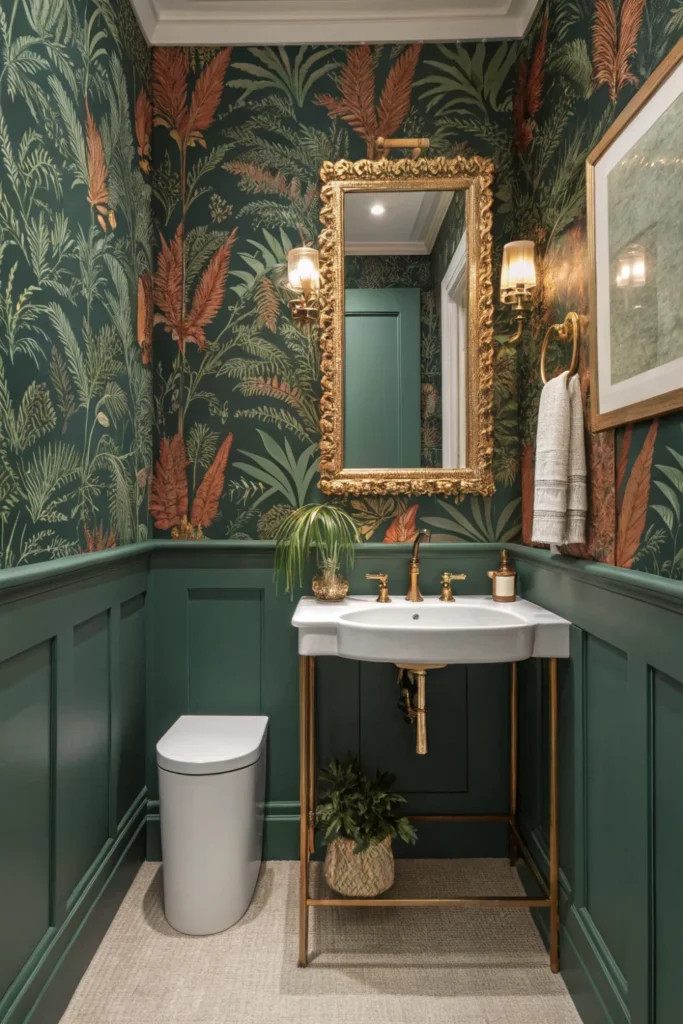
Wallpaper on a feature wall, in an alcove, on a staircase, or throughout a small room like a powder room or home office is one of the most dramatic and immediately transformative house interior decor moves — a room with wallpaper has a designed, committed quality that paint alone rarely achieves, because wallpaper requires a decision and a decision communicates design intent.
The rooms where wallpaper makes the most disproportionate impact for the smallest area covered are powder rooms and cloakrooms — a small room where a dramatic, large-scale botanical print or an immersive geometric pattern creates a jewel-box effect that would be overwhelming in a larger space but is exactly right in a room where intensity is the point.
In a room with low or average ceiling height, choose a wallpaper with a vertical repeat rather than a horizontal stripe or landscape motif — vertical elements draw the eye upward and make the ceiling feel higher, while horizontal patterns emphasise the room’s width at the expense of its height.
11 Entrance Hall Decor That Sets the Home’s Tone
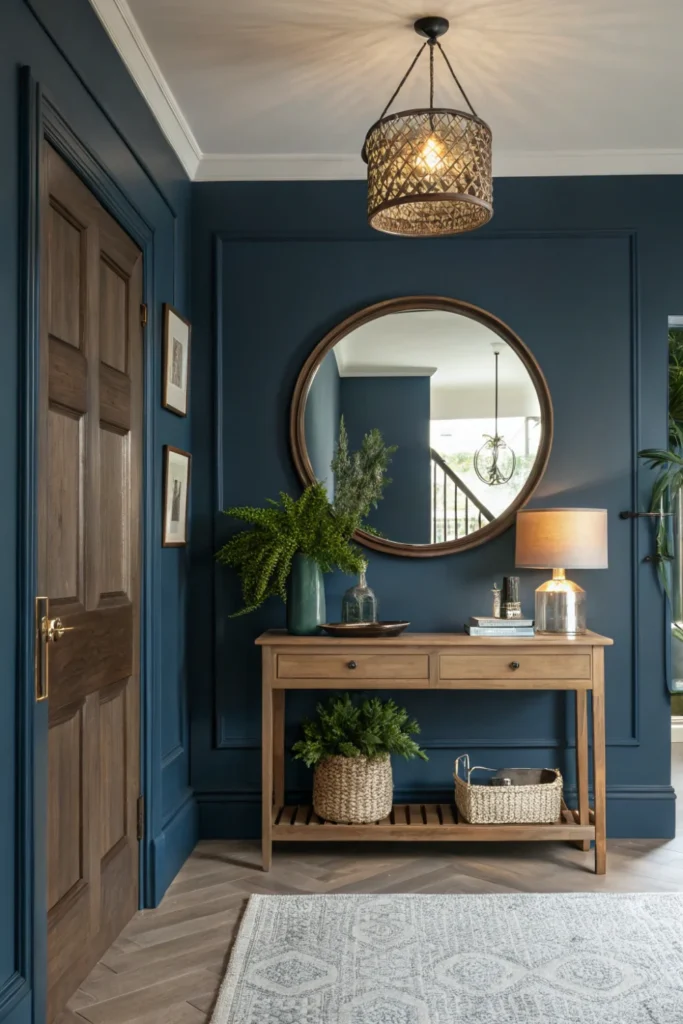
The entrance hall is the first interior space a visitor experiences and the room that most powerfully sets the tone for the entire home’s house interior decor — an entrance that is beautifully considered, warm, and personal creates an immediate impression that colours how every subsequent room is perceived.
Even the smallest hallway benefits enormously from a few considered house interior decor investments: a quality mirror that makes the space feel larger and provides a functional dressing point, a console table or narrow shelf for keys and objects, a single piece of art, and a pendant or wall sconce that provides warm atmospheric light rather than the cold overhead fluorescent that most hallways suffer.
Paint an entrance hall in a slightly deeper or more saturated version of the wall colour used in the adjacent living room — the entrance shade creates a sense of transition and arrival, and the slight darkening makes the main living space feel lighter and more open when you move from one into the other.
12 Mirrors Strategically Placed to Amplify Light and Space
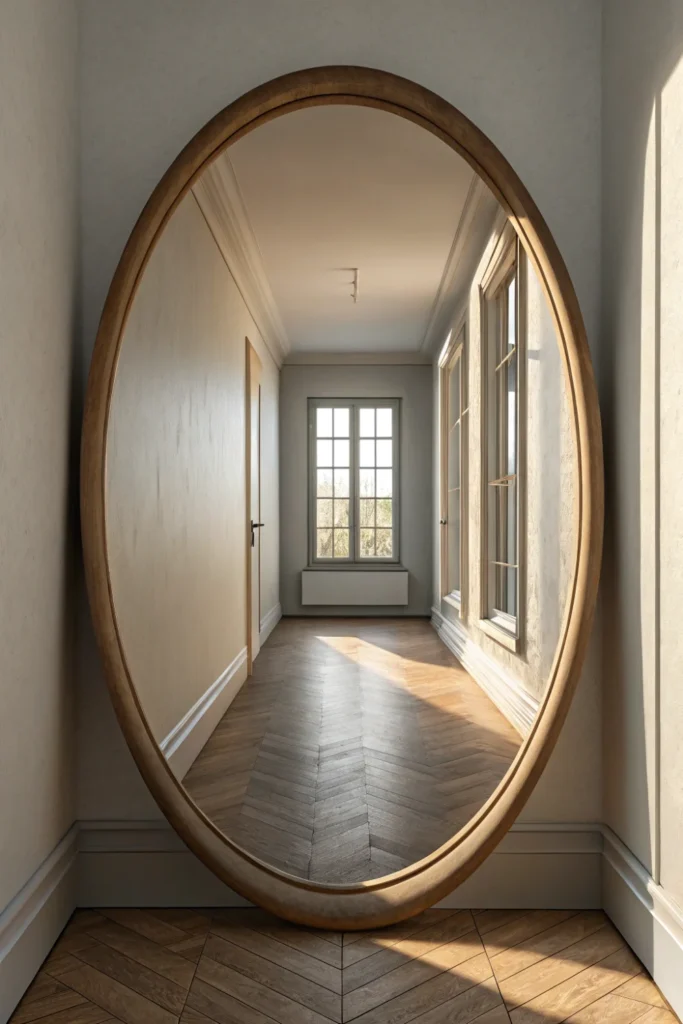
Mirrors used as a deliberate design tool — not just as functional dressing aids but as architectural elements that reflect light, views, and architectural features — are among the most powerful house interior decor investments available, capable of visually doubling the apparent size of a room and dramatically improving its brightness at no structural cost.
The most effective mirror placement positions the reflective surface to capture and double the most visually interesting element in the room — a window view, a piece of art, a beautiful lamp, or an architectural detail. A mirror that reflects a blank wall simply doubles the least interesting element of the space and provides none of the design benefit.
In a dark hallway or narrow corridor, hang a mirror at the far end rather than on the side wall — a mirror at the end of a corridor creates the illusion of the corridor continuing beyond, effectively doubling its perceived length, which is a far more dramatic spatial effect than a side mirror that merely reflects the opposite wall.
13 Scent as the Invisible Layer of House Interior Decor
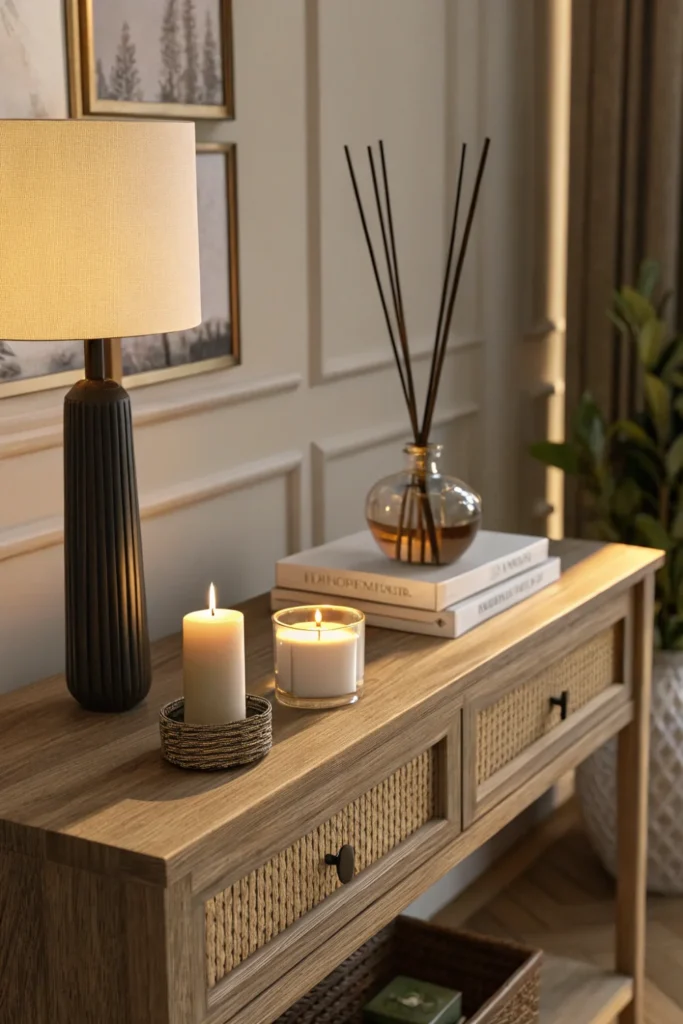
Scent is the most emotionally powerful and most consistently neglected dimension of house interior decor — the olfactory impression a home makes is processed emotionally before any visual information registers consciously, meaning that how a home smells shapes how it feels before a visitor has consciously assessed how it looks.
A considered home scent strategy uses different fragrances in different rooms — a fresh, green note in the kitchen, a warm woody or amber note in the living room, a clean linen or lavender scent in bedrooms — creating olfactory transitions that reinforce each room’s character in the same way that colour palette and lighting transitions do visually.
Scent diffusers and candles work best when placed near the entry point of each room rather than in the centre — placing fragrance near a doorway means the scent is encountered when entering the room rather than only when standing beside it, creating the fullest possible first impression of each space.
14 Dining Room Styling Around a Statement Table
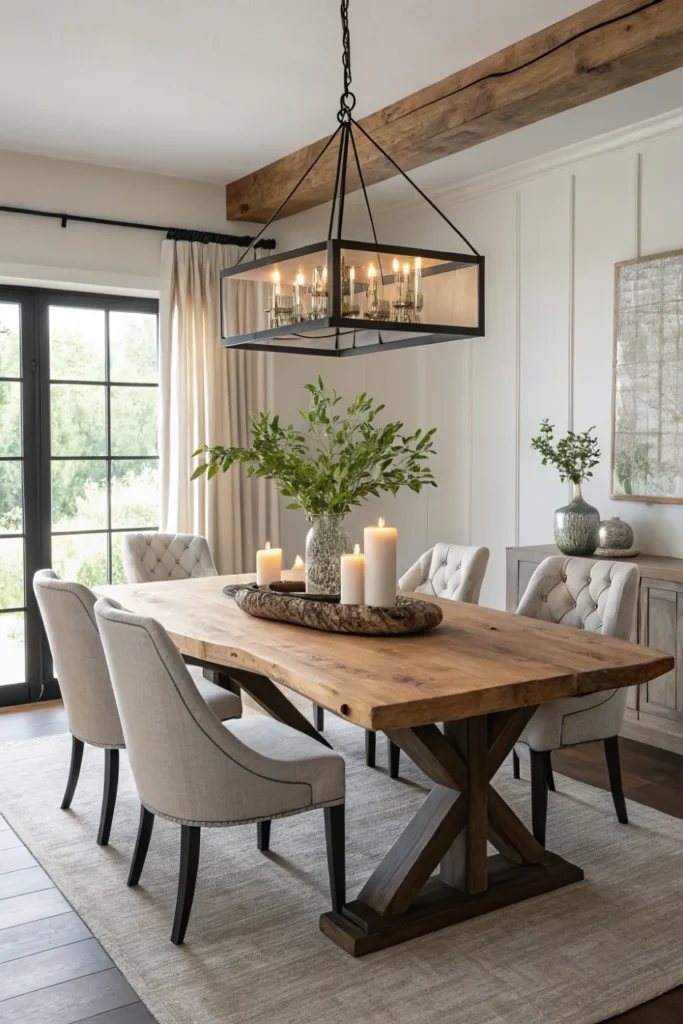
The dining table is the most socially important piece of furniture in the home — the place where meals, celebrations, conversations, and connections happen — and treating it as the primary house interior decor investment in the dining room ensures that the space performs both visually and experientially at the level it deserves.
A dining table in a material of genuine quality — solid oak, live-edge walnut, white marble, or brushed concrete — becomes more beautiful with use rather than less, developing the kind of character that flatpack and veneer tables cannot accumulate regardless of how long they are owned.
The styling of the dining table between meals matters as much as its layout during them — a centrepiece arrangement of candles and a vase of stems, a runner in a quality textile, and a small object or two creates a permanent composition that makes the room feel ready for guests at all times rather than only when the table is formally set.
Choose dining chairs in two complementary styles rather than a fully matching set — a set of six identical chairs reads as furniture store; a set of four matching chairs at the sides with two contrasting carvers at the head and foot reads as a collected, considered, and more interesting dining composition.
15 Edit Ruthlessly — Less on Display Means More Impact
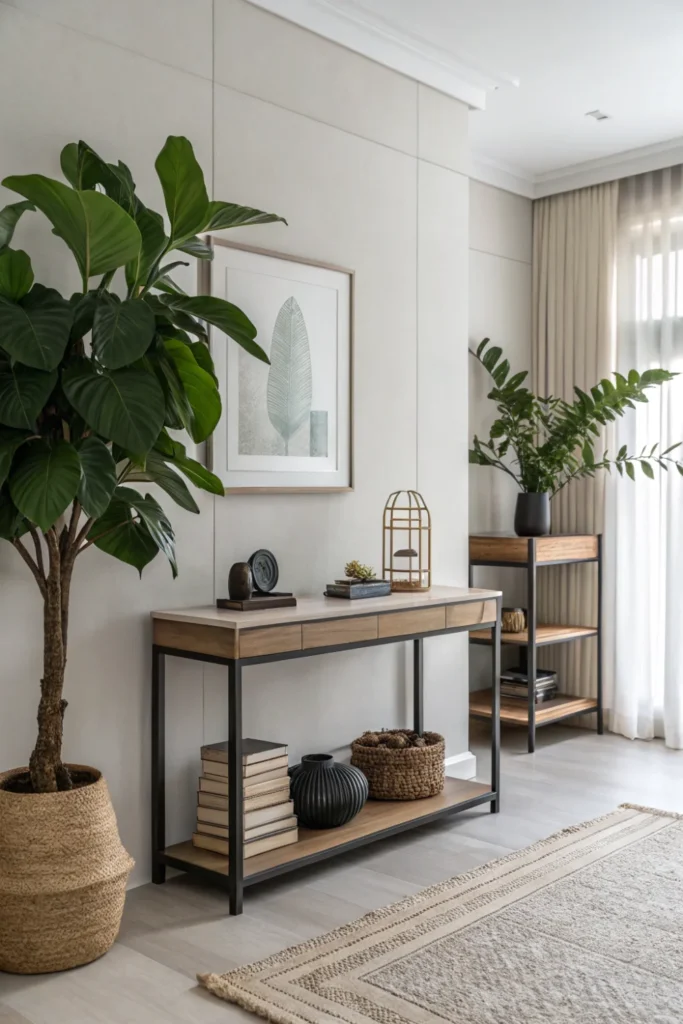
The most counter-intuitive and consistently underestimated house interior decor idea is radical editing — the deliberate removal of objects, accessories, and furniture that are not genuinely earning their place in the room, creating the generous negative space that allows the things that remain to be properly seen and appreciated.
Most homes suffer not from a lack of beautiful things but from an excess of things that individually have little significance and collectively create the visual noise that makes a room feel busy and small rather than considered and spacious. Removing forty percent of the objects from a typical shelf, console, or coffee table almost universally improves its appearance.
The museum test: treat each decorative object in your home as if you were a museum curator deciding what earns display space. If an object does not make you feel something — pleasure, memory, admiration, humour — it is occupying space that a better object or simply empty space could use more effectively. This is the discipline that distinguishes a beautifully decorated home from a merely furnished one.
Why House Interior Decor Ideas Are Worth the Investment
Investing thoughtfully in house interior decor delivers returns that compound over time — a home that has been carefully considered and deliberately decorated becomes more beautiful as the materials age, the plant life grows, the books accumulate, and the objects collected tell an increasingly layered personal story. Unlike trend-driven fast-decor that dates within seasons, quality house interior decor improves rather than diminishes.
The wellbeing benefits of a well-decorated home are documented and significant — environments that are visually calm, materially warm, well-lit, and personally resonant consistently produce lower stress hormones, better sleep quality, and greater reported life satisfaction in the people who live in them. House interior decor is therefore an investment in daily health and happiness as much as in aesthetics.
From a financial perspective, a home with genuinely considered house interior decor — quality materials, architectural interest, well-executed lighting, and a coherent design story — commands measurably higher sale prices and rental values than identical properties with generic or neglected interiors. Good decoration is one of the most cost-effective value-adding investments a homeowner can make.
Things to Consider Before Choosing House Interior Decor Ideas
Before committing to any house interior decor direction, assess your home’s architecture honestly — the bones of a Victorian terrace, a mid-century ranch, a Georgian townhouse, and a contemporary apartment each suggest different aesthetic directions, and working with the architecture rather than against it almost always produces better results. Fighting the architecture is expensive and rarely convincing.
Consider how you actually live before making any decorating decision — a white linen sofa is beautiful in theory and practically impossible to maintain with children and pets; an open-shelf kitchen display wall requires a level of daily organisational discipline that not every household can sustain; a light-coloured wool rug in a high-traffic hallway will look worn within a year. Great house interior decor always starts with honest self-knowledge about habits and lifestyle.
Always plan the whole-home palette and furniture scale before purchasing individual pieces — the most common and expensive decorating mistake is buying individual items that are each beautiful in isolation but do not relate coherently to one another. A sofa that is the wrong scale for the room, a rug in a colour that clashes with the curtains, a lamp that competes with the artwork — all avoidable with a simple whole-room plan before any purchase is made.
Comparison Table of House Interior Decor Ideas
| Decor Idea | Cost Range | DIY Friendly | Impact Level | Best Room | Time to Execute |
|---|---|---|---|---|---|
| Whole-Home Colour Palette | $60–$400 | Yes | Very High | All rooms | 1–2 weekends |
| Statement Sofa | $800–$6,000 | Yes | Very High | Living room | 6–12 weeks (delivery) |
| Layered Rug Technique | $100–$1,200 | Yes | High | Living / Bedroom | 1 hour |
| Curated Gallery Wall | $80–$800 | Yes | High | Living room / Hall | Half day |
| Architectural Moulding | $100–$2,000 | Partial | Very High | Any room | 1–2 weekends |
| Layered Lighting Design | $200–$2,000 | Partial | Very High | All rooms | 1–2 days |
| Indoor Plants as Architecture | $40–$400 | Yes | High | Any room | 1–2 hours |
| Bedroom Sanctuary Design | $200–$2,000 | Yes | Very High | Bedroom | 1–2 days |
| Bookshelf Styling | $0–$200 | Yes | Medium–High | Living / Study | 2–3 hours |
| Feature Wallpaper | $80–$600 | Partial | Very High | Any room | Half–full day |
| Entrance Hall Decor | $100–$1,200 | Yes | High | Hallway | 1 day |
| Strategic Mirror Placement | $50–$600 | Yes | High | Any room | 1–2 hours |
| Home Scent Strategy | $30–$300 | Yes | Medium–High | All rooms | 1 hour |
| Dining Room Statement Table | $400–$5,000 | Yes | Very High | Dining room | 2–8 weeks (delivery) |
| Ruthless Editing | $0 | Yes | Very High | All rooms | 1–2 weekends |
Frequently Asked Questions About House Interior Decor Ideas
Where should I start with house interior decor if my home feels completely unstyled?
Start with the whole-home colour palette before purchasing or changing anything else — identifying the three to five colours that will run through the entire home creates the design infrastructure that every subsequent purchase decision can reference. Without a palette, individual decor purchases accumulate without coherence and the home continues to feel unstyled regardless of the quality of individual pieces.
After the palette, focus on the living room sofa and primary rug as the two pieces that most strongly establish the room’s character. These two items together represent the largest visual surface area and the highest daily-use frequency of any furniture in the home, and getting them right creates a foundation that makes every subsequent house interior decor decision easier and more clearly directed.
How do I make house interior decor feel personal rather than like a showroom?
The distinction between a showroom and a genuinely lived-in home comes down to the presence of objects with personal narrative — photographs, books you have actually read, objects collected from travel, inherited pieces, artwork you bought because it moved you rather than because it matched the sofa. These items communicate that a person lives in the space rather than a concept.
The most beautifully personal house interior decor also shows evidence of time — a patinated leather chair, a worn wooden floor, a gallery wall that has grown organically over years, a shelf of books with broken spines. Homes that look as though they were designed and installed simultaneously lack the layered quality of a space that has been lived in and evolved through real life.
What are the most impactful low-budget house interior decor changes?
The four highest-impact house interior decor changes available for under $100 each are: painting walls in a deliberate, confident colour rather than continuing with builder’s white; replacing all overhead light bulbs with warm-white LED alternatives at 2700K; removing half the objects from every shelf and surface in the home; and repositioning existing furniture to create clear circulation paths and properly proportioned seating arrangements. None of these require spending significant money — they require spending time and making decisions.
Beyond these, a quality throw and two well-chosen cushions on a tired sofa, a new rug in a better colour and texture, and a large indoor plant in a beautiful pot represent the next tier of low-cost house interior decor upgrades that produce visual returns far in excess of their financial cost.
How do I keep house interior decor feeling fresh without constantly buying new things?
The most sustainable approach to keeping house interior decor feeling current and alive without continuous purchasing is seasonal restyling — moving objects between rooms, changing the arrangement of a gallery wall, rotating which art is displayed and which is stored, swapping the cushion covers and throw on a sofa, and changing the plants and flowers that occupy key positions throughout the home. All of this refreshes the visual experience of the home without adding anything new.
Editing regularly — removing things that no longer earn their place — is equally important. A home that is regularly curated and edited feels fresh and considered at any season; a home where objects accumulate undisturbed feels dated regardless of when they were purchased or how good they looked originally.