
At some point, every kitchen hits that stage where the cabinets feel like they gave up years before you did. You promise yourself a “small kitchen update,” and suddenly you’re deep in color swatches, questioning your life choices, and debating whether white oak feels calmer than walnut at 11:47 PM.
This guide will walk you through the 15 trending kitchen cabinet designs. Two-tone setups where light uppers meet darker bases, Shaker doors with those neat horizontal grains, and integrated pulls that magically make the space look organized even when the rest of your house isn’t.
You’ll also see how glossy finishes bounce light around like they’re trying to flatter you, and how warm wood tones soften the room without making it look heavy.
Two-Tone Cabinet Combinations

Two-tone cabinet combinations have shifted from a niche design choice into a distinguishing feature of modern kitchens that I’m seeing everywhere. When I design these spaces, I find contrasting color combinations work best when I pair light uppers with darker base cabinets, creating visual weight and spatial balance that feels natural.
Light uppers with darker base cabinets create natural visual weight and spatial balance in two-tone kitchen designs.
Navy blue paired with warm white delivers sophistication that never goes out of style, while sage green combined with natural oak brings organic warmth I love incorporating into family kitchens. I strategically place eye-catching accent colors on kitchen islands to convert them into functional focal points that anchor the entire space.
I often recommend charcoal gray, deep forest green, or matte black for lower cabinetry while maintaining crisp whites or soft neutrals above for ideal contrast that makes ceilings appear higher.
Pro tip: Always test your color combinations in different lighting conditions throughout the day, as natural and artificial light can dramatically change how your two-tone cabinets appear.
Shaker-Style Cabinets

While I’m exploring traditional Shaker cabinets, I’ve discovered they’ve maintained their appeal for centuries, but today’s iterations incorporate sleek hardware, unexpected finishes, and streamlined proportions that transform this classic style into something distinctly contemporary.
I’m noticing modern style updates like horizontal grain patterns, ultra-matte lacquers, and integrated pulls that eliminate visible hardware. The sleek shaker design I’m researching now features thinner rails and stiles, creating refined shadow lines that emphasize minimalism.
I’m considering pairing these cabinets with waterfall countertops or handleless mechanisms for seamless functionality. These contemporary adaptations I’m finding preserve Shaker’s honest craftsmanship while providing the clean aesthetics demanded in today’s sophisticated kitchens.
Pro tip: I recommend choosing ultra-matte finishes in neutral tones to maximize the modern Shaker aesthetic while ensuring timeless appeal that won’t date your kitchen design.
High-Gloss Lacquered Finishes

High-gloss lacquered finishes deliver unmatched reflective surfaces that amplify natural light and create the illusion of expanded space in contemporary kitchens. I’m seeing these sleek, glossy finishes transform minimal designs into sophisticated statements through high-shine lacquer details.
| Finish Type | Light Reflection | Maintenance Level |
|————-|——————|——————-|
| Piano Black | 95% reflectivity | Daily wiping required |
| Pure White | 90% reflectivity | Shows fewer fingerprints |
| Metallic Gray | 85% reflectivity | Moderate upkeep |
| Navy Blue | 80% reflectivity | Weekly cleaning sufficient |
| Emerald Green | 80% reflectivity | Scratch-resistant coating |
These surfaces demand quality materials but reward you with dramatic visual impact.
Pro tip: Install LED strip lighting under wall cabinets to maximize the light-bouncing effect of high-gloss finishes while minimizing harsh shadows.
Natural Wood Grain Cabinets
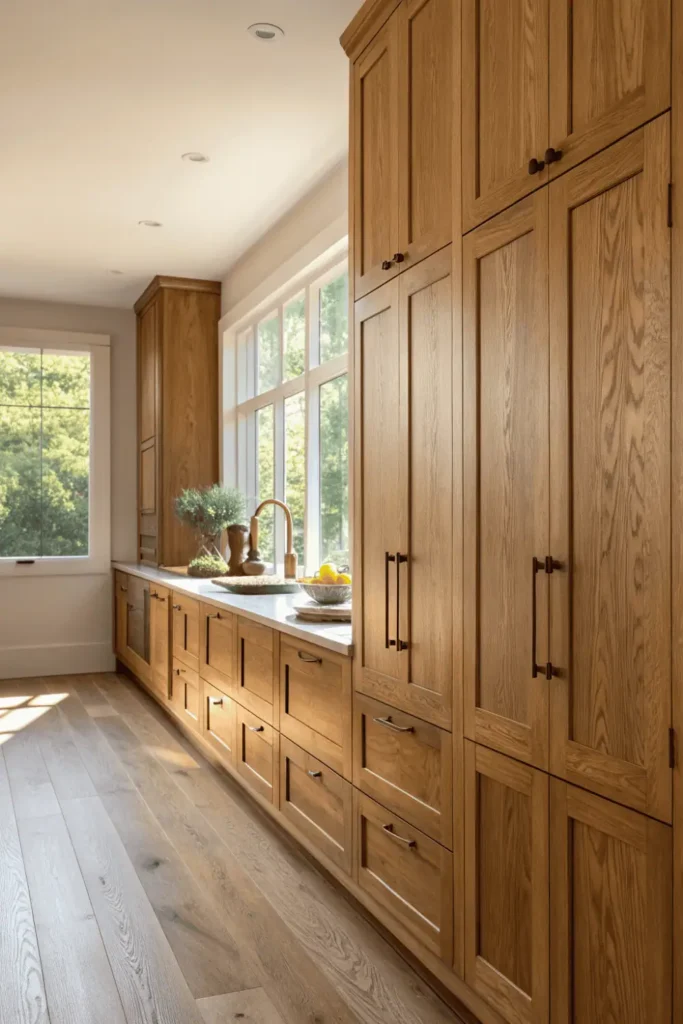
I’m designing kitchens where natural-wood-grain cabinets serve as the foundation for modern spaces, bringing organic warmth that synthetic materials can’t match. I consistently choose white oak, walnut, and maple for current projects, as each species delivers distinct character through unique grain patterns.
Natural wood grain cabinets create foundational warmth in modern kitchens through authentic organic character that synthetic materials cannot replicate.
These natural textures excel in Scandinavian-inspired designs and pair beautifully with stone countertops. I orient grains horizontally for contemporary appeal, or select vertical patterns for traditional elegance. I enhance these organic textures using matte sealers that maintain the wood’s natural feel while providing essential moisture protection.
I create sophisticated depth by pairing wood cabinets with metal accents in mixed-material designs that elevate the kitchen’s visual impact.
Pro tip: Match your wood grain direction to your kitchen’s proportions – horizontal grains make narrow spaces feel wider, while vertical grains add height to low-ceiling rooms.
Deep Navy and Jewel-Toned Cabinets

I’ve watched jewel-toned cabinets evolve from daring outliers to mainstream staples in just three years, with deep navy spearheading this bold color revolution. I’m finding this trend delivers moody sophistication that photographs exceptionally well while maintaining timeless appeal.
I’m implementing these strategic applications:
- I pair navy lowers with white uppers to ground the space without overwhelming it
- I layer jewel toned accents through hardware finishes like brass or copper pulls
- I specify semi-gloss sheens to maximize light reflection in darker palettes
- I balance saturated cabinetry with light countertops and neutral backsplashes
This approach I’m using creates dramatic focal points while preserving resale flexibility.
Pro tip: Start with navy on lower cabinets only—it’s easier to live with and you can always expand the color coverage later if you love the look.
Handleless and Push-to-Open Cabinets

Minimalist kitchen design demands hardware-free facades, and push-to-open mechanisms are converting from luxury upgrades to standard specifications across mid-range projects. I achieve seamless aesthetics by pairing these systems with soft-close hinges, eliminating noise while protecting cabinet integrity.
The hardware-free approach grants space-saving storage solutions by removing protruding handles that interrupt workflow patterns. I consider integrated aluminum profiles or J-pull channels when I need tactile access points without compromising clean lines.
These mechanisms require precise installation—cabinet alignment and door weight distribution directly impact functionality. I’m investing in contemporary sophistication that photographs beautifully and performs reliably under daily use.
Pro tip: Test push-to-open mechanisms with fully loaded cabinets during installation, as added weight can affect the release sensitivity and require adjustment.
Glass-Front Display Cabinets

Glass-Front Display Cabinets
When I’m designing contemporary kitchens, I find that glass-front display cabinets offer the perfect solution for balancing functional storage with curatorial display. I use strategic cabinet transparency to transform everyday items into design elements.
This approach takes display storage far beyond traditional china cabinets, and I often incorporate LED lighting systems and frameless glass panels for maximum impact.
Key design considerations I focus on:
- Tempered glass options – I always specify these to guarantee durability while maintaining visual clarity
- Internal lighting integration – I design this to highlight dishware and create ambient illumination throughout the space
- Mixed cabinet configurations – I combine glass-front units with solid doors to achieve the right balance
- Minimalist framing details – I keep these clean to maximize visibility and complement modern aesthetics
Through intentional curation, I create sophisticated focal points while maintaining practical kitchen functionality.
Pro tip: I recommend limiting glass-front cabinets to 30-40% of your total upper storage to avoid visual overwhelm while ensuring you have adequate concealed storage for everyday clutter.
Matte Black Cabinet Designs

Bold matte black cabinetry has evolved from an edgy accent choice into a sophisticated staple that I’m seeing anchor modern kitchen designs everywhere. I find that matte black cabinet finishes eliminate glare and fingerprints while creating dramatic visual depth that transforms any space.
These cabinets work exceptionally well in both minimalist and industrial aesthetics that I love to design, pairing beautifully with brass hardware, marble countertops, or walnut accents. The versatile design possibilities I explore extend beyond all-black kitchens—I often incorporate matte black on lower cabinets while keeping upper units light, or use it strategically on islands to establish striking focal points. This finish maintains its contemporary appeal while offering the timeless durability I always recommend to clients.
Pro tip: Start with matte black on your kitchen island first—it’s the perfect way to test this bold look before committing to full cabinetry.
Open Shelving Mixed With Closed Cabinets

You’ll achieve this balanced aesthetic through:
The perfect kitchen merges open display with concealed storage—creating visual breathing room while keeping clutter firmly behind closed doors.
- Floating shelves positioned above base cabinets to showcase curated dishware and plants
- Glass-front uppers mixed with solid doors for controlled transparency
- Staggered heights combining open and closed units for dimensional interest
- Corner shelving paired with adjacent closed storage for workflow optimization
This hybrid approach gives you functional flexibility without sacrificing design sophistication.
Pro tip: Keep open shelves styled with items you use regularly – this maintains both form and function while preventing dust accumulation on decorative pieces.
Textured and Fluted Cabinet Fronts

I’m designing fluted cabinet fronts that transform flat surfaces into architectural statements through vertical grooves that catch light and create dramatic shadow play throughout the kitchen. I find these elements particularly striking on island bases and upper cabinets, where their linear patterns establish visual rhythm.
I pair fluted designs with textured surfaces on adjacent elements to build dimensional contrast without creating visual chaos. These profiles excel in minimalist schemes, introducing tactile interest while preserving clean lines. I recommend limiting fluted treatments to key focal points—the island or a feature wall—to maximize their dramatic impact while maintaining overall design balance.
Pro tip: Position fluted cabinets perpendicular to your primary light source to enhance the shadow play and maximize their sculptural effect.
Warm Earthy Sage and Green Cabinets
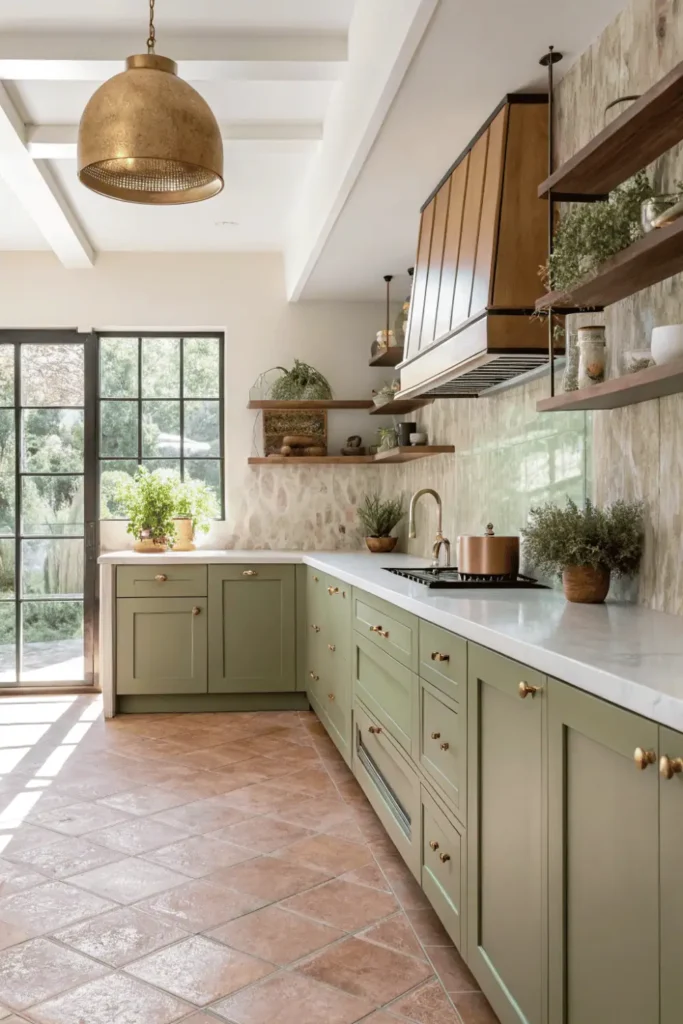
While cool-toned kitchens dominated the past decade, I’m now gravitating toward warm sage and green cabinets that ground contemporary spaces with organic sophistication. These muted botanical hues bridge minimalist modernism with rustic farmhouse aesthetic, creating environments that feel restorative rather than sterile.
Warm sage cabinets create restorative kitchen environments that seamlessly merge contemporary minimalism with rustic organic charm.
Strategic design applications I recommend:
- Pair sage cabinets with brass hardware and walnut countertops for depth
- Layer complementary accent colors like terracotta or warm whites
- Specify matte finishes to emphasize the earthy, tactile quality
- Contrast with black fixtures for a contemporary edge
I find these combinations create kitchens that balance trend-forward design with timeless natural warmth.
Pro tip: Test your sage cabinet samples under both natural and artificial lighting—these colors can shift dramatically throughout the day, and you want to ensure they maintain their warmth in all conditions.
Floating Cabinets for a Contemporary Look

I’m installing floating cabinets to create a contemporary kitchen aesthetic that maximizes both visual and physical space. I suspend the upper storage units away from walls using concealed brackets, which creates an impressive illusion of weightlessness while opening up compact kitchens visually.
I focus on the minimalist design benefits that eliminate visual clutter through clean horizontal lines and distinctive shadow gaps that enhance spatial perception. I find these space-saving solutions work exceptionally well in contemporary environments where I want to maintain uninterrupted sightlines throughout the kitchen.
I install LED strip lighting beneath the floating units to amplify the levitation effect while providing essential task illumination for food preparation areas. I pair them with handleless mechanisms and matte finishes to achieve a streamlined aesthetic that’s both highly functional and visually striking in modern residential spaces.
Pro tip: I ensure the wall structure can support the weight by using proper wall anchors and distributing the load across multiple studs for safety and longevity.
Integrated LED Lighting Solutions

I integrate LED lighting directly into cabinet design to create functional illumination systems that enhance both visibility and ambiance in contemporary kitchens. You’ll appreciate how these energy efficient lighting systems reduce electricity costs while providing superior brightness. Modern installations offer customizable lighting options that let you adjust color temperature and intensity for different tasks and moods.
Under-cabinet strips illuminate countertops for precise food preparation and cooking tasks. Interior cabinet lighting activates automatically when you open doors, showcasing dishware collections. Toe-kick lighting creates a dramatic floor-level ambient glow throughout your kitchen space. Glass cabinet backlighting highlights structural features and decorative elements beautifully.
Pro tip: Install dimmer controls for your integrated LED systems to create perfect lighting transitions from bright task illumination during cooking to warm ambient lighting for dining and entertaining.
Mixed Material Cabinets

Today’s kitchen designers are combining wood, metal, glass, and stone within single cabinet systems to create striking visual contrasts that define contemporary spaces. I’m seeing walnut doors paired with brushed brass frames, or matte lacquer uppers complementing textured oak lowers. These contrasting materials establish spatial hierarchy while adding dimensional depth to your kitchen’s aesthetic.
Blended materials work particularly well in transitional designs, where I’m bridging traditional warmth with modern minimalism. I often incorporate metal mesh inserts, leather-wrapped handles, or concrete-effect panels. This approach allows me to customize zones within your kitchen, creating functional distinction through material variation rather than color alone.
Pro tip: Start with two primary materials and add a third accent sparingly—too many mixed materials can overwhelm the space and lose visual impact.
Slab-Front Minimalist Cabinets

Slab-front cabinets represent the pinnacle of minimalist design, featuring handleless construction and completely flat, uninterrupted surfaces that eliminate visual clutter through radical simplification. I’m creating a sleek aesthetic that defines contemporary kitchens through clean lines and flush-mounted doors. The minimalist appeal extends beyond mere appearance—these cabinets integrate seamlessly with push-to-open mechanisms and recessed pulls for a truly streamlined experience.
Seamless integration: I’m incorporating concealed hinges and touch-latch systems that maintain completely unbroken surfaces
Material versatility: I’m selecting from lacquered wood, thermofoil, or high-gloss acrylic finishes to match any design vision
Color impact: I’m using monochromatic schemes that amplify the streamlined effect and create visual harmony
Space perception: I’m leveraging flat fronts to create visual continuity, making kitchens appear significantly larger
Pro tip: Pair slab-front cabinets with integrated appliances to create an uninterrupted wall of cabinetry that maximizes the minimalist impact.
Cabinet Hardware Selection Errors
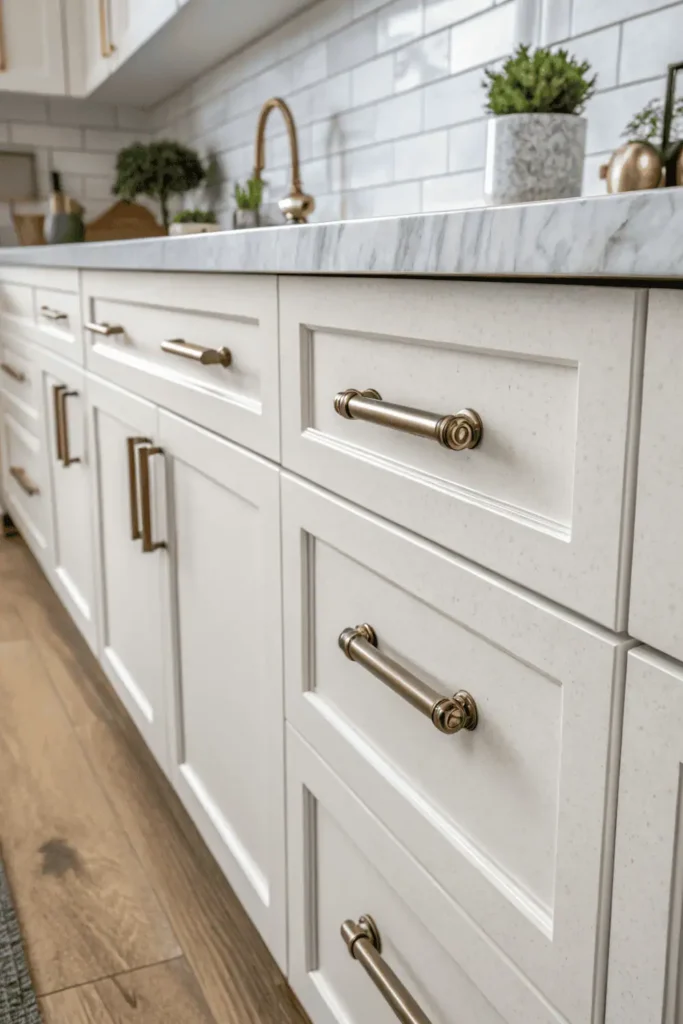
While selecting stunning cabinet designs receives considerable attention, I’ve seen hardware choices undermine even the most sophisticated cabinetry when executed poorly. I evaluate hardware finish options systematically—mixing metals without intention creates visual chaos, while coordinated finishes establish cohesion.
Hardware size considerations prove equally critical; oversized pulls overwhelm delicate shaker doors, whereas undersized knobs disappear on expansive drawer fronts. I make a mistake when selecting hardware before finalizing cabinet dimensions and door styles. Proportion matters greatly—my hardware should complement, not compete with, the cabinetry’s structural lines. I test physical samples against actual cabinet surfaces before committing.
Pro tip: Order hardware samples early in your design process and view them under your actual kitchen lighting—colors and finishes can look drastically different under showroom versus home conditions.
Kitchen Cabinet Product Links

I’ve curated specific product recommendations that align with trending cabinet aesthetics I’m evaluating throughout this guide.
These selections showcase innovative cabinet materials and cabinet storage solutions that I’m recommending to enhance your kitchen’s functionality and style:
- Semihandmade Cabinet Fronts – Premium customizable doors compatible with IKEA systems, featuring sustainable wood species and contemporary finishes that I’ve tested
- Rev-A-Shelf Pull-Out Organizers – Industrial-grade storage mechanisms I’ve found maximize corner and base cabinet accessibility
- Richelieu Hardware Collections – Designer-quality handles and knobs I’m selecting to complement modern minimalist aesthetics
- Barker Door Replacement Panels – Cost-effective refacing solutions I’m recommending in trending materials like walnut and matte thermofoil
I’m finding these products deliver professional-grade results for my kitchen projects.
Pro tip: Order samples of cabinet finishes before committing to full orders – lighting conditions dramatically affect how materials appear in your actual kitchen space.
Frequently Asked Questions
What Is the Average Cost to Replace Kitchen Cabinets?
You’ll spend $3,000-$18,000 to replace kitchen cabinets, though cabinet refacing can cut costs by 30-50%. Budget-friendly cabinet alternatives like ready-to-assemble units or paint updates deliver contemporary style without the premium price tag of custom installations.
How Long Does Kitchen Cabinet Installation Typically Take?
You’ll need 1-3 days for a professional cabinet installation timeline, while a DIY cabinet installation process typically takes 3-7 days depending on your skill level and kitchen size. Complex designs require additional time for precision fitting.
Can I Paint My Existing Cabinets Instead of Replacing Them?
You can absolutely paint your existing cabinets using professional cabinet painting techniques or try DIY cabinet refacing. It’s a cost-effective way to refresh your kitchen’s aesthetic while embracing current design trends without full replacement.
What Is the Best Way to Clean and Maintain Kitchen Cabinets?
Ironically, those Instagram-worthy cabinets won’t stay stunning without effort. You’ll need vinegar-based cleaners for grease-free surfaces and must maintain hinges and drawer slides quarterly. It’s the unglamorous routine that preserves your kitchen’s design-forward aesthetic perfectly.
Do Kitchen Cabinets Increase Home Resale Value?
Yes, you’ll see a significant return on investment—quality kitchen cabinets directly impact home appraisal, often recouping 70-80% of costs. Updated cabinetry signals modern design sensibility, making your property more competitive in today’s market.
Conclusion
Your kitchen cabinets set the stage for your entire culinary space, and these 15 trending designs prove there’s something for every aesthetic preference. Whether you’re drawn to the timeless elegance of two-tone combinations, the sleek sophistication of high-gloss finishes, or the organic warmth of natural wood grain, you’ll find inspiration here. Don’t overlook hardware selection—it’s the difference between good and exceptional design. Now it’s time to convert your vision into reality.